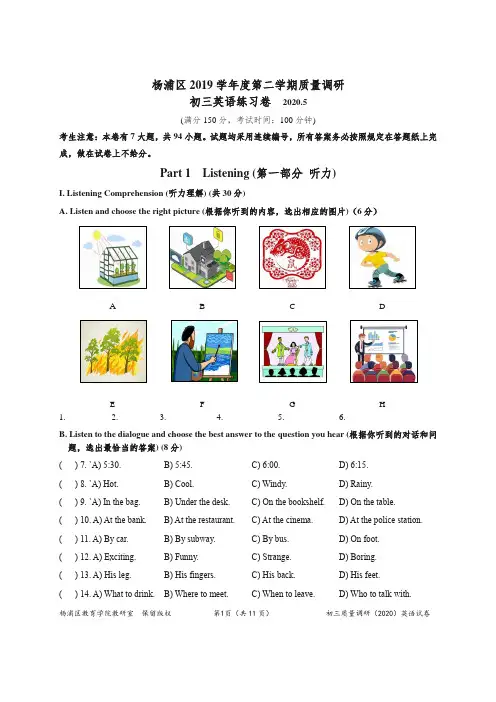
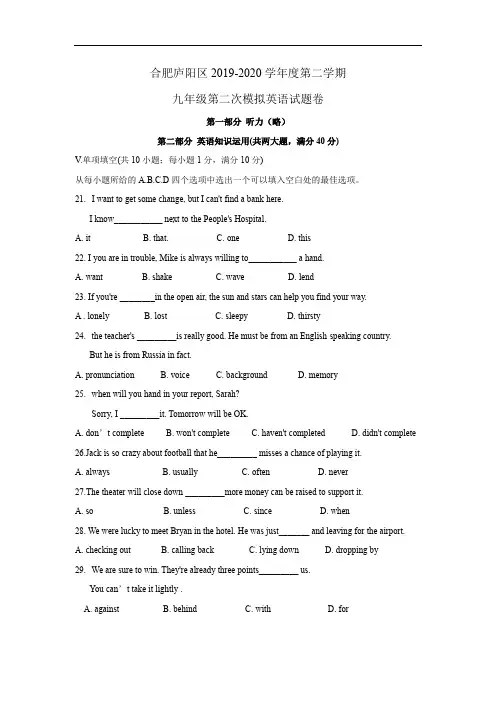
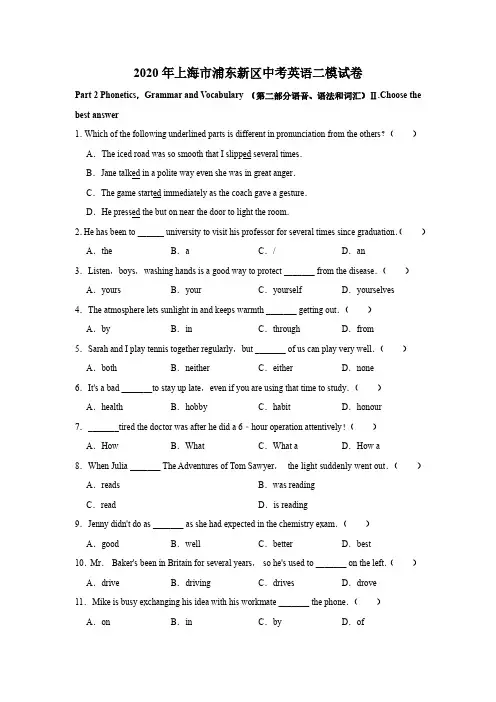
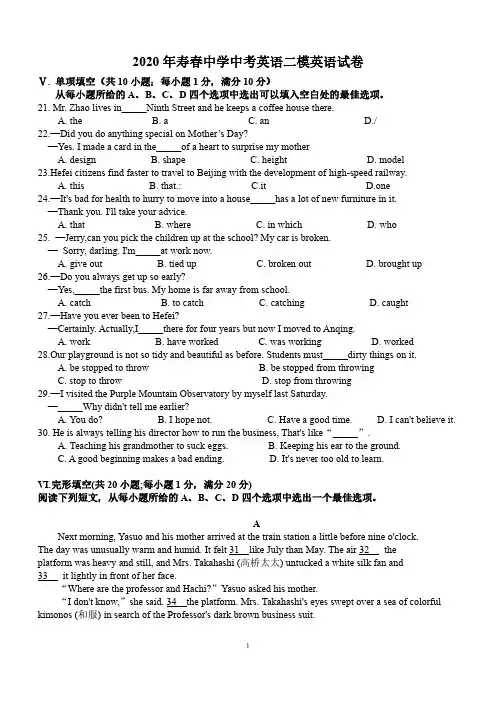
英语2020年中考二模(5月)试卷(I)卷
- 格式:doc
- 大小:309.51 KB
- 文档页数:16
英语2020年中考二模(5月)试卷(I)卷姓名:________ 班级:________ 成绩:________一、听下面五段对话,每段对话后有1个小题,请从题中所给的A,B, (共5题;共10分)1. (2分)Which animals are in danger?A .B .C .2. (2分)How's the weather now?A .B .C .3. (2分)听小对话,从题中所给的A、B、C三个选项中选出最佳选项()A .B .C .4. (2分)听录音,选出与所听内容相符的图片()A .B .C .5. (2分)选出与其意思相符的图片。
A .B .C .二、听下面两端较长对话,每段对话后有2至3个小题,请从题中所给的 (共2题;共12分)6. (6分)听材料,回答问题。
(1)How does Grace like going to the mountains?A . It's boring.B . It's tiring.C . It's relaxing.(2)What will they do this weekend?A . Go camping.B . Go shopping.C . Go fishing.(3)What will they need?A . A camera.B . A tent.C . An Mp4 player.7. (6分)听第二段对话,回答小题。
(1)What will Tony do this weekend?A . See a film.B . Visit the zoo.C . Have a party.(2)Which subject doesn't Betty learn at weekends?A . Chinese.B . Maths.C . English.(3)What does Betty think of after-school classes?A . Exciting.B . Boring.C . Interesting.三、听下面一段独白,独白后有5个小题, 请从题中所给的A,B,C (共1题;共8分)8. (8分)听下面一段独白,回答四个小题。
(1)Where is the talk being given?A . On the phone.B . At the cinema.C . In the classroom.(2)How does the film in Room 1 seem to be?A . Boring.B . Scary.C . Relaxing.(3)When is the film in Room 2 showing for the last time today?A . 9:00.B . 10:00.C . 11:45.(4)Which of the following films is shown in Room 3?A . Ships In The Night.B . Don't Open The Door.C . Streetmatch—TheReturn.四、完形填空 (共1题;共10分)9. (10分)完形填空My father was sick badly,so he needed a lot of help to do the everyday things.Dad was sitting in his old armchair and listening to the radio when I arrived.He 1and smiled.“What's new,Jim?”he said,2I sat down on the sofa.I wanted to tell him all about my problems at work,3I couldn't seem to find the works.4 he think that I was a failure,out of work at 58?”Nothing much,”I said,finally.He told me lots of family news.He was in 5 spirits.Then it was time for Dad to 6 his medicine.“I'll get it,”I said.I went into the kitchen and7a glass of water from the fridge.I found a red apple in the kitchen.I cut it into small slices,put them on a plate.He was very 8 and looked as if he were going to cry.“Dad?What's the matter?”I asked.“9has cut me an apple like that since your mother died,”he said.”it's just like what she used to do.”I shut and opened my eyes quickly to bri ng 10 the tears.I couldn't let myself cry in front of him.(1)A . layB . roseC . turned(2)A . asB . sinceC . until(3)A . soB . orC . but(4)A . CouldB . MustC . Need(5)A . poorB . goodC . low(6)A . buyB . makeC . take(7)A . boiledB . droppedC . poured(8)A . surprisedB . badC . angry(9)A . SomebodyB . NobodyC . Everybody(10)A . outB . backC . down五、阅读理解 (共4题;共30分)10. (10分)Strong earthquakes hit the east of Japan in the afternoon of March 11, causing several meter-high tsunami(海啸), which killed more than 10,000 people in areas along the coast. Several nuclear plants(核电站) at the coast were broken by the earthquake and tsunami. People living near the plants have been asked to move away. People living within 30 kilometers of the first plant are asked to stay indoors and close all windows.The breaking of the nuclear plants is causing electricity shortages(电力短缺) in Eastern Japan. As a result, electricity is cut off for 3-hour periods in the area of Tokyo and some other areas during daytime. In order to save electricity, some shops, restaurants and tourist places in the areas are closed for some time every day. But all major airports and train lines are still open and operating.For the above reasons, tourists are advised not to visit the eastern areas in the near future. Visits to Western Japan are not affected by the event. People who plan to travel over the coming weeks and months are advised to pay attention to the situation for a few more days before making decisions.(1)This passage may probably be written by a .A . scientistB . travelerC . story writerD . news reporter(2)People living near the plants were asked to move away because __A . there would be more earthquakes and tsunamisB . several nuclear plants had been brokenC . there were serious electricity shortagesD . their houses were washed away by the tsunami(3)They closed some shops and restaurants for some time every day to __A . avoid making electricity shortages even worseB . avoid more people getting togetherC . rebuild their broken buildingsD . keep away from nuclear radiation(核辐射)(4)The word “___” can be used instead of the underlined word “advised” in the last paragraph.A . foundB . invitedC . toldD . met(5)Which of the following is right?A . The earthquake happened before the tsunami.B . The earthquake happened after the tsunami.C . There was no electricity in Eastern Japan.D . People were not allowed to visit Western Japan.11. (8分)阅读理解When Justin Tong was a child, other kids felt sorry for him. His parents always had him doing lots of housework such as carrying out the rubbish and sending newspapers. But when he grew up, he was better off than his childhood friends and lived a happier and healthier life.This is the finding of a 40-year study that followed the lives of 456 children in London. It showed that the children who had worked hard in childhood had a richer and a happier future. "Children who worked in the home or community gained competence(能力) and came to feel they were worthwhile members of society," said Daniel Brown, the psychologist(心理学家) who made the discovery. "And because they felt good about themselves, others felt good about them."Brown's study followed these children in great detail. Interviews were repeated at ages 25, 31and 47. Under Brown, the researchers compared the children's mental-health scores with their childhood-activity scores. Points were awarded for part-time jobs, housework, effort in school, and ability to deal with problems.Working at any age is important. Childhood activities help a child develop responsibility, independence, confidence and competence —the underpinnings (基础) of emotional health. They also help him understand that people must cooperate and work toward common goals. The most competent adults are those who know how to do this.Yet work isn't everything. As Tolstoy once said, "One can live magnificently in this world if one knows how to work and how to love, to work for the person one loves and to love one's work."(1)What do we know about Justin Tong?A . He enjoyed a happy life.B . He felt sorry for the other kids.C . He always sold newspapers.D . He seldom collected rubbish.(2)Who will probably succeed in the future according to Paragraph 2?A . Children who enjoy happier and richer lives.B . Children who work in the home or community.C . Children who take part in Daniel Brown's study.D . Children who feel good about people around them.(3)How did Brown follow the children in his study?A . By giving housework and praise.B . By interviewing and giving scores.C . By setting goals and showing love.D . By solving problems and testing them.(4)What's the purpose of the passage?A . To talk about an interesting study.B . To introduce Justin Tong's success.C . To tell us about childhood activities.D . To encourage children to work hard.12. (6分)根据短文内容,选择正确选项。