七年级英语下册 Unit2 Where is the post office _ section A 一套课件人教版新目标总课件
- 格式:ppt
- 大小:3.80 MB
- 文档页数:54


Unit 2 Where’s the post office一. Asking ways: 问路1. Where is the nearest ……最近的……在哪里2. Can you tell me the way to ……你能告诉我去……的路吗3. How can I get to ……我怎样到达……呢4. Is there …… near here / in the neighborhood附近有……吗5. Which is the way to ……哪条是去……的路二.Showing the ways: 指路1. Go straight down / along this street. 沿着这条街一直走;2. Turn left at the second turning. 在第二个路口向左转;3. You will find it on your right. 你会在你右手边发现它;4. It is about one hundred metres from here. 离这里大约一百米远;5. You’d better take a bus. 你最好坐公交车去;You’d better+动词原形三.词组1. across from ……在……的对面 across from the bank 在银行的对面2. next to……紧靠…… next to the supermarket 紧靠超市3. between……and……在……和……之间between the park and the zoo 在公园和动物园之间among 表示位于三者或三者以上之间4. in front of……在……前面There is a tree in front of the classroom. 课室前面有棵树;in the front of……在……内的前部There is a desk in the front of the classroom. 课室内的前部有张桌子;5. behind……在……后面 behind my house 在我家后面6. turn left/ right 向左/右拐on the left/right of……在某物的左/右边 on the left of our school 在我们学校的左边on one’s left/right 在某人的左/右边 on my left 在我左边7. go straight 一直走8. down /along……沿着……街道 down/along Center Street 沿着中央街9. in the neighborhood=near here 在附近10 welcome to……欢迎来到……11. take /have a walk 散步12. the beginning of…………的开始,前端at the beginning of……在……的开始,前端in the beginning 起初,一开始13. have fun=have a good time=enjoy oneself 玩得开心,过得愉快14. have a good trip 旅途愉快 15. take a taxi 坐出租车16. 到达:get to +地方 reach +地方arrive in +大地方 I arrive in Beijing.arrive at +小地方 I arrive at the bank.17.go across 从物体表面横过 go across the street 横过马路go through 从空间穿过 go through the forest 穿过树林18.on + 街道的名称; Eg: on Center Streetat + 具体门牌号+街道的名称 Eg: at 6 Center Street三.重难点解析1.enjoy doing sth 享受做某事的乐趣,喜爱做某事I enjoy reading. 我喜爱读书;到目前为止,我们学了两个特殊的动词finish和enjoy,都是要带 doing.2.hope to do sth 希望做某事 I hope to pass this exam. 我希望通过这次考试;hope +从句 I hope tomorrow will be fine. 我希望明天将会晴朗;从句即是一个小句子,这个小句子又放在大句子中,从属于大句子,所以叫从句;如tomorrow will be fine是一个从句,它又放在I hope 的后面,形成句中有句;3. if 引导一个表示假设的句子;If I have much money, I will go to the moon. 如果我有许多钱,我就会去月球;If you are hungry, you can buy some food in the supermarket.如果你饿了的话,你可以在超市买一些食物;七年级英语下册第2单元测试题一、选择填空;30分.1. My best friend sits next ____ me. A. in B. on C. to D. behind2. Go the bridge, and you can see a big park.A. acrossB. throughC. crossD. across from3. In England traffic 车辆 goes ____ the road.A. in the middle ofB. on the right ofC. on the left ofD. on the front of4. The supermarket is _____ Fifth Avenue. A. on B. through C. between D. /5. The library is _____ the restaurant and the supermarket.A. nextB. nearC. betweenD. across6. --- Where are you ______--- Beijing.A. onB. fromC. comeD. come from7. Is _____ a pay phone in the neighborhood A. this B. there C. that D. the8. --- _____ can I get to the post office---Go down this road and turn left.A. WhereB. WhatC. HowD. When9. --- Is there a supermarket--- No, _____.A. this is notB. there isn’tC. it isn’tD. there aren’t10. There isn’t _____ clean park. A. the B. a C. anD. /11. This is a nice city ______ many interesting places. A. of B. withC. onD. and12. Bridge Street is a good place _______.A. have funB. to have funC. having funD. to fun13. --- Is there a pay phone _______ the neighborhood--- Yes, it’s____Center Street____the right.A. in, down, onB. on, on, isC. in, on, isD. on, down,on14. Can you tell me the way ______ the post officeA. toB. onC. atD. of15. You can get money in the ______ and you can get books in the ______.A. post office, bankB. bank, gardenC. bank, libraryD. library, bank16. How can he ______ the new schoolA. gets toB. get toC. arriveD. arrive to17. I hope I can have a big house ______ a beautiful garden. A. in B.for C. at D. with18. Jim often arrives _______ school at 8:00. A. in B. at C. toD. of19. My house is _______ the shop. A. to B. through C. across fromD. pass____ a pen and two pencils in the pencil case. A. is B. are C. be D. haveYour father is ______ two men. A. among B. in C. between D. ofMei is short. So she sits _____ the class.A. in front ofB. in the front ofC. at the back ofD. behind. Can you tell me the way to the libraryA. SorryB. ExcuseC. I’m sorryD. Excuse memany people are there in your ______-Three, my parents and I.A. houseB. homeC. familyD. roomstraight and turn _____. You’ll see the school.A. to leftB. the leftC. for the leftD. leftsits _____ my left. A. in B. on C. for D. oflike reading books _____ pictures. A. with B. for C. of D. atis a bridge ______ the river. A. cross B. across C. over D. through29. — there orange juice in the fridge —I don’t know.A. AmB. AreC. IsD. Does30. —Welcome to our garden district. —____.A. SureB. Not badC. Not at allD. Thank you31. It’s _____ to cross the streets in the morning and in the evening.A. dangerousB. easyC. interestingD. safe32. You can see the city well on the _____ floor of the bus.A. firstB. secondC. thirdD. fourth四.用所给词适当形式填空;5分1. The girls enjoy ____________see comedies.2. I hope the__________ begin of our tour is happy.3. The park is a good place ________ play games..4. Do you enjoy ___________you at the birthday party5. Go down ____________ three Street and turn right.五.介词填空,在空格处填入一个适当的介词;10分,每空一分1. The library is _________ the pay phone and the supermarket.2. Take a walk __________ the park on Center Avenue.3. Be careful when you go the street.4. The bank is __________ Center Street.5. The broom扫帚 is __________ the door, we can’t see it.6. They will arrive _____ London next Monday.7. Can you tell me how to get _____ the new park8. Walk _______ Seventh Avenue. The hotel is ____ your left.9. Excuse me. Is there a post office _______ here.七.句型转换:10分, 每空一分1. The post office is next to the hotel. 对划线部分提问 ________ ____ the post office2. There is a park on the other side of the street. 同义句________ ______ the street there’s a park.3. We arrive in Beijing at seven. 改为同义句 We ______ _____ Beijing at seven.4. How can I get to the nearest post office 改为同义句Can you tell me _____ ______ to the nearest post office5. Paul sits on my left. Nancy sits on my right. 合并成一句 I sit ________ Paul ______ Nancy.Ⅰ、单项选择15分1、People ________ French and English in Canada. A. speak B. say C. tellD. talk2、Jack knows ________ French. A. a lot B. many C. a little D. a3、Paris is ________ interesting place. A. a B. an C. any D. some4、-- Where ________he ________from -- Australia., come , × , come D. is, comes5、--Is there a post office near here -- .A. Yes, there’sB. Yes, there isn’tC. Sorry, I don’t knowD. No, there is6、There _______ a food shop & two hotels over there. A. has B. is C. have D. are7、The pay phone is________the post office the library.A. across fromB. between…andC. next toD. in,of8、-- ________is the bank –It’s on Center Street.A. WhereB. HowC. WhenD. What9、-- ________ is there a hotel in the neighborhoodA. SorryB. HiC. Excuse meD. All right10、-- I’m sorry I’m late. --- .A. That’s rightB. All rightC. Welcome hereD. That’sall right11、Go straight along Bank Street and take the first turning________right.A. in aB. in theC. on aD. on the12、We have a house________a small garden. A. there is B. has C. with D. of13、Bridge Street is a good place________fun. A. to have B. having C. have D. has14、-- Where________he – He lives in Tokyo.,live ,from ,lives D. does,live15、They ________ in Beijing next Sunday. A. arrive B. arrived C arrivingD. are arrivingⅡ、完成下列句子10分16、He is from the United States.同义句He the United States.17、There is a clock&some pictures on the wall. 同义句There ________ some pictures & a clock on the wall.18、The restaurant is across from the library. 同义句a restaurant across from the library.19、There are six people in my family.就画线部分提问________ ________people are there in your family20、She speaks Chinese. 就画线部分提问________ ______ she speak新目标英语七年级下册第二单元检测一、单项选择1. Does he a bus ____;home ; home ;to home ;to homeyou play chess well A. Do D. Are3. There are lots of to do every day .A. thingsB. homeworkC. newsD. maths4. Do you often tell about your everyday life A. his B he C. her5. She wants an orange. A to eat B. eating C. eat D. eatsoften take a bus to school, but I go to school by bike.A. some timeB. sometimeC. some ttimesD. sometimes7. We always after school.A. go to schoolB. go homeC. to go homeD. to go to school8. Mike his homework in the eveningA. Do; doB. Do; does C .Does ;do ;/9. Dick never eats vegetables, so this is not a life.A. happyB. healthy D. sad10. We home at 6:00 pm every day. A. go B. go C. goes D. goes to11. Xiaodong goes to school by bike 骑自行车. She walks to school.A. alwaysB. oftenC. sometimesD. neverten o'clock in the evening.A. have breakfastB. get upC. go to bedD. watch morning TV13. I go home __ __5:30 the afternoon. ;on ;in ;at ;/ 's ten o' must go . home B. home C. my home D. his home 15. He his homework on Sundays. A doesn,t B. don't do " C. doesn't do D. don't四、词汇;A根据汉语提示完成单词;36. There are 五十s tudents in my class.通常goes to school at 7:30 in the morning.38. They work for eight 小时 every day.39. What time do you take a 淋浴40. Zhou Jie 工作here from five to eleven;B 选用方框中所给的短语完成句子;lots of;go to work, brush one’s teeth, go home; all night41. My sister is very young 幼小的.She can’tparents at eight every morning.43. Liu Dehua is a famous singer and he has fans.歌迷44. That great writer作家often works .45. Let's 's a little late.五、按其求改写下列句子46. The boy eats breakfast at seven thirty.就画线部分提问does the boy eat breakfasteat dinner in the evening.就画线部分提问 you eat dinner48. The girl is a teacher.就画线部分提问 is the girl’s's a funny time to go to bed.改为感叹句 a funny time go to bedget home at 7:30 pm.改为同义句; They get home at 7:30 the .。
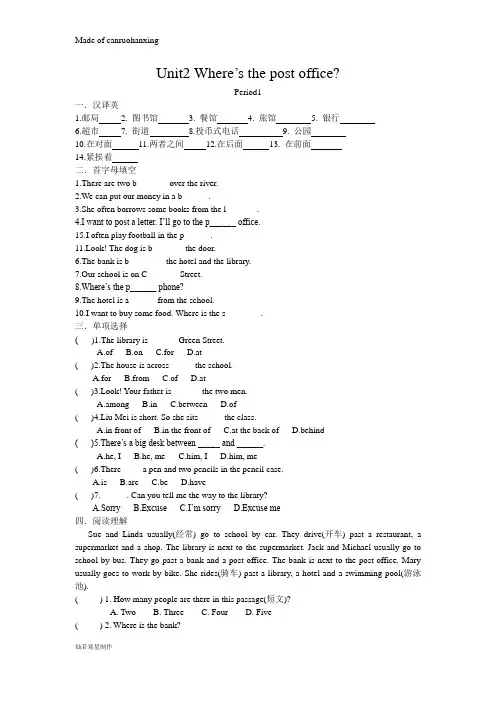
Unit2 Where’s the post office?Period1一.汉译英1.邮局2. 图书馆3. 餐馆4. 旅馆5. 银行6.超市7. 街道8.投币式电话9. 公园10.在对面11.两者之间12.在后面13. 在前面14.紧挨着二.首字母填空1.There are two b_______ over the river.2.We can put our money in a b______.3.She often borrows some books from the l_______.4.I want to post a letter. I’ll go to the p______ office.15.I often play football in the p______.11.Look! The dog is b_______ the door.6.The bank is b________ the hotel and the library.7.Our school is on C_______ Street.8.Where’s the p______ phone?9.The hotel is a______ from the school.10.I want to buy some food. Where is the s________.三.单项选择()1.The library is ______ Green Street.A.ofB.onC.forD.at( )2.The house is across _____ the school.A.forB.fromC.ofD.at( )3.Look! Your father is ______ the two men.A.amongB.inC.betweenD.of( )4.Liu Mei is short. So she sits _____ the class.A.in front ofB.in the front ofC.at the back ofD.behind( )5.There’s a big desk between _____ and ______.A.he, IB.he, meC.him, ID.him, me( )6.There ____ a pen and two pencils in the pencil case.A.isB.areC.beD.have( )7.______. Can you tell me the way to the library?A.SorryB.ExcuseC.I’m sorryD.Excuse me四.阅读理解Sue and Linda usually(经常) go to school by car. They drive(开车) past a restaurant, a supermarket and a shop. The library is next to the supermarket. Jack and Michael usually go to school by bus. They go past a bank and a post office. The bank is next to the post office. Mary usually goes to work by bike. She rides(骑车) past a library, a hotel and a swimming pool(游泳池).( ) 1. How many people are there in this passage(短文)?A. TwoB. ThreeC. FourD. Five( ) 2. Where is the bank?A. It’s next to a swimming poor.B. It’s on the right.C. It’s next to a post office.D. It’s between a shop and a restaurant.( ) 3. How does Linda go to school?A. By bike.B. By bus.C. By car.D. We don’t know.( ) 4. Where does Sue drive past?A. A restaurantB. A post officeC. A parkD. A swimming poor.( ) 5. How does Michael go to school?A. On footB. By busC. By bikeD. By taxiPeriod2一.适当形式填空1.The supermarket is on the (five) Avenue.2.There are two (library)in our school.3.Ben has an (interest)book.4.Let’s read from the (begin) of this book.5.This isn’t my shirt. It’s(you).二.根据句意,写出划线单词的反义词1.This room isn’t.It’s very big.2.Look at your hands! They aren’t.They’re very dirty.3.Don’t turn.Turn right. Then you can find the post office on your right?4.Give me that coat, please. That old one, not the one.5.That’s too noisy here. Please keep ,children.6.Your answer is wrong. His answer is .7.My mother is old, but she looks very .三.单项选择1.Please look around. What can you see your right?A. inB. onC. at2.—Excuse me. to get to the airport?—Take a taxi.A. WhatB. WhenC. How3.Let Jane the art club. She likes drawing.A. joiningB. joinC. joins4.The park is across the supermarket.A. inB. onC. from5.We can buy some in the food market.A. breadB. baseballsC. clothes6. there a bank along the street?A. IsB. AreC. Am7.The pay phone is the post office and the library.A. inB. betweenC. near8.Martin is sitting next me. We are good friends.A. toB. onC. around9.—there orange juice in the fridge?—I don’t know.A. AmB. AreC. Is10.My uncle will Beijing next Sunday.A. getB. arrive inC. arrive at四.句型转换1.There are some cars on the street.there cars on the street?2.The video arcade is across from the bank.is the video arcade?3.Turn right and go straight along the Bank Street.Turn right go straight the Bank Street.4.Excuse me. How can I get to the post office?Excuse me. get the post office?5.The English club is next to the library.The English club is the library.五.情景对话,根据图示完成下面的对话A: Look at this map. What’s in my neighborhood?B: Let me see. There a school, a ,a bank, a park and a library in your neighborhood.A: That’s right. Where’s the bank?B: It’s the school and the post office, and it’s the library.A: Yes. You’re standing at A. Go the Avenue and turn left. Go .What can you see your right?B: Er…I can see the.A: You’re quite right.Period3一.词汇1.I live on a very (繁华的)street.2.My friend usually sits on a (长凳)near his house, reading books.3.When I am on a trip. I’d like to live in a (旅馆).4.What’s in your(邻近地区)?5.John likes to live in a small house (带有)an interesting garden.二.用适当的介词填空1.There is a video arcade the busy street.2.You can phone me 8:00 a.m. and 10:00 a.m. tomorrow(明天) morning.3.They will arrive London next Monday.4.Can you tell me how to get the new park?5.Walk the Seventh Avenue. The hotel is your left.6.I put some flowers next my window.7.Is there a supermarket your neighborhood?8.Excuse me. Is there a post office here?三.根据汉语提示翻译下列句子1.沿着这条街往前走,然后向右拐。

Unit 2 Where is the post office?Language goals:●In this unit students learn to talk about asking for and give directions on thestreet.New languages:●Excuse me, is there a bank near here?●Y es, there is. It’s on Center Street.●Where is the pay phone?●It’s across from / next to / in front of / behind the library.●It’s between the post office and the library.●Just go straight and turn left.●Turn left on First Avenue.●T ake a walk through the park on Center Avenue.●There is a clean / dirty park near my house.Difficult points:1. Listening for the information of the names of the neighborhoodRead the tour guide and an e-mail from a friend you’re going to visit.Write the dialogues about asking the way and giving directions.2. Where questions.Affirmative statementsPrepositions of placeTeaching aids:● A tape recorder●Some picturesTeaching periods:Period 1: Section A1a, 1b, 1cPeriod 2: Section A2a, 2b, 2cPeriod 3: Section A3a, 3b, 4Period 4: Section B 1a, 1b, 1c, 2a, 2b, 2cPeriod 5: Section B 3a, 3b, 3c, 4Period 6: Self CheckTeaching aims:1. T each vocabulary words.2. T arget languages: Is there a bank near here? Y es, there is. It’s on CenterStreet.3. Enable the students to ask for and give directions on the street.4. Help the students to ask for and give directions on the street.Teaching procedures:Step 1. Warming upShow three pictures prepared before class to the students. There is acat in a box in picture 1. There is a cat on a box in picture 2. There is acat under the box in picture 3.Then ask some students to ask and answer these questions.Step 2.Match work (2a)Ask the students to read the picture and the words in the numbered list.Ask the students to match each word or phrase on the list with one of the pictures.Then check the answers.Present the new sentence patterns.Then ask the students to read the dialogue in the picture.Step 3. Listening (1b)Ask the students to listen to the conversations and circle the places in 1a.Change the roles and do the same again.Then students ask and answer without the help of the recording.Step 4. PracticePoint to the different locations shown in the picture. Ask different students to name each one.Then point to more locations and let the students to practice more.Homework1. Practice the conversation in the picture on page 7.2. Learn the new words and phrases in this period by heart.Teaching aims:1. Learn the vocabulary words and useful expressions.2. T arget languages:The pay phone is across from the library.The pay phone is next to the library.The pay phone is between the post office and the library.The pay phone is on Greet Street.The pay phone is in front of the library.The pay phone is behind the library.3. Enable the students to talk about the position of a place.4. Help the students to talk about the position of a place.Teaching procedures:Step 1. Revision and warming upCheck the homework by talking about the pictures on page 7 with thestudents or prepare some other pictures with different buildings in itand let the students practice asking and answering questions aboutthe places.Ask the students to practice more.Step 2. Presentation (2a)Introduce the items across from, next to, between, in front of, behindand on.Draw the following picture on the blackboard.Park 3 Centre StreetEncourage or help the students to answer: It’s across from the library.The same way goes with next to, on and in front of.Ask the students to match each sentence with one of the pictures.Then ask the students to read the six sentences and match thesentences the pictures.Check the answers.Step 3. Listening(2b)Review the buildings and street names in Activity 1a and the sixsentences in 2a.The read the six sentences in 2b to the class.Ask the students to listen to the recording and fill in the blanks.Play the tape. Check the answers.Step 4. Practice (2c)Ask the students to repeat the conversations after the recording.Ask the students to do the Pair work asking and answering questionsabout the places in 1a.Step 5.Grammar FocusAsk the students to read the sentences in the grammar box aloud. Theask them to answer the following questions. Explain some languagepoints if t he students can’t understand.HomeworkAsk the students to practice talking about their neighborhood in pairs.Period 3T eaching aims:1. T each vocabulary words.2. T arget languages:Just go straight and turn left.It’s down Bridge Street on the right.It’s next to a supermarket.3. Enable the students to talk about the neighborhood.4. Help the students to talk about the neighborhood.Teaching procedures:Step 1. RevisionLet the students look at the picture in activity 1a. And ask somestudents to answer some questions in order to check the homework.Say, Is there a library near here? Where is it? Is there a bank near here?Where is it?Put up the picture of activity 2a on the blackboard and ask them tomake conversations.Step 2. Presentation (3a)Guide the students to guess the meanings of the three traffic signs.Show the pictures and ask some questions about the pictures.Then ask the students to hold up their left hands and then their righthands to practice “left” and “right”.Point to the picture and let the students read the conversation.Ask the students to read the conversations. Then ask them to find Pauland Nancy in the picture.Ask the students to role play the conversation then point out the placethat Paul wants to get to.Step 3. Complete the conversations (3b)Ask the students to make conversations and answer the questionsbelow each picture.The students point out the place in the picture. And write down theanswers on the line in the pictures. Or ask a pair of students to say theconversation, the others point to the speakers’ place.Step 4. GameAsk the students to look at the picture in Activity 1a and name all the buildings.Ask some students to read the conversation in the picture in Activity 4.And then explain the instruction to the student.Then ask some groups to present their work.HomeworkAsk the students to make a similar conversation to that in Activity 3a. Period 4Teaching aims:1. T each vocabulary words.2. T arget languages:Is there a big supermarket near your house?Y es, there is.There is a big supermarket.No! There is a small supermarket.3. Enable the students to describe the neighborhood.4. Help the students to describe the neighborhood.Teaching procedures:Step 1. RevisionCheck the homework by asking the following questions.Say, Look at the picture in activity 3a. Suppose you are standing nearthe building on the side of New Street. Please answer my questions.Excuse me. Is there a pay phone in the neighborhood?Ask another student to answer questions.Give more students chances to practice this dialogue.Step 2.Match work (1a)Bring in some objects or pictures to the students. (Two rulers, one is old,the other is new. Two boxes, one is big and the other is small. Two bottles, one is clean and the other is dirty. Two pictures of a street, one is busy and the other is quiet.)Say, Look at the rulers, please. Can you find the difference between them? Y es. This one is old. (Show the old ruler.) And this one is new.(Show the new ruler.) Do you understand old and new?Ask the students to talk about the picture.Point to each half of each picture and ask about the difference between the halves.Go on with the other pictures to teach the language items.Ask the students to match the words with the pictures.Step 3. Pair workCall attention to the conversation in the picture.Then ask the students to work in pairs and take turns asking each other questions about the things on the list of phrases in activity 1a on page 7. Step 4. Listening (2a, 2b)Ask the students to listen to the tape and circle the places in 1a.Say: Now please listen to the tape again. Listen to it and draw the places in Michael’s neighborhood on the street map. Just listen.Play the recording.Play the recording again.Then have some students show their completed drawing to the class. Step 5. Pair workAsk the students to work in pairs talking about drawings to the class.Then ask some pairs to present their dialogues to the class.Ask the students to work in pairs, draw a map of their own neighborhood and practice asking and answering questions about the places they live in.HomeworkAsk the students to make similar conversations to that in Activity 1b.Period 5Teaching aims:1. T each vocabulary words.2. T arget languages:Turn left on First Avenue and enjoy the city’s quiet streets and small parks.T ake a walk through the park on Center Avenue.This is the beginning of the garden tour.Bridge is a good place to have fun.3. Enable the students to write a tour guide and draw the rout to somewhere.4. How to write a tour guide and draw the rout to somewhere.Teaching procedures:Step 1. RevisionCheck the homework by asking about the student’s neighborhood.Ask the students to work in pairs.Ask the students to work in pairs.Then ask some pairs to present their conversations to the whole class.Step 2. Reading (3a, 3b)Ask the students to read the tour guide.Divide the whole class into four groups to have a quiz.T ell the students to keep these words down and make at least two sentences with each word after class.After that ask the students to look at the pictures and fill in the blanks for this tour guide.Step 3.WritingAsk the students to write a tour guide with the students.Names of buildings and locations.Description wordsWords that talk about positions.Words that talk about directions.Step 4. Pair work (4b)Learn to draw a picture of neighborhood. First ask the students toanswer the questions according to the pictures.Then ask the students to draw a picture according to the followingconversation.Then ask students to present their drawings to the whole class.Homework1. Ask the students to talk about the street and buildings in their ownneighborhood.2. Ask the students to make sentences with the description words they keptdown in the class.Period 6Teaching aims1. T each vocabulary words.2. T arget languages:I know you are arriving next Sunday.Let me tell you the way to my house.I hope you have a good trip.3. Enable the students to write about the neighborhood.4. Help the students to learn how to write about the neighborhood.Teaching procedures:Step 1. RevisionCheck the homework by asking and answering some questions.Give more students chances to practice.Step 2.Key word check(1)Ask the students to check the words they know.Then ask the students to do the some exercises.Step 3.Vocab-Builders (2)Expand the students’ vocabulary.After that ask the students to share their list with other students.Step 4. ReadingAsk the students to read the letter and draw the rout on the map.Ask the students to change the letter into a telephone conversation.Let the students pay attention to the pictures.Say, Look at the picture of Sally. How old do you think she is? Where do you think she is from? What language do you think she speaks? What do you think she likes?What do you think she dislikes?The same step goes with Jim and Julie.After a few minutes, ask some students to read their descriptions to the class.Step 5. Just for Fun!Call attention to the conversation in the cartoons.Ask the students to read the conversation and then answer the questions.HomeworkAsk the students to do the following:1. Suppose your friend is going to visit you. He doesn’t know the way toyour house. Write a letter to him to tell him the route from the bus stop to your house.2. Review the next unit.。