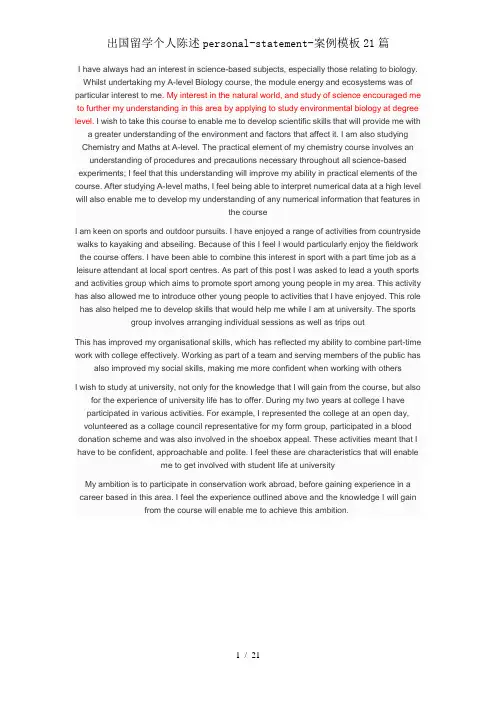
如何写Personal_Statement
- 格式:doc
- 大小:195.00 KB
- 文档页数:20
如何写Personal Statement读书计划的内容应包含下列三项资料:(一)申请者的学术或专业兴趣及背景(二)欲研究的方向(三)未来的职业目标写作时,依以上三点将文章分为三段。
不要像列清单,也不要重覆申请表格已有的资料。
八个注意事项:(一)详读学校的写作说明并了解问题的重点,不赘言,不遗漏,且在要求的字数内完成。
例如学校要求五百字内完成(In 500 words or less),则全文最好不要超过五百字。
如果学校要求以问答方式来叙述(Responses to essay questions.....,Please limit your response to on page.),即依其要求回答不长过一页。
(二)写作时应清楚明确。
例如:1. "I am interested in English literature" 这句话表达不够清楚,而I was concentrated on Milton and Shakespeare in college" 就明白的说出了申请人的志趣及专研]范围。
2."I received extensive training in physics" 这句话不够详细,"My training was in the area of particle physics"就具体多了。
3. "I was very active as a student representative" 最好说明曾经做什麽:主办演讲、沟通学生与校方之意见等。
4."I am attracted to your department by its brilliant faculty--"应说明对於教授的认知是从何而来,如在何处读到某教授之文章而愿受教於他,或某位教授正在从事一项重要研究,与自己欲攻读的研究领域相同等。
表达对所申请之系的课程、教师和特性有些了解,依学校之不同而提及某位任教於该校的教授、新课程或该校的某个学位有兴趣。
(三)不要用语意模糊的句子,如"Your esteemed school---"应代以学校的名字。
"I will return to serve my country---"应明确的说出所要从事的到底是什麽工作等。
(四)避免用深奥的字汇,尽量以简单容易的字来表达。
(五)不要抄袭,改写书上的样本文章。
应详读学校的介绍,了解其要求,再对自己的学业背景、计划加以考虑,写出自己的风格。
(六)检查英文的时态、性别及单多数等方面的错误,美国的学校不会期望外国学生的英文完美无缺,故陈述得清楚明白比十全十美的英文重要。
(七)态度诚恳认真,不卑不亢。
不用为自己的弱点道歉,譬如:托福成绩不高等;也不要表现得过份自信。
重要的是给学校一个专业,认真的印象。
(八)不要离题,谈论一些不相干的事。
下面是一所学校的Guide Line:In view of the relatively poor quality of the study plan we received in the past years, the department decides to offer more concrete guidelines to help applicants writing their study plans.The intention is to tell applicants what the department is looking for in the study plans, and how the applicants can best distinguish themselves during the admission process.Of course these guidelines are only recommendatory. Applicants are welcome to use their imagination whenever/wherever possible.The study plan serves three purposes. First, it shows how well applicants can express their ideas in plain English. This requires well-organized thinking skills as well as clear writing. Second, the study plan is supposed to show how much thought the applicants have given to the particular fields in which they want to study. For example, if an applicant wants to study Neural Networks, exactly how much they know about Neural Network and why do they think they are capable of doing research in this field should be clearly explained in the study plan. The third purpose of a study plan is to provide students with lesser grade anopportunity to present their intellectual accomplishments other than academic records. For research projects that require extensive hands-on capabilities, practical problem-solving skills will play as much important roles as course grades.To help the applicants write down the types of information that will interest the admission committee most, we prepare a list of specific questions that the applicants may consider to answer in their study plans. Again, answering these questions is not mandatory. They are suggested here to reduce the possibility of wasted efforts on the part of applicants.[1] What is the most significant achievement you've ever accomplished so far? This could be a class project, a piece of artifact you built, or a research, and it doesn't have to be related to our program.[2] Is there any specific field you want to work on? Please be as specific as you can. Try to explain how your academic background prepares you to do research in this (these) field(s).[3] If you have any previous research experiences, please explain them in terms of your roles in the projects, your owncontributions, and most importantly the process of deriving the solutions/algorithms you developed, if any.[4] In case your course grade is not particularly distinguished, why do you think you still have what it takes to do graduate study in our department?Last suggestion: the applicants are advised to take writing the study plan as serious as they possibly can. Think of it as doing the homework for getting into graduate schools. The more efforts you spent on it, the better chances you have to be admitted into topnotch graduate programs.The first paragraph of your personal statement, one or two sentences, should make clear the purpose of your writing: to present an interpretive summary of your background, academic interests, and future goals as justification for your admission to a program of graduate study.The second paragraph interprets your background for the graduate admissions committee. This paragraph should establish your academic preparation for the program to which you have applied. If you have been a strong student throughout your undergraduate years, you may callattention to what you believe have been strong combinations of courses which seem to fit your prospective graduate program well. If you have had ups and downs as an undergraduate, you may call attention to progressive improvement in your studies: i.e., the difference between your junior/senior GPA and your freshman/sophomore GPA or your record in selected course work that is directly related to the kinds of course work that you will undertake as a graduate student. If you scored well on whatever graduate examination that you took, you may want to cite that fact as well. Keep in mind that graduate admissions committees want assurance that you will be a successful student. If you have had relevant experiences, you may mention them here, too. Some graduate programs such as applied sociology or social work or resource development, etc. look for evidence that you have already sought out ways to translate your academic background into practical, professionally oriented applications. In short, this paragraph should assure the graduate admissions committee that you have matured during your undergraduate years, that your intellectual and professional interests have taken shape, and that you have begun a conscientious progress towardprofessional development.In this example format, the third paragraph will be a description of your professional goals. (This paragraph and the next, however, could be reversed.) Though your letter takes the general shape of a summary of your interests and background, it also builds an argument for your admission to a particular graduate program. The logic of this argument runs this way: I know what interests me; I know that I would like to engage in this work as my profession; and I believe that the necessary, most logical way to assure me of success in this profession is to earn this graduate degree. This paragraph describes what you know about the professional careers to which this course of graduate study may lead. Generally, people who pursue graduate degrees tend toward any of four professional occupations: academic, public service, private industry, or self-employment (i.e., writers, lawyers, physicians, etc.). Though you do not have to commit yourself to one career only, you are best served by presenting to the admissions committee as specific as ideas as possible about what you intend to do with their degree. If you know that you would eventually like to be a business consultant specializing in labor market analysis, say so. Sucha statement indicates to the committee that you are goal oriented, that you are capable of identifying what you want and of developing a systematic means to attain it. This paragraph, in conjunction with the previous one, assures the admissions committee that you are an applicant with a purpose.The fourth paragraph, which describes what you intend to study in graduate school, should tighten your argument. Now that you have made clear your interests, background, and professional goals, you must make the case that the best way for you to bridge your undergraduate years and your successful performance as a professional is to study what this particular graduate program offers. Be as specific as you can. Learn what courses this graduate program offers. Identify its faculty members and what research they are conducting. Know the program's reputation, its strengths and its weaknesses. Your undergraduate professors can be of very great assistance in this regard. If, say, you are interested in pursuing advanced work in cognitive psychology, your application will not be most appropriately sent to a department that is trying to make its name in industrial/organizational behavior. As you describe yourreasons for applying to this particular program try to link your interest with what you know is available through that program and its parent college or university. If you know that it encourages practicum experience, something you want, say so. If some of your undergraduate texts or assignments have utilized materials produced by that program, say so. Offer suggestions about combinations of courses or faculty advisors that you think might be especially imaginative or productive. This paragraph, thus, accomplishes two ends: you place this graduate program in the continuum of your own professional development and you demonstrate that you have applied to it as the result of an informed, reflective selection process of your own.Your personal statement should close with a brief summary of your background and goals, again just a sentence or two. This last statement reaffirms both your preparation and your confidence that your choice of this graduate program is right.The graduate school personal statement is your chance to demonstrate your unique qualifications for and commitment to graduate study by discussing those experiences, people, and events that influenced your decision to pursue your fieldof interest.That's a lot to accomplish--especially in the typical two pages allowed for your personal statement. You can find the key to success by focusing on a few illustrative incidents as opposed to giving a superficial overview. Remember: Detail, specificity, and concrete examples will make your essay distinctive and interesting. Generalities and platitudes that could apply to every other graduate school applicant will bore. If you use them, you'll just blur into one of the crowd. Following "Ten Do's and Don'ts for Your Personal Statement" will help you write a compelling, focused essay, one that will transform you from a collection of numbers and classes into an interesting human being.Ten Do's and Don'ts for Your Personal StatementThe Do'sUnite your essay and give it direction with a theme or thesis. The thesis is the main point you want to communicate. Before you begin writing, choose what you want to discuss and the order in which you want to discuss it.Use concrete examples from your life experience to support your thesis and distinguish yourself from other applicants. Write about what interests you, excites you. That's what theadmissions staff wants to read.Start your essay with an attention-grabbing lead--an anecdote, quote, question, or engaging description of a scene. End your essay with a conclusion that refers back to the lead and restates your thesis.Revise your essay at least three times.In addition to your editing, ask someone else to critique your personal statement for you.Proofread your personal statement by reading it out loud or reading it into a tape recorder and playing back the tape. Write clearly, succinctly.The Don'tsDon't include information that doesn't support your thesis. Don't start your essay with "I was born in...," or "My parents came from..."Don't write an autobiography, itinerary, or résumé in prose. Don't try to be a clown (but gentle humor is OK).Don't be afraid to start over if the essay just isn't working or doesn't answer the essay question.Don't try to impress your reader with your vocabulary.Don't rely exclusively on your computer to check your spelling.Don't provide a collection of generic statements and platitudes.Don't give mealy-mouthed, weak excuses for your GPA or test scores.Don't make things up.Make It Personal!When I lecture about writing personal statements, I perform the following experiment: I ask my audience four or five general, superficial questions about their backgrounds and goals and ask for a show of hands. For example, "How many of you feel your courses have prepared you to succeed in graduate or professional school?" "How many of you have had work or volunteer experience that is relevant to your career goals?" OK, you have the idea. Usually, all or the overwhelming majority of the hands go up. Then I ask, "Why did I ask these questions?" Someone will usually say, "Because we're all the same."But of course my audience is not "all the same." And you are not the same as those you are competing against--unless you write on a very general and superficial level. If you write on the same level that I asked my questions, you will fail to distinguish yourself from your competition.You need to use your unique experiences and specific details from those experiences to bring you and your essay to life. Don't write about volunteering for the homeless; write about Joe, the homeless, Vietnam vet with the toothless smile who taught you something specific that you will carry with you. Don't write about your trip to Europe; write about watching a Gypsy troupe perform a Rachmaninoff concerto that you had played many times, but never understood before sitting under that grimy circus tent in the Ukraine. Many students can write about volunteering for the homeless or traveling in Europe, but only you can write about your memorable experiences and their impact upon you. Those unique anecdotes will be how admissions officers remember you and your essay.In addition to distinguishing you from your competition, experiences and anecdotes are much more interesting to read than generalities and platitudes. Think about the lecturers who just give the theory and principles and compare them to those who bring the theory alive with real examples and anecdotes. I'll take the latter any day.Do you want to write a memorable essay that is truly revealing of your unique experiences and personality? Usespecifics. They will bring your essay to life.I took some time to read your statement. It's telling. Anyway, I talked with the chair of our department today and asked about his opinion on what he expects one to be. He gave me a few points:First, you need to show why you're interested in biology. It could be just a brief history, a class or something that turned on your interest. But don't give the impression of being too romantic. He told me about a bad statement, in which a Chinese student told the story of when he was 2 years old and his mother showed him a tadpole and he's been interested in biology ever since then and bla bla bla... Second, tell what kind of field you would want to work in. Don't be too specific because if there's no one in the department doing such a thing, the committee will think you won't be satisfied when you get here. So, you may check first to make sure that the research area you want in represented in the department.Third, tell why you want to be a Ph.D. This is generally showing that you're interested in research.I told them you have been in the lab. 'Them' means the chairand his wife. They said you should stress that in your tatement. I think you can write about what your lab is doing, what kind of experimental techniques are you using and what your role is in there.They also said that they are looking for someone with genuine interest in biology research and they expect this expressed in the statement. Since you've been working so long, you can sound more mature or formal when describing your lab experience. And, don't make the statement too long, they get tired out before reaching the end. You can have your script read by some other teachers and have some feedback on what they think of it.Personal Qualities1. Mature,dynamic and honest.思想成熟、精明能干、为人诚实。