英语语法基础----句子划分
- 格式:doc
- 大小:24.50 KB
- 文档页数:3
学习好资料 欢迎下载
高中句子划分
课堂讲义之句子结构及成分划分
概念
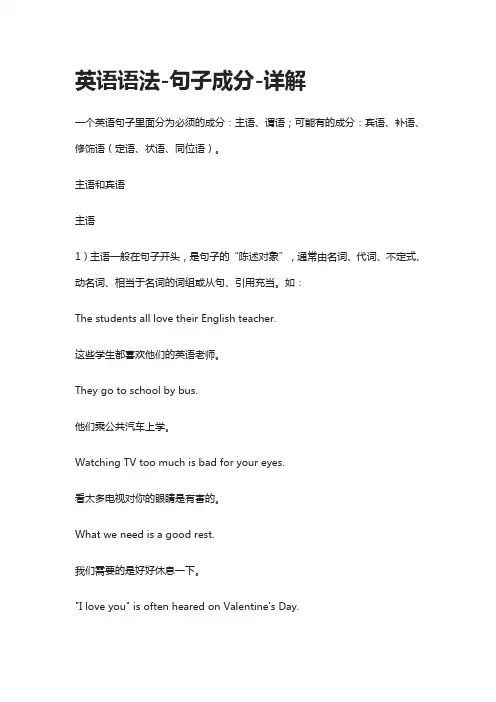
句子的成分包括:主语、谓语、表语、宾语(直接和间接宾语)、宾语补足语、定语和状语。主语和谓语是句子的主体部分(在英语中,一般句子必须有主语和谓语)。
1.主语
一般由名词、代词、不定代词或相当于名词的单词或短语来充当,也有从句充当的现象。大多数主语都在句首。如:
We work in a big factory. The classroom is very big.
Three are enough. To operate on the blind is one of the ORBIS Doctor’s job.
What we need is food.
在“There be …”句型中,主语的位置在中间。如:
There are some bottles of milk in the box.
▲ 在个别句型中,主语在整个句子后面,这时前面用it作形式主语。如:
It is very interesting to play the game called “treat or trick”.
It took two workers about three months to build the house.
2.谓语
谓语必须是动词,谓语和主语在“人称”和“数”两方面必须一致。如:
He is very generous. She looks very smart and cool
We have finished the job. He can speak German.
3.表语
表语由名词、形容词、介词、副词、不定式及相当于名词的词或短语来充当,它的位置在系动词后面。
You look younger than before. My father is a teacher.
Everyone is here. They are at the theatre.
My job is to teach them English. Her job is training the nurses.
That is why he didn’t come to school yesterday.
4.宾语
▲宾语是动作、行为的对象,由名词、代词、不定式、或相当于名词的词或短语或从句来充当,它和谓语动词一起说明主语是什么,通常放在谓语动词后面。有时,会有双宾语。如:
He often helps me. He likes to sleep in the open air.
The Americans enjoyed living in China. I believe that they can finish the work in time.
▲直接宾语和间接宾语
及物动词作谓语时,后面要跟宾语,宾语分直接宾语和间接宾语。直接宾语是及物动词的对象。但有些动词除了直接宾语外,还需要有一个间接宾语,间接宾语表语动作是对谁做的,所以只能用名词或代词来充当。如:
We brought them some food.
主 谓 间宾 直宾
间接宾语可以放在直接宾语后面,但必须加to 或 for。
5.宾语的补足语
在英语的句子中有些句子里只有宾语并不能表达完整的意思,还必须在宾语后面加上宾语的补足语才能表达完整的意思。我们把“宾语+宾语补足语”合起来称为复合宾语。名词、动词、形容词、副词、介词短语、不定式、现在分词、过去分词都可以作宾语补足语.如: 学习好资料 欢迎下载
If you let me go, I’ll make you king.
Don’t make your hands dirty.
We found Li Ming out when we arrived.
Make yourself at home.
I saw a girl go into the building.
The boy ordered the dog to lie down.
The boss kept them working all day.
Yesterday he got his leg broken.
6.定语
▲ 定语用来修饰名词或代词。如:
The black bike is mine. What’s your name?
They made some paper flowers. The boys in the room are in Class Three, Grade One.
I have lots to eat and drink. The tall boy who is standing there is Peter.
▲ 在英语中,并不是所有的定语都放在被修饰词的前面,有的是放在被修饰词的后面,故称“后置定语”。
▲ 修饰不定代词 something, anything, nothing, something, anyone, somebody, anybody,
nobody 的定语必须后置。如:
We’ll go to have something English.
If you don’t know the answer, ask someone else.
▲介词短语作定语时要后置。如:
Do you know the boy behind the tree?
The students in the room are all my friends.
I think the picture on the left is better than the one on the right.
▲动词的不定式作定语时要后置
What about something to drink?
I have no time to travel to China is in Autumn or in Spring.
7.状语
状语用来修饰动词、形容词或副词。它表示行为发生的时间、地点、目的、方式、程度等,一般由副词、介词短语、不定式,从句或相当于副词的词或短语来充当。状语一般放在句末,但有时也可以放在句首、句中。如:
He did it carefully They missed me very much.
Without his help, we couldn’t work it out.
In order to catch up with my classmates, I must study hard.
When I was young, I could swim well.
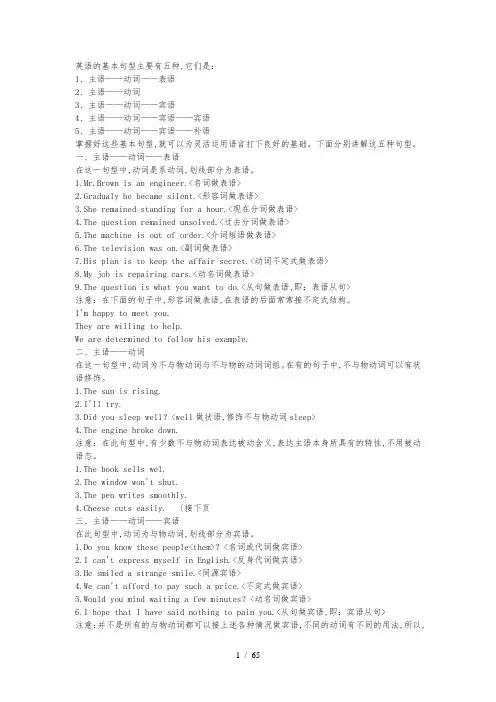
英语五种基本句型列式如下:
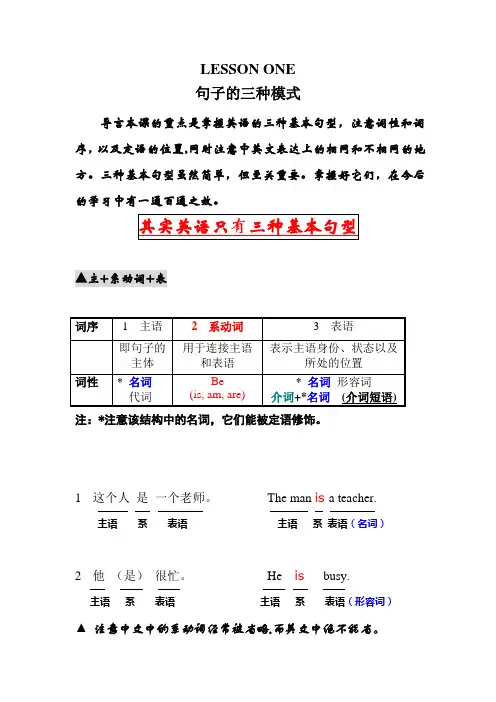
一: S V (主+谓) The moon rose.
二: S V P (主+系+表)The dinner smells good.
三: S V O (主+谓+宾)He has refused to help them.
四: S V o O (主+谓+间宾+直宾)She cooked her husband a delicious meal.
五: S V O C (主+谓+宾+宾补)They found the house deserted.
练习:
指出下列句子中划线部分的句子成分:
1.Whether we’ll go depend on the weather .
2. People’s standards of living are going up steadily . 学习好资料 欢迎下载
3. That was how they were defeated.
4.The nursery takes good care of our children .
5.I’ll return the book to you tomorrow .
6.We are sure that we shall succeed .
7.The woman with a baby in her arms is his other .
8.There are many film that I’d like to see.
9.Have you met the person about whom he was speaking ?
10.I have a lot of work to do .
11.Anyway I won’t stop you from doing it .
12.I said it in fun .
13.We can send a car over to fetch you .
14.She had to work standing up .
15.Seeing this ,some comrades became very worried .
16.Much interested , he agreed to give it a try .
17.The bus arrived ten minutes late .
18.We should serve the people heart and soul.
19.Spring coming on , the tree turned green .
20.Some farmers saw something strange in the sky .
21.We think it necessary that everyone should attend the meeting .
22.It’s strange that she doesn’t come today .
23.It was in the library that I come today .
24.He likes drawing at times when he isn’t working .
25.We left in such a hurry that we forgot to lock the door.