
日本公司企业管理 英文【精品】
- 格式:ppt
- 大小:168.50 KB
- 文档页数:15


日企工作方法English:When working with a Japanese company, it is important to understand and respect their unique work methods. Japanese companies often prioritize teamwork, consensus-building, and attention to detail. Decision-making is typically done through a group process, and there is a strong emphasis on maintaining harmonious relationships within the team. In addition, punctuality and respect for hierarchy are highly valued in the workplace. Meetings and communication are often very formal and respectful, with a focus on clear and precise language. It is also common for employees to engage in "nemawashi," the process of quietly laying the groundwork for a decision by gathering consensus from all relevant parties before a formal meeting. This emphasis on thorough preparation and consensus-building can lead to longer decision-making processes, but it is an important part of how Japanese companies operate.中文翻译:在与日本公司合作时,了解并尊重他们独特的工作方法非常重要。
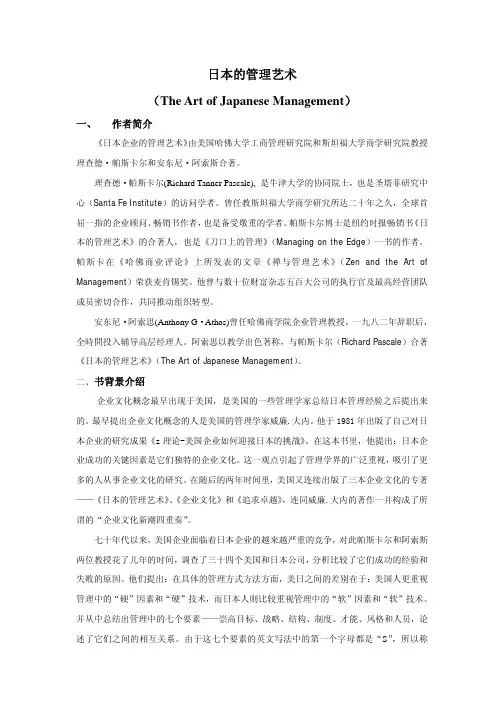
日本的管理艺术(The Art of Japanese Management)一、 作者简介《日本企业的管理艺术》由美国哈佛大学工商管理研究院和斯坦福大学商学研究院教授理查德·帕斯卡尔和安东尼·阿索斯合著。
理查德·帕斯卡尔(Richard Tanner Pascale),是牛津大学的协同院士,也是圣塔菲研究中心(Santa Fe Institute)的访问学者。
曾任教斯坦福大学商学研究所达二十年之久,全球首屈一指的企业顾问、畅销书作者,也是备受敬重的学者。
帕斯卡尔博士是纽约时报畅销书《日本的管理艺术》的合著人,也是《刀口上的管理》(Managing on the Edge)一书的作者。
帕斯卡在《哈佛商业评论》上所发表的文章《禅与管理艺术》(Zen and the Art of Management)荣获麦肯锡奖。
他曾与数十位财富杂志五百大公司的执行官及最高经营团队成员密切合作,共同推动组织转型。
安东尼·阿索思(Anthony G·Athos)曾任哈佛商学院企业管理教授,一九八二年辞职后,全時間投入辅导高层经理人。
阿索思以教学出色著称,与帕斯卡尔(Richard Pascale)合著《日本的管理艺术》(The Art of Japanese Management)。
二、书背景介绍企业文化概念最早出现于美国,是美国的一些管理学家总结日本管理经验之后提出来的。
最早提出企业文化概念的人是美国的管理学家威廉.大内。
他于1981年出版了自己对日本企业的研究成果《z理论-美国企业如何迎接日本的挑战》。
在这本书里,他提出:日本企业成功的关键因素是它们独特的企业文化。
这一观点引起了管理学界的广泛重视,吸引了更多的人从事企业文化的研究。
在随后的两年时间里,美国又连续出版了三本企业文化的专著——《日本的管理艺术》、《企业文化》和《追求卓越》,连同威廉.大内的著作一并构成了所谓的“企业文化新潮四重奏”。

日本管理制度英文叫什么Introduction:The management system in Japan is often regarded as unique and successful, as it has contributed significantly to the growth and development of Japanese industries and the overall economy. This system is deeply rooted in Japanese culture and values, and it is characterized by a strong emphasis on teamwork, discipline, and continuous improvement. In this article, we will explore the key features of the Japanese management system, its historical background, and its impact on the performance and competitiveness of Japanese companies.Historical Background:The modern Japanese management system has its roots in the post-World War II era when Japan was undergoing a rapid process of industrialization and economic reconstruction. During this period, the Japanese government played a crucial role in promoting and supporting the development of domestic industries through various policies and initiatives. One of the key measures was the establishment of the Ministry of International Trade and Industry, which provided guidance and resources to help Japanese companies modernize and expand their operations. Additionally, the government encouraged the formation of keiretsu, which are intricate networks of interlinked companies and suppliers that collaborate closely with each other. These keiretsu played a critical role in fostering long-term relationships and mutual support among member companies, thereby strengthening the overall competitiveness of the Japanese industry.Key Features of the Japanese Management System:1. Lifetime Employment:One of the distinguishing characteristics of the Japanese management system is the practice of lifetime employment, which entails companies offering job security and long-term career prospects to their employees. In Japan, it is common for workers to join a company after graduating from university and to remain with the same employer until retirement. This commitment to lifelong employment fosters loyalty and commitment among employees, and it also incentivizes them to invest in their skills and professional development.2. Seniority-based Promotions:Japanese companies typically adhere to a seniority-based promotion system, wherein employees are rewarded based on their length of service and experience rather than their individual performance. This approach is intended to create a stable and predictable career progression for employees, and it also reflects the Japanese emphasis on respect for elders and hierarchical order in the workplace.3. Group-oriented Decision Making:Another hallmark of the Japanese management system is its emphasis on group-oriented decision making, whereby consensus-building and collaboration are highly valued. In Japanese organizations, decisions are often made through a process of collective discussion and agreement among employees, supervisors, and various stakeholders. This approach promotes cooperation and harmony within the workplace, and it also encourages employees to contribute their ideas and opinions to the decision-making process.4. Continuous Improvement (Kaizen):The concept of continuous improvement, known as kaizen in Japanese, is deeply ingrained in the management philosophy of Japanese companies. Kaizen emphasizes the need for ongoing efforts to enhance quality, productivity, and efficiency in all aspects of the business. Japanese companies are known for their relentless pursuit of excellence and their commitment to eliminating waste and inefficiency through incremental improvements in processes and operations.5. Quality Control and Total Quality Management (TQM):Japanese companies place a strong emphasis on quality control and total quality management as essential elements of their management system. This commitment to excellence is exemplified by the renowned Japanese approach to quality improvement, such as the "Five S" methodology (seiri, seiton, seiso, seiketsu, and shitsuke) and the pioneering work of quality gurus like W. Edwards Deming and Joseph M. Juran. TQM principles have been widely adopted by Japanese businesses to ensure the highest standards of product and service quality.Impact of the Japanese Management System:The Japanese management system has had a profound impact on the performance and competitiveness of Japanese companies across various industries. Notably, it has contributed to the success of leading Japanese corporations in automotive, electronics, consumer goods, and other sectors, enabling them to achieve global recognition and market leadership. The emphasis on teamwork and collaboration has helped Japanese companies to foster strong organizational cultures and high levels of employee engagement, which are essential factors in driving innovation and achieving operational excellence. Additionally, the commitment to continuous improvement has enabled Japanese companies to adapt to changing market conditions and technological advancements, remaining agile and resilient in the face of global competition.Challenges and Evolving Trends:While the Japanese management system has many strengths, it also faces challenges and evolving trends in the contemporary business environment. In recent years, demographic changes, economic pressures, and increasing globalization have posed significant challenges to the traditional practices of Japanese management. The aging population and declining birth rates in Japan have led to labor shortages and demographic imbalances, promptingcompanies to reassess their employment practices and talent management strategies. Moreover, the rise of digital technologies and the expansion of global supply chains have necessitated greater flexibility and adaptability in the way Japanese companies operate and compete.In response to these challenges, Japanese companies are embracing new approaches to management and organizational practices, such as greater emphasis on merit-based promotions, increased flexibility in employment arrangements, and the adoption of agile methodologies and digital tools to enhance productivity and innovation. Furthermore, Japanese firms are actively seeking to diversify their workforces and leadership teams to promote inclusivity and harness a wider range of talents and perspectives.Conclusion:In conclusion, the Japanese management system is a distinctive and influential model that has shaped the performance and success of Japanese companies for many decades. Its emphasis on lifetime employment, seniority-based promotions, group-oriented decision making, continuous improvement, and quality management has yielded significant benefits in terms of organizational culture, employee engagement, and operational excellence. However, in the face of evolving business dynamics and demographic shifts, Japanese companies are undergoing a process of adaptation and transformation to remain competitive and relevant in the global marketplace. As they navigate these challenges, the enduring principles of the Japanese management system, coupled with innovation and openness to change, will continue to be vital drivers of success for Japanese businesses in the years ahead.。

日本管理制度英文叫什么范文Title: An Overview of Japan's Management System Introduction:Japan's management system is known for its unique approach and effectiveness in driving economic growth and creating successful companies. This article provides an in-depth analysis of the various aspects of Japan's management system, including its history, principles, key components, and the role of stakeholders. The article also explores the impact of the management system on the Japanese economy and its international influence.I. Historical Evolution:A. Feudalistic Roots:- Influence of Confucianism and Samurai culture on the early management system.- Importance of loyalty, hierarchy, and harmony in organizational structures.- Paternalistic leadership style in feudal Japan.B. Meiji Restoration:- Impact of western management ideas and techniques brought during the Meiji Restoration.- Introduction of a more inclusive and merit-based management style.- Formation of the Zaibatsu system and its role in modernizing management practices.II. Key Principles:A. Long-term Orientation:- Focus on sustainable growth rather than short-term profits.- Concepts like "Lifetime Employment" and "Company as a Family" reflect this principle.- How Japanese management practices contribute to corporate stability and employee loyalty.B. Quality Control:- Emphasis on the pursuit of perfection and continuous improvement.- Introduction of Total Quality Management (TQM) and "Kaizen" philosophy.- Examples of renowned Japanese companies that prioritize quality, such as Toyota and Sony.C. Consensus Decision-making:- Importance of group harmony and consensus in decision-making processes.- Role of "nemawashi" (informal consensus-building) in Japanese organizations.- Comparison of consensus-driven decision-making with more assertive Western approaches.III. Components of Japanese Management System:A. Organizational Structure:- Hierarchical structure and clear reporting lines.- Division of labor and specialization based on expertise.- Impact of "senpai-kohai" (mentorship) relationships on the management hierarchy.B. Employment Practices:- Lifetime employment system and its benefits and challenges.- Company loyalty and the concept of "acquiring skills" rather than job-hopping.- Introduction of performance-based evaluations and flexibility in recent years.C. Human Resource Development:- Importance of training and development programs.- Role of trade associations and universities in fostering a skilled workforce.- Encouragement of employees' self-improvement through lifelong learning.IV. Stakeholder Involvement:A. Government Involvement:- Role of the Ministry of Economy, Trade, and Industry (METI) in shaping management policies.- Government initiatives like Abenomics and its impact on the business environment.B. Employee Involvement:- Influence of labor unions and employee representation in decision-making.- Examples of joint labor-management committees and collective bargaining.C. Suppliers and Customers:- Collaborative relationships between companies, suppliers, and customers.- Just-in-time (JIT) inventory management and its impact onsupply chain efficiency.- Concept of "keiretsu" and its role in maintaining long-term relationships.V. International Influence:A. Global Expansion:- How Japanese management practices have been adopted by international companies.- Expansion of Japanese companies overseas and the transfer of management practices.B. Lean Management:- Introduction of Lean Management concepts developed by Toyota. - Impact of Lean Management on manufacturing processes globally.Conclusion:Japan's management system is a complex blend of traditional values, modern management principles, and stakeholder involvement that has contributed to its economic success. The focus on long-term sustainability, quality control, and consensus decision-making has made Japanese companies renowned worldwide. Understanding the key components and historical evolution of the management system helps in appreciating its unique characteristics and potential influence on future business practices globally.。