
pep小学四年级下册英语 音标复习
- 格式:ppt
- 大小:34.50 KB
- 文档页数:6
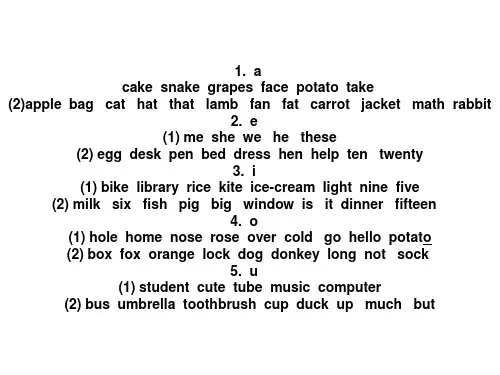

人教版(PEP)小学英语四年级下册期末复习(单词与音标、附答案)一、判断下列单词划线部分发音是否相同。
1.判断划线部分读音是(T)否(F)相同。
⑴________ ball tall⑵________ card tiger⑶________ art car⑷________ girl water⑸________ bird nurse2.判断每组单词中画线部分读音是(T)否(F)相同。
⑴________ A.her B.sister C.under⑵________ A.there B.father C.mother⑶________ A.winter B.where puter⑷________ A.after B.dinner C.eraser二、匹配题,将单词与图片匹配起来。
3.单词和对应的图片匹配。
A. playground B.garden C.library D.teachers' office⑴________⑵________⑶________⑷________4.将单词和对应的图片匹配。
A.lunch B. P.E class C. English class D. music class⑴________⑵________⑶________⑷________5.将单词和对应的图片匹配。
A. get up B. go to school C. go home D. go to bed⑴________⑵________⑶________⑷________三、看图,写出对应的短语。
6.他在什么时间做了什么?(1)________ ________(2)________ ________(3)________ ________四、根据提示补全单词。
7. 补充单词(1)老虎tig ________ ________(2)苹果app ________ ________(3)高t ________ ________ l(4)卡片 c ________ ________ d8.补全单词。
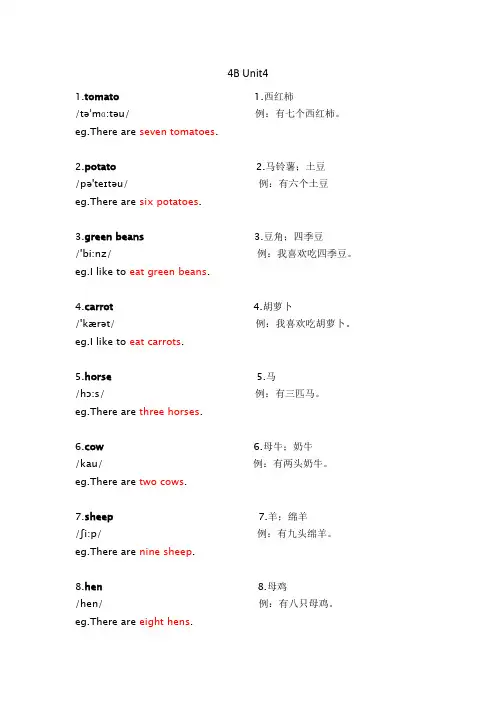
4B Unit41.tomato 1.西红柿/təˈmɑ:təu/ 例:有七个西红柿。
eg.There are seven tomatoes.2.potato 2.马铃薯;土豆/pə'teɪtəu/ 例:有六个土豆eg.There are six potatoes.3.green beans 3.豆角;四季豆/'bi:nz/ 例:我喜欢吃四季豆。
eg.I like to eat green beans.4.carrot 4.胡萝卜/'kærət/ 例:我喜欢吃胡萝卜。
eg.I like to eat carrots.5.horse 5.马/hɔ:s/ 例:有三匹马。
eg.There are three horses.6.cow 6.母牛;奶牛/kau/ 例:有两头奶牛。
eg.There are two cows.7.sheep7.羊;绵羊/ʃi:p/ 例:有九头绵羊。
eg.There are nine sheep.8.hen8.母鸡/hen/ 例:有八只母鸡。
eg.There are eight hens.9.these 9.(this的复数形式) 这些/ði:z/ 例:这些是鸭子。
Eg.These are ducks.10.yum 10.(表示味道或气味非常好)/jʌm/11.animal 11.兽;动物/ˈænɪml/ 例:你有许多的动物。
eg.You have a lot of animals.12.those 12. (that的复数形式)那些/ðəʊz/ 例:那些是苹果。
eg.Those are apples.13.garden 13.花园;菜园/ˈgɑ:dn/ 例:这是蔬菜园。
eg.This is the vegetable garden.14.farm 14.农场/fɑ:m/ 例:我们在农场里面。
eg.We are on the farm.15.goat 15.山羊/gəʊt/ 例:它们是山羊。
人教版(PEP)小学英语四年级下册期末复习(单词与音标、附答案)一、判断下列单词划线部分发音是否相同。
1.判断划线部分读音是(T)否(F)相同。
⑴________ ball tall⑵________ card tiger⑶________ art car⑷________ girl water⑸________ bird nurse2.判断每组单词中画线部分读音是(T)否(F)相同。
⑴________ A.her B.sister C.under⑵________ A.there B.father C.mother⑶________ A.winter B.where puter⑷________ A.after B.dinner C.eraser二、匹配题,将单词与图片匹配起来。
3.单词和对应的图片匹配。
A. playground B.garden C.library D.teachers' office⑴________⑵________⑶________⑷________4.将单词和对应的图片匹配。
A.lunch B. P.E class C. English class D. music class⑴________⑵________⑶________⑷________5.将单词和对应的图片匹配。
A. get up B. go to school C. go home D. go to bed⑴________⑵________⑶________⑷________三、看图,写出对应的短语。
6.他在什么时间做了什么?(1)________ ________(2)________ ________(3)________ ________四、根据提示补全单词。
7. 补充单词(1)老虎tig ________ ________(2)苹果app ________ ________(3)高t ________ ________ l(4)卡片 c ________ ________ d8.补全单词。
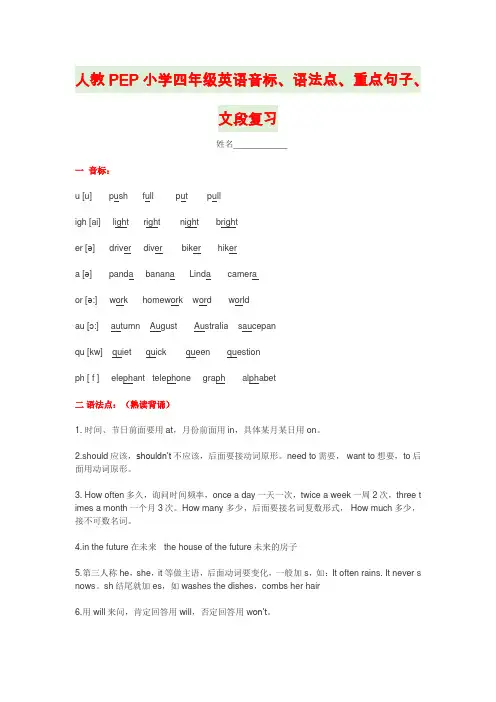
人教PEP小学四年级英语音标、语法点、重点句子、文段复习姓名___________一音标:二语法点:(熟读背诵)1. 时间、节日前面要用at,月份前面用in,具体某月某日用on。
2.should应该,shouldn’t不应该,后面要接动词原形。
need to需要, want to想要,to后面用动词原形。
3. How often多久,询问时间频率,once a day一天一次,twice a week一周2次,three t imes a month一个月3次。
How many 多少,后面要接名词复数形式, How much多少,接不可数名词。
4.in the future在未来 the house of the future未来的房子5.第三人称he,she,it等做主语,后面动词要变化,一般加s,如:It often rains. It never s nows。
sh结尾就加es,如washes the dishes,combs her hair6.用will来问,肯定回答用will,否定回答用won’t。
7.用why问,用because回答。
8.掌握下面节日单词:Easter—eat chocolate eggs--April Halloween ---play trick or treat—Octoberthe Dragon Boat Festival—watch boat races Christmas—get presents—December Chinese New Year—get lucky money—FebruaryChildren’s Day is in June. May Day is in May.New Year’s Day is in January. Christmas is in December.Chinese New Year is in February. Halloween is in October.Mid-autumn Day is in September. Easter is in April.三重点句子1. A: Will there be cats and dogs in the future? B: I think so.2. A: I will go shopping at four o’clock. Do you want to come? B: Yes, I do.3. A: Can we go there for our next holiday? B: Sure.6. It’s very cold in Harbin in winter. It often snows.7. In Shanghai, it’s cool in spring.8. In Shenzhen, it’s cool and dry in winter. But sometimes it’s cold,it never snows.9. In winter, it’s cold in Changchun. It often snows.10. In autumn, it’s cool and dry in Beijing.But it’s very hot in summer.11. In summer, it often rains in Guangzhou. It’s hot.12. In Hangzhou, it’s warm and wet in spring. It often rains.13.Tom drinks a lot of Coke every day.14. Sam and David brush their teeth twice a day.15. Paul often reads books when he walks.16. Penny reads books every day.17. Candy often says ‘please’ and ‘thank you’.18. John doesn’t wash his hands before meals.19. Tim likes eating meat, but he doesn’t like vegetables.20. Pat gets up late every day.21. Sally always throws rubbish in the bin.{$setpage}四文段:(重点理解)1Every day, Tim gets up late so he always runs to school. He doesn’t like English, so he n ever reads English in the morning. He eats lunch at school. Before meal, he washes his h ands. He likes eating meat and vegetables, but he doesn’t like sports.2My house of the future will be like this.In the living room, there will be a big TV and a long sofa. We will watch TV and play there. In the bedrooms, there will be big beds and wardrobes.In the library, there will be a lot of books and CDs. We will read books and listen to music there.The kitchen will be big. We will cook and eat there.There will be a big swimming pool. We will swim there.3Teacher: There are four seasons in a year. What are they?Kitty: They are spring, summer, autumn and winter.Teacher: Very good, Kitty. Alice, do you like spring?Alice: Yes, spring is nice. It’s warm. It’s not cold.The leaves are green. The grass is green, too.We can see many beautiful flowers. Teacher: Do you like spring, Peter?Peter: No, I don’t. Ilike autumn. It’s cool and dry. The leaves are brown and yellow. We c an fly kites in the park and play football on the playground.4Chinese New Year is the most important festival in China. We also call it “Spring Festival”.We can have a happy holiday. In the evening before the Chinese New Year ,we have a big dinner. In some places people like to have dumplings. Children like the festival very m uch ,because they can have delicious food ,wear new clothes and get lucky money. This money is given to children for good luck .People visit families and friends with some pres ents. People like the Spring Festival, during this time they can have a good rest.5We say, "Thank you."We say, "Please."We listen when people talk to us.We share(分享) our toys and take our turn.Good manners aren‘t too hard to learn.It‘s really easy, when you find.Good manners means JUST BEING KIND!(最后记得每天朗读背诵课本73-76页的单词)。