
19音乐之都维也纳
- 格式:ppt
- 大小:1.13 MB
- 文档页数:19


在音乐中流淌思维的清泉------音乐之都维也纳教学内容:苏教版五年级下册第15课教学目的:1、能正确、流利、有感情地朗读课文。
2、学习并掌握本课生字及其组成的新词。
3、感受音乐之都维也纳浓厚的音乐氛围,体会维也纳人民对音乐的酷爱。
4、品味课文语言,学习本课从几个方面介绍一个地方或一件事情的写作方法。
教学重点:1、读懂课文,了解维也纳与音乐的渊源,知道维也纳为什么被称为音乐之都。
2、引导学生在充分的语言实践中,培养阅读能力,增强语感,提高积累和运用祖国语言的能力。
教学难点:1、体会音乐之都的内涵,培养喜爱音乐的情趣。
2、引导学生在充分的语言实践中,培养阅读能力,增强语感,提高积累和运用祖国语言的能力。
教学准备:多媒体课件,文中涉及的音乐家们资料及他们的成名曲教学过程:一、激趣导入有人说:“音乐是维也纳的灵魂,没有音乐也就没有维也纳。
”那么我们今天就一边听着音乐一边来感受这音乐之都的魅力。
二、研读,感受独特魅力1、谈话激趣,生动手同学们知道维也纳最具特色的个性是什么吗?到底有哪些独特之处使维也纳堪称音乐之都呢?我们先学课文二至四自然段,请大家先用心默读课文的第二至第四自然段,把这三段中最能体现维也纳这个城市音乐个性的语句用“_”线画出来。
2、学生默读,师巡视3、合作探究,生交流(1)从哪里看出维也纳是欧洲古典音乐的摇篮呢?“摇篮”本来是指什么?在文中这个词有什么含义呢?说说你的理解。
(介绍“摇篮”里造就得音乐大师相关资料)(2)维也纳是一座用音乐装饰起来的城市,你是怎么理解的?请默读课文,画出相关的语句。
①指名读,谈感受。
②重点品读两个“装饰”。
③欣赏文中提及的相关图片。
(补充直观图片,点出课文插图,让学生有直观的感受)④感情朗读。
“音乐是维也纳的灵魂,没有音乐也就没有维也纳。
” 能通过你的朗读,来给大家介绍这座用音乐装饰起来的城市吗?(3)出示:维也纳几乎一天也离不开音乐。
从那些地方可以看出来?生默读,读并圈画出相关语句,从中体会。
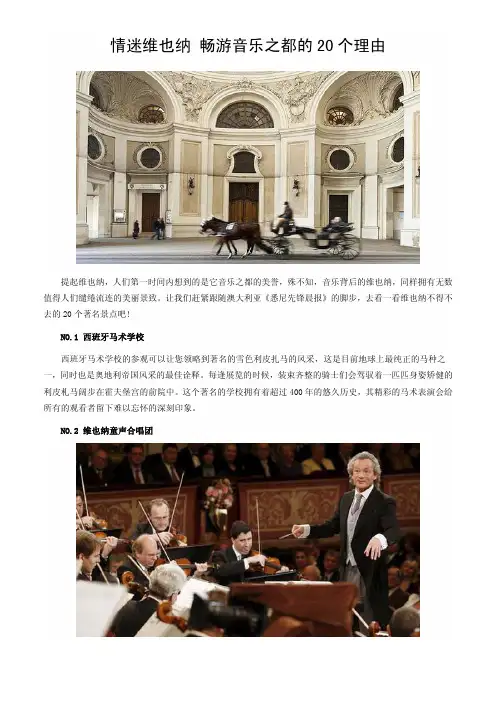
情迷维也纳 畅游音乐之都的20个理由提起维也纳,人们第一时间内想到的是它音乐之都的美誉,殊不知,音乐背后的维也纳,同样拥有无数值得人们缱绻流连的美丽景致。
让我们赶紧跟随澳大利亚《悉尼先锋晨报》的脚步,去看一看维也纳不得不去的20个著名景点吧!NO.1 西班牙马术学校西班牙马术学校的参观可以让您领略到著名的雪色利皮扎马的风采,这是目前地球上最纯正的马种之一,同时也是奥地利帝国风采的最佳诠释。
每逢展览的时候,装束齐整的骑士们会驾驭着一匹匹身姿矫健的利皮札马阔步在霍夫堡宫的前院中。
这个著名的学校拥有着超过400年的悠久历史,其精彩的马术表演会给所有的观看者留下难以忘怀的深刻印象。
NO.2 维也纳童声合唱团霍夫堡皇宫雄伟恢弘的建筑群中有一处不得不提的宫殿,那就是霍夫堡宫教堂。
每个星期日早晨的九点一刻,维也纳童声乐团都会在此举行演出。
该童声乐团作为一个炙手可热的音乐组织经常参加各种大型商业音乐会,因此拥有强大的经济来源,但是每个周日的早晨,霍夫堡宫教堂依然是他们的传统聚集地。
NO.3 维也纳爱乐乐团作为曾经孕育了海顿,莫扎特和施特劳斯等一代大师的音乐之都,维也纳市内有着浓浓的音乐气息。
徜徉在维也纳街头,您会不经意地遇见一些向您派发古典音乐会传单的人,而这些音乐会大多规模很小,效果一般。
如果您想倾听真正的大师级音乐会,那么维也纳爱乐乐团就是您的不二选择。
作为世界上最著名的交响乐团,维也纳爱乐乐团每年穿梭于世界各地大大小小的演奏厅内,一定能够为您带来一次绝妙的听觉盛宴。
NO.4 音乐之家如果您想更好地贴近维也纳市内的音乐遗址,音乐之家是最热门的首选地。
房子的顶层曾经居住着世界顶级的音乐天才们,音乐之都的美誉就诞生于他们笔下的五线谱中。
这里浓缩着大师们的生活轨迹,来到这儿,人们可以如此近距离地瞻仰到自己心中的偶像。
NO.5 酥炸小肉排和芳香牛肉羹来到维也纳,一定要尝一下大名鼎鼎的当地美食酥炸小肉排。
而维也纳城中最著名的肉排店非Figlmuller莫属,生意火爆的Figlmuller餐厅做着全市最好的肉排,让世界各地慕名而来的游客们心满意足地吃了近一百年。

维也纳是音乐之都的原因英语作文全文共3篇示例,供读者参考篇1Why Vienna is Considered the Music Capital of the WorldAs a student of music, I have always been fascinated by the rich cultural heritage of Vienna, Austria. This magnificent city, nestled in the heart of Europe, has earned the well-deserved reputation as the "Music Capital of the World." From the grand concert halls that have witnessed the premieres of countless masterpieces to the quaint coffee houses where composers found inspiration, Vienna's very soul resonates with the harmonies of the ages. In this essay, I will explore the reasons why this city has become synonymous with musical excellence, examining its historical significance, influential composers, and enduring cultural traditions.Vienna's musical legacy can be traced back centuries, with its golden age spanning from the late 18th to the early 20th century. During this period, the city was a veritable mecca for composers, musicians, and music enthusiasts alike. The Habsburg Empire, which ruled over much of Central Europe, patronized the artsand fostered an environment where music could flourish. The imperial court's love for music attracted some of the greatest talents of the time, including Wolfgang Amadeus Mozart, Ludwig van Beethoven, and Franz Schubert.Mozart, arguably one of the most beloved and influential composers of all time, spent a significant portion of his life in Vienna. It was here that he composed some of his most celebrated works, including the operas "The Marriage of Figaro" and "Don Giovanni." Beethoven, too, found his artistic home in Vienna, where he created his monumental symphonies and piano sonatas that continue to inspire musicians and audiences worldwide.The city's musical traditions extend far beyond these legendary figures. Vienna was also the birthplace of the waltz, a dance that captured the essence of the city's elegant and refined culture. The Viennese waltz became a global phenomenon, popularized by the works of composers such as Johann Strauss II, whose waltzes, polkas, and operettas are still performed and cherished today.One of the most remarkable aspects of Vienna's musical legacy is the sheer number of renowned composers who called this city home. From the Classical era's Joseph Haydn and FranzSchubert to the Romantic period's Johannes Brahms and Gustav Mahler, Vienna nurtured and inspired generations of musical geniuses. These composers not only left an indelible mark on the city but also shaped the course of Western classical music as we know it today.Beyond its illustrious composers, Vienna boasts an array of world-class concert venues and institutions that have contributed to its musical reputation. The Vienna State Opera House, a grand Baroque masterpiece, has hosted countless opera performances and is renowned for its exceptional acoustics and breathtaking interior. The Musikverein, another iconic venue, is home to the prestigious Vienna Philharmonic Orchestra and is considered one of the finest concert halls in the world.Vienna's musical traditions are not merely relics of the past but are woven into the fabric of modern life. The city hosts numerous festivals and cultural events throughout the year, celebrating its rich musical heritage. The Vienna Philharmonic's annual New Year's Concert, broadcast globally, has become a beloved tradition, featuring the works of the Strauss family and other Viennese composers.Moreover, Vienna's coffee house culture has played a vital role in shaping the city's musical identity. These cozy establishments, with their warm atmospheres and the aroma of freshly brewed coffee, have served as meeting places for artists, intellectuals, and musicians throughout history. It was in these very coffee houses that great composers such as Beethoven and Schubert found inspiration and penned some of their most celebrated works.In addition to its historical significance and cultural traditions, Vienna's musical education system has contributed to its reputation as a global center for music. The University of Music and Performing Arts, Vienna, is one of the most prestigious music conservatories in the world, attracting talented students from around the globe. This institution, along with numerous other music schools and academies, ensures that Vienna's musical legacy continues to thrive and inspire future generations of musicians.As a student of music, I am deeply grateful for the opportunity to study and appreciate the rich musical heritage of Vienna. This city, with its grand concert halls, illustrious composers, and enduring cultural traditions, has left an indelible mark on the world of music. From the soaring melodies ofMozart to the powerful symphonies of Beethoven, Vienna's musical legacy continues to resonate through the ages, captivating audiences and inspiring artists alike.In conclusion, Vienna's status as the "Music Capital of the World" is well-deserved and deeply rooted in its history, culture, and unwavering commitment to fostering musical excellence. As I continue my musical journey, I am forever grateful for the invaluable lessons and inspiration that this city has imparted, and I look forward to carrying on its legacy through my own artistic endeavors.篇2The Reasons Why Vienna is the Capital of MusicVienna, the elegant capital of Austria, is renowned for its rich musical heritage and has earned the well-deserved title of "The Capital of Music." This city has been the birthplace, home, and muse for some of the most celebrated composers in history, whose works have transcended time and continue to captivate audiences worldwide. In this essay, I will delve into the compelling reasons that have solidified Vienna's reputation as the epicenter of classical music.First and foremost, Vienna's musical legacy can be traced back to the remarkable composers who called this city their home. The names of these musical giants are etched into the annals of history, and their compositions have become cornerstones of the classical repertoire. Wolfgang Amadeus Mozart, one of the most prolific and influential composers of all time, spent a significant portion of his life in Vienna. His operas, symphonies, and concertos were often premiered in the city's illustrious concert halls, captivating audiences with their sublime melodies and intricate harmonies.Another composer who left an indelible mark on Vienna's musical landscape was Ludwig van Beethoven. Although born in Bonn, Beethoven spent the majority of his adult life in Vienna, where he composed some of his most celebrated works, including his groundbreaking symphonies and the iconic piano sonatas. His deafness did not diminish his creative genius, and his compositions continue to inspire and move listeners to this day.Vienna was also home to the "Waltz King," Johann Strauss Jr., whose enchanting waltzes and operettas captured the essence of the city's vibrant social scene. His works, such as "The Blue Danube" and "Tales from the Vienna Woods," have becomesynonymous with the spirit of Vienna and are cherished by audiences worldwide.Beyond the contributions of these legendary composers, Vienna's rich musical heritage can be attributed to its thriving cultural scene and patronage of the arts. The city's aristocracy and wealthy patrons played a crucial role in supporting and promoting classical music. The lavish palaces and grand concert halls of Vienna provided the perfect settings for musical performances, attracting audiences from all walks of life.One of the most renowned concert venues in Vienna is the Musikverein, home to the prestigious Vienna Philharmonic Orchestra. This iconic concert hall, with its stunning architecture and exceptional acoustics, has hosted countless performances by the world's finest musicians and orchestras. Attending a concert at the Musikverein is an unforgettable experience, offering a glimpse into Vienna's musical grandeur.Vienna's musical legacy extends beyond the realms of classical music, as the city has also been a breeding ground for innovative contemporary composers and musicians. The Vienna Conservatory and the University of Music and Performing Arts have nurtured generations of talented artists, ensuring the continuation of Vienna's musical tradition.Moreover, Vienna's cultural fabric is intertwined with music in a way that permeates every aspect of daily life. From the street musicians serenading passersby in picturesque squares to the opulent balls and festivals celebrating the city's musical heritage, music is an integral part of Vienna's identity. The annual Vienna Opera Ball, for instance, attracts visitors from around the globe, who come to experience the grandeur and elegance of this iconic event.In conclusion, Vienna's status as the "Capital of Music" is well-deserved and deeply rooted in its rich musical history, cultural patronage, and unwavering appreciation for the arts. The city's legendary composers, world-class concert halls, and vibrant cultural scene have created a lasting legacy that continues to inspire and captivate audiences worldwide. As a student of music, I am in awe of Vienna's musical heritage and grateful for the opportunity to learn and appreciate the works of these musical masters in the city where they flourished.篇3The Reasons Why Vienna is the Capital of MusicVienna, the charming capital of Austria, has long been revered as the "Capital of Music" or the "City of Music." Thisprestigious title is not merely a fanciful moniker but awell-deserved recognition of Vienna's rich musical heritage and enduring contributions to the world of classical music. As a student passionate about music, I have delved into the fascinating history and cultural tapestry of this remarkable city, uncovering the multitude of reasons that solidify its status as the epicenter of musical excellence.One of the most compelling factors that have propelled Vienna's musical preeminence is its illustrious pantheon of composers who have left an indelible mark on the annals of music history. The city served as a fertile creative ground for some of the greatest musical geniuses of all time, including Wolfgang Amadeus Mozart, Ludwig van Beethoven, Franz Schubert, Johann Strauss Jr., and Gustav Mahler, among others. These titans of classical music found inspiration within the vibrant cultural milieu of Vienna, composing masterpieces that continue to captivate audiences worldwide.Mozart, perhaps the most celebrated of Vienna's musical prodigies, arrived in the city at the tender age of six and quickly established himself as a virtuoso performer and composer. His operas, symphonies, and concertos, composed during his time in Vienna, are widely regarded as pinnacles of classical music.Similarly, Beethoven, the indomitable genius who challenged the boundaries of musical expression, spent a significant portion of his career in Vienna, where he composed his iconic symphonies and piano sonatas, forever altering the course of Western music.Beyond the contributions of these legendary composers, Vienna has nurtured a rich tradition of musical education and patronage, fostering an environment conducive to the flourishing of musical talent. The city's renowned institutions, such as the Vienna Boys' Choir, the Vienna Philharmonic Orchestra, and the Vienna State Opera, have played a pivotal role in preserving and promoting the city's musical heritage. These hallowed institutions have not only nurtured generations of talented musicians but have also served as cultural ambassadors, representing Vienna's musical excellence on global stages.The architectural splendor of Vienna's concert halls and opera houses further underscores the city's reverence for music. The iconic Musikverein, home to the Vienna Philharmonic Orchestra, is a architectural masterpiece renowned for its exceptional acoustics, making it a coveted destination for music lovers from around the world. The grand Wiener Staatsoper (Vienna State Opera), with its opulent interior and storied history,has hosted some of the most celebrated opera productions, attracting audiences and performers alike.Vienna's cultural landscape is inextricably intertwined with its musical legacy, and this symbiotic relationship has contributed to the city's enduring allure. The annual celebrations, such as the Vienna Opera Ball and the famous New Year's Concert by the Vienna Philharmonic Orchestra, are cherished traditions that attract visitors from far and wide, eager to immerse themselves in the city's musical splendor.Moreover, Vienna's strategic geographic location at the crossroads of Europe has played a crucial role in shaping its musical identity. Throughout history, the city has been a melting pot of cultures, attracting artists, musicians, and intellectuals from various parts of the continent. This cultural exchange has enriched Vienna's musical fabric, infusing it with diverse influences and fostering an environment of artistic collaboration and innovation.As a student of music, exploring Vienna's musical legacy has been an awe-inspiring and humbling experience. Walking the same streets as Mozart, Beethoven, and Schubert, visiting the historic concert halls and opera houses, and witnessing the city'sunwavering commitment to preserving its musical heritage have deepened my appreciation for the art form and its。

维也纳的诞生名词解释维也纳,这个美丽而魅力十足的城市,曾被誉为“音乐之都”、“世界最佳居住城市”等等。
然而,对于维也纳这个名字的起源与含义,人们可能不太了解。
事实上,维也纳这个名词背后蕴含着丰富的历史和文化内涵,其诞生与起源追溯到远古时期。
在古老的凯尔特人部落中,曾存在着一个名为“Vedunia”的部落,该部落居住在奥地利现今维也纳的地区。
这个名字被认为是维也纳名词的最早来源之一。
然而,随着时间的推移和历史的演变,维也纳的名字发生了多次变化。
在罗马帝国时期,奥斯特里亚河流域成为罗马帝国的一部分,并与著名的“维斯堡”相连。
维斯堡是古罗马帝国的一个城堡,该城堡的名字又演变为“Viena”,这也是维也纳名字的另一个起源。
与此同时,在奥斯曼帝国对欧洲的侵略中,维也纳成为了这些战争的重要战场。
嘉芙雷女王时期,维也纳城被围困,并经历了一次惨烈的攻防战。
虽然奥斯曼帝国失败了,但维也纳战役成为了历史上重要的一幕。
从那时起,维也纳的名字开始广为人知,并被一直沿用至今。
然而,维也纳的名字不仅源于历史事件,还与音乐有着紧密的联系。
维也纳是世界音乐之都,许多著名作曲家如贝多芬、莫扎特和海顿等都在这里创作过众多不朽的作品。
音乐成为了维也纳的象征,而维也纳的名字在音乐领域中也被广泛使用。
除了历史和音乐,维也纳还以其优美的建筑和文化艺术而闻名于世。
维也纳大剧院、美泉宫、圣斯蒂芬大教堂等建筑物都成为了城市的标志性景点。
而维也纳画派的兴起也使这座城市成为了欧洲艺术界的中心。
维也纳画派以其独特的风格和视觉效果,深受艺术家和观众的喜爱。
这些丰富多样的文化艺术元素也使得维也纳在全球范围内享有盛名。
维也纳的诞生名词解释,是对这座城市丰富文化内涵、历史意义和艺术成就的一种概括。
维也纳这个名字不仅是一个地名,更是一个象征着辉煌和灵感的符号。
它以其多样化的元素吸引着世界各地的人们,成为一个充满活力和魅力的城市。
无论是音乐家、艺术家、历史爱好者还是普通游客,维也纳都是一个不容错过的目的地。