小学五年级英语语法知识汇总.docx
- 格式:docx
- 大小:55.35 KB
- 文档页数:8
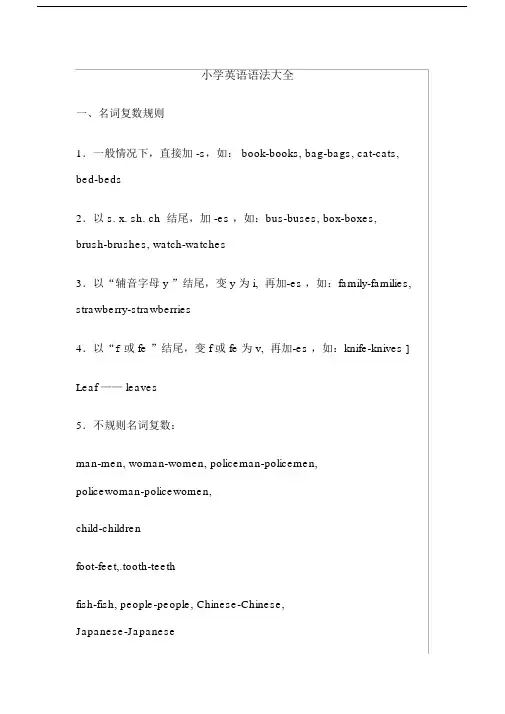
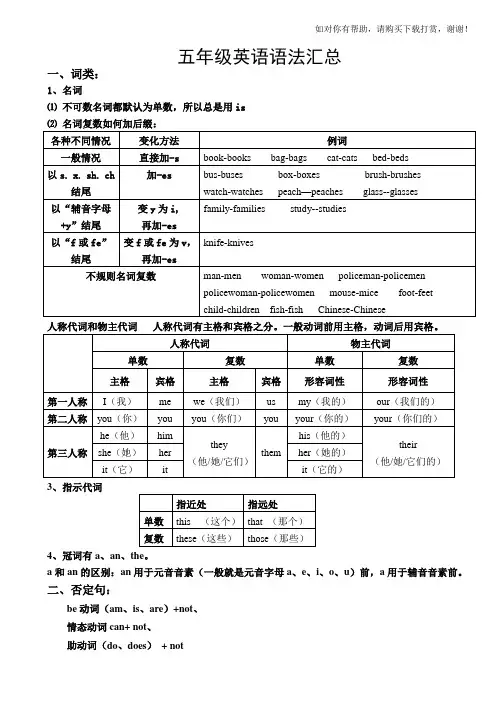
小学五年级英语语法知识汇总一、词类:1、名词这里强调两点:不可数名词都默认为单数,所以总是用is名词复数如何加后缀:各种不同情况变化方法例词一般情况直接加 -s book-books bag-bags cat-catsbed-beds以 s. x. sh. ch加-es bus-buses box-boxes brush-brushes结尾watch-watches peach —peachesglass--glasses以“辅音字母变 y 为 i,再加 family-families study--studies+y”结尾-es以“ f 或 fe ”结变 f或 fe为 v, knife-knives尾再加 -es不规则名词复数man-men woman-women policeman-policemenpolicewoman-policewomen mouse-micefoot-feet child-children fish-fishChinese-Chinese2、人称代词和物主代词人称代词物主代词单数复数单数复数主格宾格主格宾格形容词性形容词性第一人称I (我)me we(我们)us my(我的)our(我们的)第二人称you(你)you you(你们)you your (你your (你们的)的)he(他)him they his(他的)their第三人称she(她)her(他/她/them her(她的)(他/她/它it (它)it它们)it (它的)们的)人称代词:有主格和宾格之分。
一般动词前用主格,动词后用宾格。
3、指示代词指近处指远处单数this(这个)that(那个)复数these (这些)those (那些)4、冠词有 a、an、the 。
a 和an 的区别: an 用于元音音素(一般就是元音字母a、e、i 、o、u)前, a 用于辅音音素前。
二、否定句:be 动词( am、is 、are )+not 、情态动词 can+ not 、助动词( do、does) + not如何将一个肯定的陈述句改为否定句:1、看句中有无 be 动词,如有,直接在be 动词后 + not 。
2、看句中有无情态动词,如有,直接在情态动词后+ not 。
3、如上述二者都没有,就应用助动词+ not 。
分四个步骤:(1)肯定陈述句中本来是没有助动词的,要加上去,位置在主语(某人或某物)后,动词前。
(2)确定助动词用do、does,根据句中动词,动词是原形的助动词就用do,动词是第三人称单数的助动词就用does,(3)在助动词后加not 。
(4)原句中动词假如发生变化就要恢复成原形。
强调一点,有 some的要考虑是否要用any。
三、一般疑问句。
如何将一个肯定的陈述句改为一般疑问句:1、看句中有无 be 动词,如有,把 be 动词提到句首即可。
2、看句中有无情态动词,如有,把情态动词提到句首即可。
3、如上述二者都没有,就应把助动提到句首。
分四个步骤:(1)肯定陈述句中本来是没有助动词的,要加上去,位置在主语(某人或某物)后,动词前。
(2)确定助动词用 do 还是 does,根据句中动词,动词是原形的助动词就用do,动词是第三人称单数的助动词就用does(3)把助动词后提到句首。
(4)原句中动词假如发生变化就要恢复成原形。
强调一点,有 some的要考虑是否要用any。
四、特殊疑问句。
表示疑问,有疑问词(在开头),回答有很多种可能。
常用疑问词:疑问词意思用法What time什么时间问具体时间,如几点钟Who谁问人Whose谁的问主人Where在哪里问地点What什么问东西、事物What colour什么颜色问颜色How old多大年纪问年纪How many多少数量(可数名词)问数量How much多少钱;多少数量(不可数问多少钱或数量(不可数)名词)五、时态1、一般现在时(1)一般现在时中的 be 动词:一般用原形: am is aream用于第一人称单数(I );is 用于第三人称单数(he she it和其他人名或称谓,如: Ben his sister等); are 用于第二人称单数( you)和所有复数(包括第一人称复数 we、第二人称复数 you;第三人称复数 they 和其他复数,如 the children、his parents等)。
(2)一般现在时中的动词:第一种情况:主语是第三人称单数(he she it和其他,如Helen、her cousin 等),动词后一般加s 或 es。
第二种情况:主语不是第三人称单数,动词都用原形。
(4)一般现在时判断依据(如何判断一个句子是一般现在时):△be 动词是 am、is 、 are△动词用原形或加s、es△没有时间状语或有usually 、often 、 everyday 、sometimes 等不是具体的时间2、现在进行时(1)构成形式: Be 动词 +动词的 ing 形式这里强调一点,两者缺少其中任何一种都不可以构成现在进行时。
(2)现在进行时表示动作正在进行或事情正在发生。
(3)有用的依据:一个句子中既有be 动词,又有动词,且动词加了ing 是现在进行时(4)句中往往有 now、 look 、listen等词。
动词现在分词的变化见下表:词尾情况变化方式例词一般情况加— ing play 玩— playing do做—doing ←→ 该句go去— goingjump 跳— jumping sing唱— singingski滑雪— skiing see看见 --seeing以不发音的 e 结尾去 e 加— ing make做— making take拿到— taking like喜欢—likingcome来— coming write写— writingdance 跳舞— dancing have有— havingclose 关— closing以重读闭音节结双写最后一个swim 游泳— swimming sit 坐— sitting尾的动词,中间只辅音字母再加run 跑— running get得到— getting有一个元音字母,— ing put 放— putting begin开始— beginning词尾只有一个辅jog 慢跑— jogging音字母同音词: too---two----to buy---by I---eye four----for龄there----their right----write sun----sonno----know here---hear who’ s----whose近义词: many----a lot of / lots of large----bigdesk----tablephoto----picture lamp----lightlike----love反义词或对应词:old----new go----comebig----smallopen----close black----whitehere----there完整形式: let ’s=let us( 让我们 ) I’d=I would can’t=can not I’m=I am词性变换:one( 序数词 ) first monkey(复数)monkeys skiing(原形 )ski is(复数)are families(单数)familymake(现在分词) making we are(缩略形式)we’re do(第三人称单数 )does have(第三人称单数)has photo(复数 )photos fat(反义词)thin做题目时一定要记住:1.can+动词原形2.like+ 动词 ing3.like+ 名词复数4.play+ 足球类play the +乐器类5.how many +名词复数6.would like +to+动词原形7.let ’s+动词原形8.现在进行时: be(am,is,are)+ 动词ing9.动词第三人称单数形式3、一般过去时定义:表示过去发生的行为或状态,这种时态往往都有一个明确的过去时间状语,如: yesterday ,last week (month, year )等,或联系上下文能确切知道行为发生在过去,其谓语用过去式。
(1)一般过去时中的be 动词: was werewas用于第一人称( I )和第三人称单数( he she it和其他人名或称谓),were 用于第二人称单数( you)和所有复数(包括第一人称复数we、第二人称复数you;第三人称复数 they 和其他复数,如the children、his parents等)。
(2)在动词 1、基本形式: am、 are 、is(1) am第一人称 I+am (注意:“ I”无论何时都要大写,不管位于句首还是句中)例: I am a beautiful girl.I am twenty.(2) are第二人称 you+are;一人称复数we+are;三人称复数they+are其他复数名词+are (注意:第二人称单复数同形,都为you)例: You are my good friend. They are on the road.(3) is第三人称 he( 男) +is ; she(We are in the same class.The books are on the desk.女)+is; it(不是人)+is;其他单数名词+is例: He\She is a good student.It is a white cat. A dogis on that street.后面加 ed。
动词过去式的构成规则:一般情况,直接加ed,clean —cleaned ,finish—finished,want—wanted,watch —watched。
以不发音字母“ e”结尾的加 d, move— moved,live —lived ,arrive —arrived 。
以“辅音字母 +y”结尾的,变 y 为 i ,再加 ed,study —studied ,cry —cried ,try —tried 。
注意,“以元音字母 +y”结尾的,直接加 ed, play —played 。
以重读闭音节结尾,结尾只有一个元音字母加一个辅音字母的,双写最后一个辅音字母再加 ed。
是 stop —stopped ,drop — dropped。
(3)一般过去时的句型:否定句: be 动词( was were )+not 、助动词( did ) + not+ 动原疑问句: was/were + 主+其他?Did +主+动原+其他?特殊疑问句:特殊疑问词 +一般疑问句?一课时: be 动词主讲与人称代词的搭配1、基本形式: am、are 、 is(3) am第一人称 I+am (注意:“ I”无何都要大写,不管位于句首是句中)例: I am a beautiful girl.I am twenty.(4) are第二人称 you+are;一人称复数we+are;三人称复数they+are其他复数名+are (注意:第二人称复数同形,都you)例: You are my good friend. They are on the road. (3) is第三人称 he( 男) +is ; she(We are in the same class.The books are on the desk.女)+is; it(不是人)+is;其他数名+is例: He\She is a good student.is on that street.It is a white cat. A dog2、肯定、否定、疑(等于号后是写)肯定否定—— be一般疑——一般疑否定一般疑回答后加 not be 移到主肯定和否定前I am ⋯ =I ’I am not ⋯Am I ⋯?Am not I ⋯ ?Yes,I ’m.m⋯ .=I ’m not ...No,I ’ m not. You are ⋯You are not ⋯ Are you ⋯?Are not you...?Yes,you are. = you ’ re ⋯=You aren ’=Aren ’t No,you are t ⋯you⋯?not.She\He\It She\He\It is Is Is not Yes,she\he\It is ⋯ =not ⋯she\he\it ⋯?she\he\it⋯?is.=She\He\It=Isn ’tNo,she\he\ItShe\He\It ’s isn ’t ⋯she\he\it⋯?is not.We are We are not ⋯Are we ⋯?Are not we ⋯?Yes,we are. =We’re=Wearen ’t ⋯=Aren’ t we ⋯ ?No,we are not. They are They are Are they ⋯ ?Are not they ⋯?Yes,they are.=They’ re not ⋯=Aren’ t No,they are =They aren ’t they ⋯?not.例: I am(not) from London.My eyes are(not) small.My hairis(not) long.Am I a Chniese?回答:肯定:Yes, you are.否定:No, you aren’t. Is the cat fat?回答:肯定:Yes, it is.否定:No, it isn’t.注意:在一般疑回答中,肯定回答除I ’ m不可写 , 否定回答均可写。