
人权运动Civil Rights Movement
- 格式:ppt
- 大小:898.00 KB
- 文档页数:13
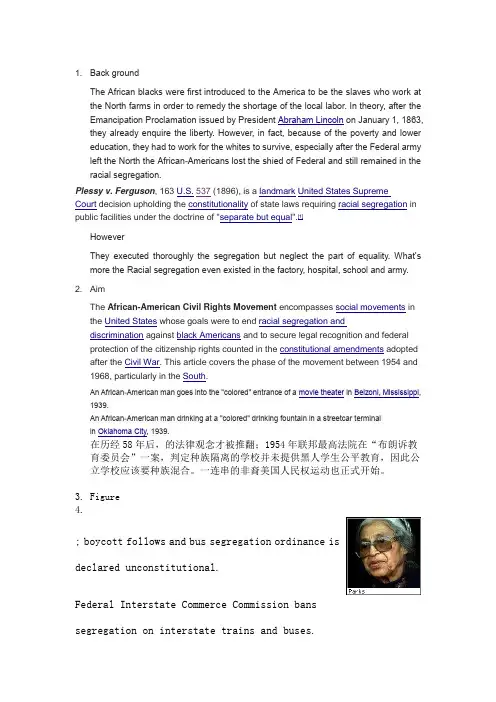
1. Back groundThe African blacks were first introduced to the America to be the slaves who work at the North farms in order to remedy the shortage of the local labor. In theory, after the Emancipation Proclamation issued by President Abraham Lincoln on January 1, 1863, they already enquire the liberty. However, in fact, because of the poverty and lower education, they had to work for the whites to survive, especially after the Federal army left the North the African-Americans lost the shied of Federal and still remained in the racial segregation.Plessy v. Ferguson, 163 U.S.537 (1896), is a landmark United States SupremeCourt decision upholding the constitutionality of state laws requiring racial segregation in public facilities under the doctrine of "separate but equal".[1]HoweverThey executed thoroughly the segregation but neglect the part of equality. What’s more the Racial segregation even existed in the factory, hospital, school and army.2. Aim1939.An African-American man drinking at a "colored" drinking fountain in a streetcar terminal在历经58年后,的法律观念才被推翻;1954年联邦最高法院在“布朗诉教育委员会”一案,判定种族隔离的学校并未提供黑人学生公平教育,因此公立学校应该要种族混合。

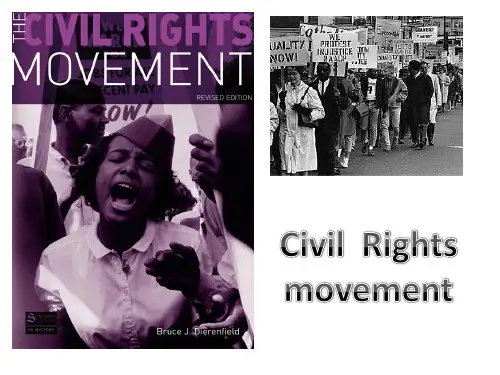
介绍美国民权运动英语作文The civil rights movement in the United States was a pivotal moment in history. It was a time when people from all walks of life came together to fight for equality and justice. It was a time when brave individuals stood up against oppression and discrimination. The civil rights movement was a powerful force for change, and it paved the way for a more inclusive and just society.The leaders of the civil rights movement were courageous and determined. They faced violence, intimidation, and even death, but they never wavered in their commitment to justice. Their actions inspired millions of people to join the fight for civil rights. The civil rights movement was a grassroots movement, driven by ordinary people who were tired of being treated as second-class citizens. It was a movement that brought together people of all races, backgrounds, and beliefs, united in their desire for a better world.The civil rights movement was marked by powerful acts of resistance and protest. From sit-ins to marches to boycotts, people across the country took a stand against injustice. They demanded an end to segregation, discrimination, and violence. They demanded equal rights and equal opportunities for all. The civil rights movement was a loud and clear message to the world that change was coming, and that justice would prevail.The legacy of the civil rights movement is still felt today. It paved the way for landmark legislation such as the Civil Rights Act of 1964 and the Voting Rights Act of 1965. It inspired future generations to continue the fight for justice and equality. The civil rights movement was a turning point in American history, and its impact can still be seen in the ongoing struggle for civil rights and social justice.In conclusion, the civil rights movement was a defining moment in American history. It was a time of courage, determination, and unity. It was a time when people came together to fight for a better future for all. The civilrights movement was a powerful force for change, and its legacy continues to inspire us to this day.。

Civil Rights Movement in the United States, political, legal, and social struggle by black Americans to gain full citizenship rights and to achieve racial equality. The civil rights movement has also been called the Black Freedom Movement, the Negro Revolution, and the Second Reconstruction. The civil rights movement was first and foremost a challenge to segregation, the system of laws and customs separating blacks and whites that whites used to control blacks after slavery was abolished in the 1860s. During the civil rights movement, individuals and civil rights organizations challenged segregation and discrimination with a variety of activities, including protest marches, boycotts, and refusal to abide by segregation laws.Segregation was an attempt by white Southerners to separate the races in every aspects of life and to achieve supremacy over blacks. Segregation was often called the Jim Crow system. Segregation became common in Southern states following the end of Reconstruction in 1877. During Reconstruction, which followed the Civil War (1861-1865), Republican governments in the Southern states were run by blacks, Northerners, and some sympathetic Southerners. The Reconstruction governments had passed laws opening up economic and political opportunities for blacks. By 1877 the Democratic Party had gained control of government in the Southern states, and these Southern Democrats wanted to reverse black advances made during Reconstruction. To that end, they began to pass local and state laws that specified certain places “For Whites Only” and others for “Colored.” Blacks had separate schools, transportation, restaurants, and parks, many of which were poorly funded and inferior to those of whites. Over the next 75 years, Jim Crow signs went up to separate the races in every possible place.Throughout the South, segregation had the support of the legal system and the police. Beyond the law, however, there was always the threat of terrorist violence against blacks who attempted to challenge or even question the established order. During Reconstruction, the Ku Klux Klan (KKK), the Knights of the White Camellia, and other terrorist organizations murdered thousands of blacks and some whites in order to prevent them from voting and participating in public life.The civil rights movement was the struggle for equal rights for blacks in the 1950s. it started with an event called the Montgomery bus boycott.Before 1955, buses in Montgomery, Alabama were segregated. Whites sat in the front of the bus; blacks had to sit in the back. One day Rosa Parks, a black seamstress, was on her way home from work. The bus became crowded, and she was told to give herseat to a white man because this was the law. Rosa Parks refused to give up her seat. She was arrested and fined.Thi s incident angered Montgomery’s black community. It was time to change the law, community leaders decided. And they boycotted the buses. The boycott which was led by Martin Luther King, lasted for over a year. In November 1956 the Supreme Court upheld a federal court decision that ruled the bus segregation unconstitutional. The decision went into effect December 20, 1956, and the black community of Montgomery ended its boycott the next day.In 1957 nine black students desegregated Little Rock, Arkansas’s Ce ntral High School, despite strong resistance by many white members of the community. President Dwight Eisenhower called out federal troops to enforce the desegregation and to ensure the safety of the students. Shown here are six of the “Little Rock Nine.” With them, in the center of the picture, are Thurgood Marshall, then a lawyer for the National Association for the Advancement of Colored People (NAACP) and Daisy Bates, president of the Little Rock NAACP.Civil Rights Movement in the United StatesCivil Rights Movement in the United States, political, legal, and social struggle by black Americans to gain full citizenship rights and to achieve racial equality. The civil rights movement was first and foremost a challenge to segregation, the system of laws and customs separating blacks and whites that whites used to control blacks after slavery was abolished in the 1860s. During the civil rights movement, individuals and civil rights organizations challenged segregation and discrimination with a variety of activities, including protest marches, boycotts, and refusal to abide by segregation laws. Many believe that the movement began with the Montgomery bus boycott in 1955 and ended with the V oting Rights Act of 1965, though there is debate about when it began and whether it has ended yet. The civil rights movement has also been called the Black Freedom Movement, the Negro Revolution, and the Second Reconstruction.Segregation“Whites Only” Waiting RoomA black man is ordered out of a “whites only” waiting room.Separate facilities for blacks and whites were maintained throughout the South from the end of the 19th century until the 1960s.Segregation was an attempt by white Southerners to separate the races in every sphere of life and to achieve supremacy over blacks. Segregation was often called the Jim Crow system, after a minstrel show character from the 1830s who was an old, crippled, black slave who embodied negative stereotypes of blacks. Segregation became common in Southern states following the end of Reconstruction in 1877.During Reconstruction, which followed the Civil War (1861-1865), Republican governments in the Southern states were run by blacks, Northerners, and some sympathetic Southerners. The Reconstruction governments had passed laws opening up economic and political opportunities for blacks. By 1877 the Democratic Party had gained control of government in the Southern states, and these Southern Democrats wanted to reverse black advances made during Reconstruction. To that end, they began to pass local and state laws that specified certain places “For Whites Only” and others for “Colored.” Blacks had separate schools, transportation, restaurants, and parks, many of which were poorly funded and inferior to those of whites. Over the next 75 years, Jim Crow signs went up to separate the races in every possible place. The system of segregation also included the denial of voting rights, known as disfranchisement. Between 1890 and 1910 all Southern states passed laws imposing requirements for voting that were used to prevent blacks from voting, in spite of the 15th Amendment to the Constitution of the United States, which had been designed to protect black voting rights. These requirements included: the ability to read and write, which disqualified the many blacks who had not had access to education; property ownership, something few blacks were able to acquire; and paying a poll tax, which was too great a burden on most Southern blacks, who were very poor. As a final insult, the few blacks who made it over all these hurdles could not vote in the Democratic primaries that chose the candidates because they were open only to whites in most Southern states.Because blacks could not vote, they were virtually powerless to prevent whites from segregating all aspects of Southern life. They could do little to stop discrimination in public accommodations, education, economic opportunities, or housing. The ability to struggle for equality was even undermined by the prevalent Jim Crow signs, which constantly reminded blacks of their inferior status in Southern society. Segregation was an all encompassing system.Conditions for blacks in Northern states were somewhat better, though up to 1910 only about 10 percent of blacks lived in the North, and prior to World War II (1939-1945), very few blacks lived in the West. Blacks were usually free to vote in the North, but there were so few blacks that their voices were barely heard. Segregated facilities were not as common in the North, but blacks were usually denied entrance to the best hotels and restaurants. Schools in New England were usually integrated, but those in the Midwest generally were not. Perhaps the most difficult part of Northern life was the intense economic discrimination against blacks. They had to compete with large numbers of recent European immigrants for job opportunities and almost always lost.Company E, 4th U.S. Colored InfantryBlack soldiers fought in segregated all-black units, such as this one, during the American Civil War (1861-1865). Almost all black soldiers fought for the Union army, and they served in nearly 500 engagements. Twenty-four black soldiers and sailors were awarded the Medal of Honor for bravery, the U.S. military’s highest honor. Segregation and ViolenceKu Klux KlanFormer Confederate soldiers founded the Ku Klux Klan (KKK) after the American Civil War (1861-1865). The KKK used violence and intimidation to prevent blacks from voting and holding office, and to keep them segregated.Throughout the South, segregation had the support of the legal system and the police. Beyond the law, however, there was always the threat of terrorist violence against blacks who attempted to challenge or even question the established order. During Reconstruction, the Ku Klux Klan (KKK), the Knights of the White Camellia, and other terrorist organizations murdered thousands of blacks and some whites in order to prevent them from voting and participating in public life. The KKK was founded in the winter of 1865 to 1866 by a former Confederate general to stop both blacks and Northerners from carrying out their government and social reforms. The Klan and other white terrorist groups directed their violence against black landowners, politicians, and community leaders, as well as whites who supported the Republica n Party or racial equality. During Reconstruction only the presence of the U.S. Army prevented massive killings; however, there were never enough soldiers to stop the violence. For example, in 1876 and 1877 mobs of whites, led by former Confederate generals, killed scores of blacks in South Carolina to prevent them from voting or holding office.School DesegregationDesegregation in Little RockIn 1957 nine black students desegregated Little Rock, Arkansas’s Central High School, despite strong resistance by many white members of the community. President Dwight Eisenhower called out federal troops to enforce the desegregation and to ensure the safety of the students. Shown here are six of the “Little Rock Nine.” With them, in the center of the picture, are Thurgood Marshall, then a lawyer for the National Association for the Advancement of Colored People (NAACP) and Daisy Bates, president of the Little Rock NAACP.In the postwar years, the NAACP's legal strategy for civil rights continued to succeed. Led by Thurgood Marshall, the NAACP Legal Defense Fund challenged and overturned many forms of discrimination, but their main thrust was equal educational opportunities. For example, in Sweat v. Painter (1950), the Supreme Court decided that the University of Texas had to integrate its law school. Marshall and the Defense Fund worked with Southern plaintiffs to challenge the Plessy doctrine directly, arguing in effect that separate was inherently unequal. The U.S. Supreme Court heard arguments on five cases that challenged elementary- and secondary-school segregation, and in May 1954 issued its landmark ruling in Brown v. Board of Education that stated that racially segregated education was unconstitutional. Montgomery Bus BoycottDespite the threats and violence, the struggle quickly moved beyond school desegregation to challenge segregation in other areas. On December 1, 1955, Rosa Parks, a member of the Montgomery, Alabama, branch of the NAACP, was told to give up her seat on a city bus to a white person. When Parks refused to move, she was arrested. The local NAACP, led by Edgar D. Nixon, recognized that the arrest of Parks might rally local blacks to protest segregated buses. Montgomery's blackcommunity had long been angry about their mistreatment on city buses where white drivers were often rude and abusive. The community had previously considered a boycott of the buses, and almost overnight one was organized. The Montgomery bus boycott was an immediate success, with virtually unanimous support from the 50,000 blacks in Montgomery. It lasted for more than a year and dramatized to the American public the determination of blacks in the South to end segregation. In November 1956 the Supreme Court upheld a federal court decision that ruled the bus segregation unconstitutional. The decision went into effect December 20, 1956, and the black community of Montgomery ended its boycott the next day.Rosa ParksIn 1955 Rosa Parks was arrested for disobeying a segregation law in Montgomery, Alabama, that required her to give up her seat on a bus to a white person. Her bold action helped to stimulate protests against inequality. The blacks in the community organized a boycott of the bus system. The boycott, which was led by Martin Luther King, Jr., forced city officials to repeal the discriminatory law.Sit-insSit-Ins in Greensboro, North CarolinaIn 1960 four black college students walked into a Woolworth store in Greensboro, North Carolina, and sat down at the lunch counter, which was for white customers only. The students waited to be served until the store closed for the day. For the next six days, a growing number of students joined the sit-ins until Woolworth closed its doors. Then the students decided to suspend the sit-ins for two weeks to give stores in the community the chance to desegregate.Freedom RidersBurned Bus in Anniston, AlabamaFreedom Riders sit by their bus which had been burned by a white mob in Anniston, Alabama. Several of the riders were beaten by the mob. Freedom Riders began traveling through the South in 1961 to try to desegregate Southern bus stations.Civil Rights March, 1963The national civil rights leadership decided to keep pressure on both the Kennedy administration and the Congress to pass the civil rights legislation proposed by Kennedy by planning a March on Washington for August 1963. It was a conscious revival of A. Philip Randolph's planned 1941 march, which had yielded a commitment to fair employment during World War II. Randolph was there in 1963, along with the leaders of the NAACP, CORE, SCLC, the Urban League, and SNCC. Martin Luther King, Jr., delivered a moving address to an audience of more than 200,000 civil rights supporters. His “I Have a Dream” speech in front of the giant sculpture of the Great Emancipator, Abraham Lincoln, became famous for how it expressed the ideals of the civil rights movement.。