
Chapter 2 sustainability-Shen
- 格式:ppt
- 大小:488.00 KB
- 文档页数:15


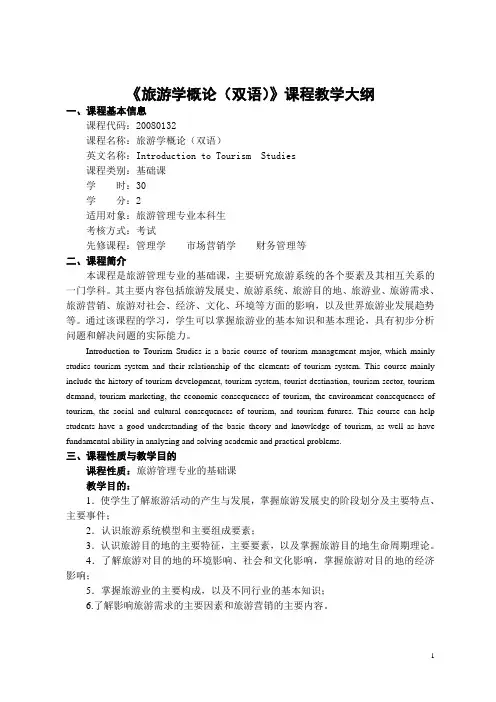
《旅游学概论(双语)》课程教学大纲一、课程基本信息课程代码:20080132课程名称:旅游学概论(双语)英文名称:Introduction to Tourism Studies课程类别:基础课学时:30学分:2适用对象:旅游管理专业本科生考核方式:考试先修课程:管理学市场营销学财务管理等二、课程简介本课程是旅游管理专业的基础课,主要研究旅游系统的各个要素及其相互关系的一门学科。
其主要内容包括旅游发展史、旅游系统、旅游目的地、旅游业、旅游需求、旅游营销、旅游对社会、经济、文化、环境等方面的影响,以及世界旅游业发展趋势等。
通过该课程的学习,学生可以掌握旅游业的基本知识和基本理论,具有初步分析问题和解决问题的实际能力。
Introduction to Tourism Studies is a basic course of tourism management major, which mainly studies tourism system and their relationship of the elements of tourism system. This course mainly include the history of tourism development, tourism system, tourist destination, tourism sector, tourism demand, tourism marketing, the economic consequences of tourism, the environment consequences of tourism, the social and cultural consequences of tourism, and tourism futures. This course can help students have a good understanding of the basic theory and knowledge of tourism, as well as have fundamental ability in analyzing and solving academic and practical problems.三、课程性质与教学目的课程性质:旅游管理专业的基础课教学目的:1.使学生了解旅游活动的产生与发展,掌握旅游发展史的阶段划分及主要特点、主要事件;2.认识旅游系统模型和主要组成要素;3.认识旅游目的地的主要特征,主要要素,以及掌握旅游目的地生命周期理论。

Human Development and Economic Sustainability*SUDHIR ANANDSt.Catherine's College,Oxford,UKandAMARTYA SENTrinity College,Cambridge,UKSummary.ÐThis paper attempts to integrate the concern for human development in the presentwith that in the future.In arguing for sustainable human development,it appeals to the notion ofethical``universalism''Ðan elementary demand for impartiality of claimsÐapplied within andbetween generations.Economic sustainability is often seen as a matter of intergenerational equity,but the speci®cation of what is to be sustained is not always straightforward.The addendumexplores the relationship between distributional equity,sustainable development,optimal growth,and pure time preference.Ó2000Elsevier Science Ltd.All rights reserved.1.FUTURE PROSPECTS AND PRESENTLIVES``It is justice,not charity,that is wanting in the world,''wrote Mary Wollstonecraft,the pioneering feminist,in A Vindication of the Rights of Woman,published in1792,the same year in which her friend Thomas Paine published the second part of the Rights of Man. Both were concerned with giving everyoneÐwomen and menÐpower over their own lives and opportunities to live the way they had reasons to value.One particular feature of their common approach is particularly worth emphasizing in the context of policy discussions today,viz.the implicit``universalism''that characterizes both the approaches.The domain of concern is not arbitrarily restricted to,say, men,or men of a certain class or background. This shared aspect of the original contributors to the human rights approach is of speci®c interest in interpreting the task of``human development''in a world that is marked,on the one hand,by enormous inequities in contem-porary living conditions,and on the other,by real threats to the prospects of human life in the future.Appeals to rights and entitlements that have moved the world forcefully have often tended to ignore the freedoms of particular groups.For example,while ancient Greek philosophers presented some of the most far-reaching ana-lyses of individual independence and auton-omy,they typically did not hesitate to leave out the slavesÐand often women tooÐfrom the discourse.The language and the rhetoric as well as the reality of rights in the contemporary world are often characterized by the neglect of particular sections of the populationÐless privileged ethnic groups,exploited classes, sequestered women.The basic idea of expanding``human capa-bility,''or of``human development,''which has been pursued in di erent forms in recent years, involves the assertion of the unacceptability of such biases and discrimination.1We shall not spend any time here on the issue of whether formalisms used in successive Human Develop-World Development Vol.28,No.12,pp.2029±2049,2000Ó2000Elsevier Science Ltd.All rights reservedPrinted in Great Britain0305-750X/00/$-see front matterPII:S0305-750X(00)00071-1/locate/worlddev*This paper draws on an earlier discussion paper``Sustainable Human Development:Concepts and Prior-ities''prepared by the authors for the United NationsDevelopment Programme(Anand&Sen,1996).Forhelpful conversations and suggestions,we thank SisselaBok,Robert Dorfman,Mahbub ul Haq,Robert Solow,Paul Streeten,and the referees of this journal.Researchsupport from the John D.and Catherine T.MacArthurFoundation is gratefully acknowledged.Final revisionaccepted:5May2000.2029ment Report s do full justice to the idea.But its focus on universalism is something of impor-tance for contemporary debates on public policy.The growing concern with``sustainable development''re¯ects a basic belief that the interests of future generations should receive the same kind of attention that those in the present generation get.2We cannot abuse and plunder our common stock of natural assets and resources leaving the future generations unable to enjoy the oppor-tunities we take for granted today.We cannot use up,or contaminate,our environment as we wish,violating the rights and the interests of the future generations.The demand of ``sustainability''is,in fact,a particular re¯ec-tion of universality of claimsÐapplied to the future generations vis- a-vis us.That universalism also requires that in our anxiety to protect the future generations,we must not overlook the pressing claims of the less privileged today.A universalist approach cannot ignore the deprived people today in trying to prevent deprivation in the future. One of the strongest arguments in favor of giving priority to the protection of the envi-ronment is the ethical need for guaranteeing that future generations would continue to enjoy similar opportunities of leading worthwhile lives that are enjoyed by generations that precede them.This,as we discuss in Section3 of this paper,is the central idea underlying the demand for``sustainable development,''and it has many important implications.But this goal of sustainabilityÐincreasingly recognized to be legitimateÐwould make little sense if the present life opportunities that are to be``sus-tained''in the future were miserable and indi-gent.Sustaining deprivation cannot be our goal,nor should we deny the less privileged today the attention that we bestow on genera-tions in the future.The living standard of a substantial part of humanity has radically moved forward in a way that would have been hard to anticipate in Paine's or Wollstonecraft's time.While it would have been,then,di cult to dispute that human life everywhere was``nasty,brutish and short''(as Thomas Hobbes had put it in Levi-athan),people today in many countries in Europe,North America and elsewhere have lives that are much longer,less miserable,and far less battered by forces beyond the person's control.Yet a great many people in the world continue to su er from the absence of funda-mental opportunities to lead decent and satis-fying lives.The continued high incidence of premature mortality,ill-health,undernourish-ment,illiteracy,poverty,insecurity,and other forms of deprivation indicate the failure of the modern world to bring even the most basic capabilities within the reach of all.A newborn child may be doomed to a life of extreme brevity or intense misery if that child happens to be born in a``wrong class,''in a``wrong country,''or to be of the``wrong sex.'' Ethical universalism is basically an elemen-tary demand for impartialityÐapplied within generations and between them.It is,in the present context,the recognition of a shared claim of all to the basic capability to lead worthwhile lives.Not working toward guaran-teeing the basic capabilities to the future generations would be scandalous,but in the same way,not working toward bringing those elementary capabilities within the reach of the deprived in the present generation would also be outrageous.Given the implicit biases in many policy debates,there is a real need for jealously guarding that universalist perspective. As the full signi®cance of the issues forcefully discussed in the environmental conference (UNCED)in Rio in1992begins to be more fully understood,the integration of human progress and environmental conservation has emerged as one of the central challenges faced by the modern world(Pronk&Haq,1992; Speth,1992;Brundtland,1993).The moral value of sustaining what we now have depends on the quality of what we have,and the entire approach of sustainable development directs us as much toward the present as toward the future.There is,in principle,no basic di culty in broadening the concept of human develop-ment to accommodate the claims of the future generations and the urgency of environmental protection.2.ALTERNATIVE DEVELOPMENTAPPROACHES(a)Human development and wealth The foundational task of scrutinizing the demands of sustainable human development also provides an appropriate occasion to see how the``human development''approach relates to the more conventional analyses to be found in the standard economic literatureÐfrom Adam Smith(1776,1790)onwards. Interest in human development is not new inWORLD DEVELOPMENT 2030economics.Indeed,this motivating concern is explicitly present in the writings of the early founders of quantitative economics(such as William Petty,Gregory King,Francßois Ques-nay,Antoine Lavoisier,and Joseph Lagrange) as well as the pioneers of political economy (such as Adam Smith,David Ricardo,Robert Malthus,Karl Marx,and John Stuart Mill).3 There is,in this sense,no foundational depar-ture in making economic analysis and policy take extensive note of the demands of human development.The approach reclaims an old and established heritage,rather than importing or implanting a new diversion. Economics has never been a subject of one tradition only.The interest in human develop-ment has had to compete with other priorities and pursuits within the same body of main-stream economics.The preoccupation with commodity production,opulence and®nancial success can also be traced in professional economics through several centuriesÐinvolv-ing many leading economists as well as busi-nessmen and bureaucrats,who have preferred to concentrate more on the characteristics of overall material success than on the deprivation and development of human lives.Indeed,the dominant contemporary tradition of focusing on such variables as per capita gross national product or national wealth is a continuationÐperhaps even an intensi®cationÐof the old opulence-oriented approach.The focus on wealth maximization can be taken at di erent levels,and at the common aggregative level,the spotlight is put entirely on making the community as a whole as opulent as possible,irrespective of distribution and irre-spective of what that wealth does to human lives.It is,of course,true that being rich, wealthy and a uent can be among the most important contributory factors in generating well-being,and the opulence-oriented approach to economic progress certainly cannot be criti-cized for being irrelevant to the success of human living.On the other hand,insofar as it neglects other crucial factors,such as public care and social organization,which also contribute to the well-being and freedom of individuals,the approach is deeply limited and defective.4Insofar as the concern is with overall wealth maximizationÐirrespective of distributionÐthere is a serious disregard of individual predicaments in favor of some conglomerative achievement,which can be blind to the most extreme deprivations su ered by many,while others make useÐpossibly excellent useÐof the accomplishment of wealth and opulence.Thus,the fundamental di culty with the approach of wealth maximization and with the tradition of judging success by overall opulence of a society is a deep-seated failure to come to terms with the universalist unbiasedness needed for an adequate understanding of social justice and human development.In this sense,the wealth-based approach is not,by any means, inconsequential,but it certainly is signi®cantly partisan.The most basic problem with the opulence view is its comprehensive failure to take note of the need for impartial concern in looking at the real opportunities individuals have.The exclusive concentration only on incomes at the aggregative or individual levels ignores the plurality of in¯uences that di er-entiate the real opportunities of people,and implicitly assumes away the variationsÐrelated to personal characteristics as well as the social and physical environmentÐin the possibility of converting the means of income into the ends of good and livable lives which people have reason to value.(b)Objectives and instrumentsHow illuminating is the di erence between the two traditions of focusing respectively on(i) development of human capability,or human development,and(ii)overall wealth and opu-lence?These traditions can be seen as di ering, directly or indirectly,in two distinct respects. The®rst concerns divergences in the ultimate objectives,and the second relates to di erences in the e ectiveness of distinct instruments. While the human development approach has conformed broadly to the line of reasoning enunciated by Aristotle more than two millennia ago(``wealth is evidently not the good we are seeking,for it is merely useful and for the sake of something else''),there have been many professional experts who have seen their task as being con®ned to the maximiza-tion of opulence(an old illustration is the17th century monograph by the pioneering mercantilist author,Thomas Mun,England's Treasure by Foreign Trade,or the Balance of Our Foreign Trade is the Rule of Our Treasure). That division about our basic objectives still surfaces in the debates on current policies in di erent parts of the world,and also in discussions about what importance to attach to various indicators and criteria of progress (such as GNP per capita).5HUMAN DEVELOPMENT AND ECONOMIC SUSTAINABILITY2031At the level of objectives,the case for following Aristotle rather than Mun is not hard to appreciate.How can we possibly give priority to the means of living,which is what treasures and wealths are,over the ends of good and free human lives?While much of economic and®nancial writing proceeds as if there is nothing beyond opulence with which we need be concerned,it is fair to see that as a problem of presentation,rather than a re¯ec-tion of some deep-seated eccentricity about ends and means.The really interesting debates must relate to instrumental e ectiveness of overall wealth and opulence in promoting those things for which wealth and opulence are sought.There is,in fact,much more substance in the opulence-centered approach than the implau-sible view that opulence is an end in itself.This takes us to the second di erence,which relates to the cause±e ect relationships in the pursuit of the deeper objectives.Some have taken the view that while opulence is not to be valued at all for its own sake,it still is the most important instrument in promoting the more basic objec-tivesÐeven the Aristotelian one of rich and ful®lling lives.To take a prominent example,W.Arthur Lewis,one of the leading modern development economists,did not entertain much doubt that the appropriate objective to pursue is increas-ing``the range of human choice.''He also acknowledged the causal role of many factors in advancing the freedom to choose.But nevertheless he decided to concentrate speci®-cally on``the growth of output per head,'' because it``gives man greater control over his environment,and thereby increases his free-dom''(Lewis,1955,pp.9±10,420±421).Indeed, the focus of his classic book was su ciently precise to permit him to assert:``Our subject matter is growth,and not distribution.'' Lewis's faith in the instrumental e cacy of total growth has proved to be quite disputable in terms of the experiences observed in the actual world.Many countries have grown fast without a commensurate impact on living conditions,and more importantly,some coun-tries have achieved high quality of life despite relatively moderate growth of GNP or GDP per head.It has also been observed that even when there is a generally positive and statisti-cally signi®cant relationship between GNP per head and indicators of quality of life in the gross intercountry data,much of that rela-tionship turns on the use of extra income in the speci®c®elds of public education and health, and in reducing absolute poverty.It is certainly true that the higher the average income of a country,the more likely it isÐgiven other thingsÐthat it will tend to have a higher average life expectancy,lower infant and child mortality rates,higher literacy,and in fact,a higher value of the``human development index.''A number of recent studies have con®rmed this general pattern.The associa-tions are,however,far from perfect.For example,in intercountry comparisons,income di erences tend to explain not much more than half the variations in life expectancy,or in infant or child mortality,and they explain a smaller proportion of variation in adult literacy rates.6Many countries,such as Sri Lanka, China,Jamaica,Costa Rica,and the state of Kerala in India,have achieved levels of human development that are enormously higher than what would be expected on the basis of their GNP or real income per head.What is also of importanceÐperhaps even more soÐis the route through which growth of GNP most e ectively in¯uences human devel-opment.Economic growth not only involves increase in private incomes,it can also signi®-cantly contribute to generating resources that can be marshalled to improve social services (such as public healthcare,epidemiological protection,basic education,safe drinking water, etc.).In some cases such marshalling is e ec-tively done,while in other cases,the fruits of growth are put to little use of this kind.7This can make a big di erence to the outcome in terms of the expansion of basic human capa-bilities.Similarly,while the expansion of private income certainly is of instrumental importance in enhancing basic capabilities,the e ectiveness of that impact depends much on the distribution of the newly generated incomes.In particular, the biggest impact may be expected to occur if the rise in average GNP per head goes with a sharp reduction in the poverty of the worst-o people,rather than going in other directions.To what extent this will happen depends on a variety of economic and social circumstances related to the labor-intensive nature of tech-niques of production,the sharing of education and skills across the population,the success of land reforms and the sharing of rural resources, and so on.Here again the experiences of di erent countries and of di erent policy regimes have been quite divergent.There is signi®cant evidence that the statis-tical correlation between GNP per head andWORLD DEVELOPMENT 2032human development tends to work through the impact of GNP expansion on higher public expenditure and lower poverty.For example,it is found in Anand and Ravallion(1993)that when life expectancy variations are linked with public health spending per person and an index of poverty,the addition of GNP per person as a further explanatory variable yields a coe cient that is not signi®cantly di erent from zero.8 ThisÐand related results that focus on other characteristics of quality of lifeÐmust not,of course,be interpreted to imply that economic growth does not matter in expanding the quality of life.Rather,what they indicate is that the connections are seriously contingent, and much depends on how the fruits of economic growth are shared(in particular what the poor get)and how far the additional resources are used to support public services (for example,public spending on health servi-ces,which are particularly crucial in in¯uencing life expectancy).Thus the opulence-oriented view of progress, which has little intrinsic merit(as was discussed earlier),has a conditionally important instru-mental roleÐand that conditionality relates speci®cally to features on which the human development approach has tended to focus,to wit,public action and poverty reduction.There is no basic con¯ict between regarding economic growth to be very important,and taking it to be in itself an insu cient basis of human devel-opment.Insofar as growth of GNP or GDP promotes enhancement of living conditions,its biggest impact comes through the expanded ability to undertake public action to promote human development,and the share of the additional income that is enjoyed by the poor. In recognizing the importance of economic growth as a means for human development,we must also take full note of(i)the contingent nature of its e ectiveness as means(depending on the use of the means for promoting human development),and(ii)its nonuniqueness as means(there are other means as well,including social organization).3.THE ENVIRONMENT ANDSUSTAINABLE DEVELOPMENT(a)The environmental challengeThe idea of sustainable development arose essentially from concerns relating to the over-exploitation of natural and environmental resources.Early discussions stressed the limits to economic activity imposed by the physical environment,and concluded that species and ecosystems should be utilized in ways that allow them to go on renewing themselves inde®nitely (IUCN,1980).The anxieties expressed by environmental scientists and ecologists were recognized by policymakers and economists, who attempted to formulate concepts of``sus-tainable development.''An early formulation by Robert Repetto(1985,p.10)was as follows:At the core of the idea of sustainability,then,is the con-cept that current decisions should not damage the pros-pects for maintaining or improving living standards in the future...This implies that our economic systems should be managed so that we live o the dividend of our resources,maintaining and improving the asset base so that the generations that follow will be able to live equally well or better.This principle also has much in common with the ideal concept of income that accountants seek to determine:the greatest amount that can be consumed in the current period without reducing prospects for consumption in the future.As we shall presently argue,this connection between the ideal of sustainable development and the economic accountant's concept of maintaining the income level(discussed,in particular,by Hicks,1946)is an important one to explore.A more recent characterization has been suggested by Robert Solow(1992,p.15):The duty imposed by sustainability is to bequeath to posterity not any particular thingÐwith rare excep-tions such as Yosemite,for exampleÐbut rather to endow them with whatever it takes to achieve a stan-dard of living at least as good as our own and to look after their next generation similarly.We are not to consume humanity's capital,in the broadest sense.In this section and the next,we follow this characterization,but we subject it to critical scrutiny in Section3(c).The term``sustainable development,''in fact, owes its widespread usage to the Brundtland Commission Report(WCED,1987),Our Common Future,which de®ned it as``develop-ment that meets the needs of the present with-out compromising the ability of future generations to meet their own needs.It contains within it two key concepts:Ðthe concept of`needs,'in particular the essential needs of the world's poor,to which overriding priority should be given;andÐthe idea of limitations imposed by the state of technology and social organizationHUMAN DEVELOPMENT AND ECONOMIC SUSTAINABILITY2033on the environment's ability to meet present and future needs''(WCED,1987,p.43). The Brundtland Commission de®nition is often cited and has become very in¯uential.9 As a general statement,it reminds us that sustainability is about an obligation to future generations(toward meeting their``needs''), and thus it is necessarily about intergenera-tional allocation.Unlike some earlier state-ments,it also helpfully shifts attention away from conserving speci®c resources and``leaving the world as we found it''in every particular. The latter would appear to be neither feasible nor necessarily sensible:resources are basically fungible and can be substituted for one another.The Brundtland Commission's notion of sustainable development is indeed broader and invites examination even independently of environmental concerns.Moreover,the obligation of sustainability cannot be left entirely to the market.The future is not adequately represented in the marketÐat least not the distant futureÐand there is no reason that ordinary market behavior will take care of whatever obligation we have to the future.Universalism demands that the state should serve as a trustee for the interests of future ernment policies such as Pigouvian taxes,subsidies,and regulation can adapt the incentive structure in ways that protect the global environment and resource base for people yet to be born.As Pigou(1932, pp.29±30)had noted,there is wide agreement that the State should protect the interests of the future in some degree against the e ects of our irrational discounting and of our prefer-ence for ourselves over our descendants.The whole movement for`conservation'in the United States is based on this conviction.It is the clear duty of Government,which is the trustee for unborn genera-tions as well as for its present citizens,to watch over, and,if need be,by legislative enactment,to defend, the exhaustible natural resources of the country from rash and reckless spoliation.(b)Intergenerational equity and sustainabledevelopmentWhat are our obligations to future genera-tions?Joseph Addison,writing in The Spectator of1714was dismissive of any duty to posterity:Most people are of the humour of an old fellow of a college,who,when he was pressed by the Society to come into something that might redound to the good of their successors,grew very peevish;`We are alwaysdoing,'says he,`something for posterity,but I would fain see posterity do something for us.'10Yet,of course,there is something posterity can do for us:it can inherit less physical and natural capital,and thus allow us to achieveÐthough not out of its choiceÐa higher standard of living at its expense.How much capital should the future inherit from us?This has been the subject matter of optimal growth theory since the pioneering article of Frank Ramsey(1928).The theory has formed the basis of development policy and social cost-bene®t analysis in the less-developed countries.In Section5we present a simple two-period model which captures the central features of intergenerational allocation as seen in this approach.This framework is founded on the essentially utilitarian criterion of maximizing the sum total of welfare of di erent generations.It allows the welfare of one generation to be traded o one-for-one against that of another generation.If the bene®t to us from economic activities which continue to emit greenhouse gases at the present rates outweighs the harm done to future generations from global warming,then the criterion would recommend no change in our activities.Other ethical notions of the total ``good''may allow for di erent tradeo sÐfor example,those that take account of welfare inequality between generations(see Section 5(a)).Yet others may allow no tradeo in certain rangesÐfor example,those based on the``rights''of future generations to the same quality of environment and levels of clean air as the present generation has.This latter view of justice would give priority to speci®c rights that generations have over decisions based on a calculation of aggregate welfare(Rawls,1971; Dworkin,1978;Sen,1982a,b).Within the broadly welfarist framework of optimal growth theoryÐby far the main economic approach used to analyze questions of intergenerational justiceÐit is relevant to enquire whether sustainable development is necessarily a consequence of growth being optimal.If it were,then a(derived)justi®cation for sustainability could be found in maximizing the total good.Let us take sustainable devel-opment to mean nondeclining welfare over timeÐalthough other de®nitions are formu-lated in terms of nondeclining income, consumption,or capital stock.Even though Ramsey(1928)had argued for treating the welfare of di erent generationsWORLD DEVELOPMENT 2034。