
动词的时态和语态-课件
- 格式:ppt
- 大小:879.00 KB
- 文档页数:35


1 / 20
动词的语态及时态
一:动词的语态
1. 被动语态的时态。动词的被动语态由动词be加上过去分词构成,时态通过be表现出来。
①A library with five thousand books is offered to the nation as a gift.
一所藏书五千册的图书馆作为礼物被送与国家。
②The sports meet will be put off because of the bad weather.
因为糟糕的天气运动会将被延期。
③ When the firefighters arrived, the big fire had been put out.
当消防员赶到时,大火已经被扑灭。
2. 短语动词的被动语态。由“动词+副词+介词”构成的三词动词和一些以介词结尾的成语动词变被动语态时要避免遗漏介词。
The book is often referred to. 这本书经常被参考。
3. 不及物动词没有被动语态。例如:appear,arrive , belong, break (开始,突变),come true,die,escape,fall,happen,last,remain,succeed,take place,occur等。
The news quickly spread in the country. 消息很快传遍这个国家。
4. 有些动词尽管是及物动词但也不能变为被动语态。如:have on,agree with,write to,belong
to,have等。
①I quite agree with you.我十分同意你的观点。
②His brother owns a large company. 他的兄弟有家大公司。
5. 有些动词的主动形式表示被动含义。这类动词是一些表示主语的特征、性质的不及物动词。如:sell,wash,wear,shut,open,read,write,cut,end,begin等;连系动词look,feel,taste,smell,sound等,也是用主动形式表示被动意义,但后面要接形容词做表语,不能接副词。

动词的时态和语态
1.现在时表将来
常用在下列从句中。
If, unless, even if 的条件句:
when , before, after, once, until, as soon as, the moment 等引导的时间状语从句。
例:
I’ll not go unless I’m invited.
Tell him the news as soon as he comes.
He said he would go for a holiday when he finished his work.
2.从句中可用现在完成时表示将来完成时, 强调从句动作在主句之前发生。
如:
You can't go out until you have finished you homework.
(先完成作业再出去玩)
3过去时在语境中的运用
在没有明确时间状语的情况下,考生对过去时的判定往往会失误,原因是只凭汉语直译而不看语境。语境中的过去时,往往表示"刚才、刚刚"之意,暗示现在已"不再这样"。如:
I never thought he would do that.
我从没想到他会做这样的事。
4..现在完成时与一般过去时
深刻领会"现在完成时强调对现在造成的影响"这句话的含义。
一般过去时仅仅说明动作在过去,不强调对现在的影响。如:
When have you put the recorder ?
I can’t find it anywhere.
I put it right here ,but now it's gone.
问句用现在完成时,表明说话者在找录音机,希望对方告诉他录音机在哪儿。
而答语用过去时,因为"录音机已经不见了"。
"刚才"把录音机放这儿与"现在不见了"没有直接关系。再如:
He has forgot to post your letter. It's still on.

动词的时态和语态
自学导读单
一.一般现在时
1. 表示现在的情况。 I’m a teacher. I speak Chinese.
2. 表示习惯性,经常性的动作。I often get up at five o’clock.
3. 表示客观真理和客观存在及自然现象。The earth goes round the sun.
4. 用于时间、条件等状语从句中,表示将来意义。
If it doesn’t rain, we’ll go on a picnic as planned
5. 表示按时间表拟定的或安排好的事情,或要发生的动作。The train leaves London at six.
6. 用在以here ,there 开头的倒装句中,表示现在正在发生的动作或存在的状态..
Here comes the bus! There goes the bell.
巩固检测单
1. I _______ all the cooking for my family, but recently I’ve been too busy to do it..
A. will do B. do C. am doing D. had done
2. My parents ________ in Hong Kong. They were born there and have never lived anywhere else.
A. live B. lived C. were living D. will live
3. Chinese married couple ______ red packets to children during the Chinese New Year.
A. give B. have been giving C. are diving D. have given
第7讲 动词的时态和语态
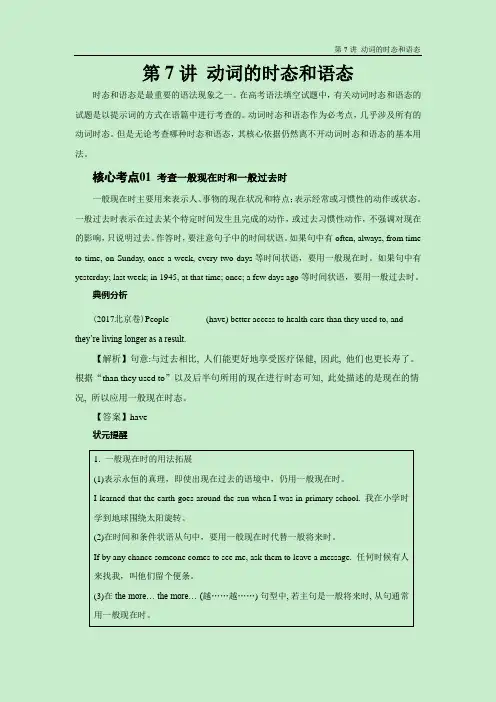
第7讲 动词的时态和语态
时态和语态是最重要的语法现象之一。在高考语法填空试题中,有关动词时态和语态的试题是以提示词的方式在语篇中进行考查的。动词时态和语态作为必考点,几乎涉及所有的动词时态。但是无论考查哪种时态和语态,其核心依据仍然离不开动词时态和语态的基本用法。
核心考点01 考查一般现在时和一般过去时
一般现在时主要用来表示人、事物的现在状况和特点;表示经常或习惯性的动作或状态。一般过去时表示在过去某个特定时间发生且完成的动作,或过去习惯性动作,不强调对现在的影响,只说明过去。作答时,要注意句子中的时间状语。如果句中有often, always, from time
to time, on Sunday, once a week, every two days等时间状语,要用一般现在时。如果句中有yesterday; last week; in 1945, at that time; once; a few days ago等时间状语,要用一般过去时。
典例分析
(2017北京卷)People ________(have) better access to health care than they used to, and
they’re living longer as a result.
【解析】句意:与过去相比, 人们能更好地享受医疗保健, 因此, 他们也更长寿了。根据“than they used to”以及后半句所用的现在进行时态可知, 此处描述的是现在的情况, 所以应用一般现在时态。
【答案】have
状元提醒
1. 一般现在时的用法拓展
(1)表示永恒的真理,即使出现在过去的语境中,仍用一般现在时。
I learned that the earth goes around the sun when I was in primary school. 我在小学时学到地球围绕太阳旋转。