
【最新】牛津译林版七年级英语下册Unit2 NeighboursReading优质课课件.ppt
- 格式:ppt
- 大小:3.12 MB
- 文档页数:26

牛津译林英语七年级英语下册Unit 2 Neighbours 知识点归纳
7B Unit2 知识点解析
一、知识要点
1. Where are you going? 你打算去哪里?
be going此处为“现在进行时表将来”。现在进行时表将来主要用于表示按计划或安排将要发生的动作,常有“意图”“安排”或“打算”的含义。这种现在进行时比较生动,给人一种期待感。go, come, leave等表示位移的动词,都可以用于现在进行时表将来。
例如:He is going. 他要走了。
I’m coming. 我要来了。
Tom is leaving. 汤姆要走了。
2. I’m going to visit our new neighbours.我打算拜访我们的新邻居。
be going to意为“计划,打算”,后接动词原形,用于表将来。
例如:I’m going to wash the car if I have time. 若有时间我想洗洗车。
Where are we going to stay tonight? 我们今晚住哪里?
3. I’m afraid they won’t welcome visitors like you.恐怕他们不会欢迎像你一样的拜访者。
(1)welcome作及物动词,意为“欢迎’’,可与介‘词to连用;也可作形容词,意为“受欢迎的"。如:
Welcome you to our school! 欢迎到我们学校来!
You’re welcome.不用谢。
(2)句中like是介词,意为“像,相似’’,其反义词是unlike;作动词时,意为“喜欢’’,后可接动名词或不定式作宾语。如:
What is Jim like? 吉姆这个人怎么样?
They like playing football on Sunday.他们喜欢在星期天踢足球。
Unit 2 Neighbours Reading (1)
Teaching aims:
1. Understand the knowledge about the centre of a town.
2. Can introduce in English.
Teaching contents:
Words: helpful, community, skill, problem, something, engineer,
check, broken, someone, fix, anyone, college, lucky
Sentences: They help us with all kinds of problems.
There’s something wrong with my computer.
I’m going to ask a computer engineer to check it.
Some college students are ready to help.
Teaching steps:
Step1. Review
T: Where do you live? How many buildings are there in your neighbourhood? How many floors
do they have? When you’re ill, where do you go? ......encourage the students to answer with
their own words.
Step 2. Presentation
1.T: I’m very lucky to have many good neighbours. They have different skills and can do
many different things. They’re also very helpful. When they’re free, they often go to the
Unit 2 Neighbours
Welcome to the unit
新课导入
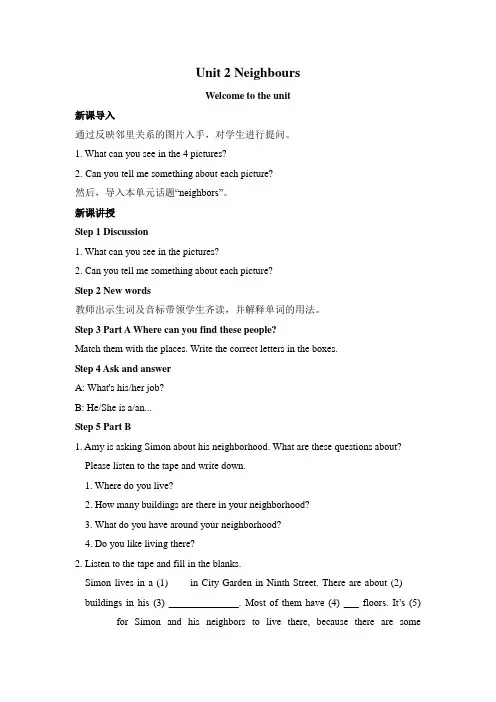
通过反映邻里关系的图片入手,对学生进行提问。
1. What can you see in the 4 pictures?
2. Can you tell me something about each picture?
然后,导入本单元话题“neighbors”。
新课讲授
Step 1 Discussion
1. What can you see in the pictures?
2. Can you tell me something about each picture?
Step 2 New words
教师出示生词及音标带领学生齐读,并解释单词的用法。
Step 3 Part A Where can you find these people?
Match them with the places. Write the correct letters in the boxes.
Step 4 Ask and answer
A: What's his/her job?
B: He/She is a/an...
Step 5 Part B
1. Amy is asking Simon about his neighborhood. What are these questions about?
Please listen to the tape and write down.
1. Where do you live?
2. How many buildings are there in your neighborhood?
3. What do you have around your neighborhood?
4. Do you like living there?
2. Listen to the tape and fill in the blanks.
1 / 2
Unit 2 Neighbours
Lesson 5
【教学目标】
知识目标
能了解朗读时常见的连读方式。
能力目标
能使用正确的连读方式朗读句子。
情感目标
如何在朗读中正确时候用连读。
【教学重难点】
如何在朗读中正确时候用连读。
【教学过程】
Step I 呈现
1.播放一段英美人士说话的片段,让学生听听他们在说什么。
2.学生反复辨听后,给学生提供文本,让他们朗读。启发学生发现两种朗读方式的不同,从而引导出英美人士说话时的连读现象。教师说:We often link sounds together when we speak
English. Can you find out the wayside of linking sounds together?
3.教师呈现图片,引入本课内容。教师说:Look at this picture. What can you see? 学生回答:I can see an apple.
一家三口的图片:Look at the little boy. He’s tom. Who are these two people? They are tom’s
father and mother.
几只狗和一条鱼的图片:Look at the dogs. Do they like eating fish? Of course not. They don’t
like eating fish. So they go away.
4.教师指导学生正确朗读四组短语。启发学生发现连读的规律。阅读示例。
We usually link a consonant sound with a vowel sound.
When the first word with in –r or –re and the next word begins with a vowel sound, we join