
牛津译林版英语七年级下册Unit 2 Neighbours 第一课时 课件
- 格式:pptx
- 大小:10.46 MB
- 文档页数:32

牛津译林英语七年级英语下册Unit 2 Neighbours 知识点归纳
7B Unit2 知识点解析
一、知识要点
1. Where are you going? 你打算去哪里?
be going此处为“现在进行时表将来”。现在进行时表将来主要用于表示按计划或安排将要发生的动作,常有“意图”“安排”或“打算”的含义。这种现在进行时比较生动,给人一种期待感。go, come, leave等表示位移的动词,都可以用于现在进行时表将来。
例如:He is going. 他要走了。
I’m coming. 我要来了。
Tom is leaving. 汤姆要走了。
2. I’m going to visit our new neighbours.我打算拜访我们的新邻居。
be going to意为“计划,打算”,后接动词原形,用于表将来。
例如:I’m going to wash the car if I have time. 若有时间我想洗洗车。
Where are we going to stay tonight? 我们今晚住哪里?
3. I’m afraid they won’t welcome visitors like you.恐怕他们不会欢迎像你一样的拜访者。
(1)welcome作及物动词,意为“欢迎’’,可与介‘词to连用;也可作形容词,意为“受欢迎的"。如:
Welcome you to our school! 欢迎到我们学校来!
You’re welcome.不用谢。
(2)句中like是介词,意为“像,相似’’,其反义词是unlike;作动词时,意为“喜欢’’,后可接动名词或不定式作宾语。如:
What is Jim like? 吉姆这个人怎么样?
They like playing football on Sunday.他们喜欢在星期天踢足球。
Unit 2 Neighbours
Welcome to the unit
新课导入
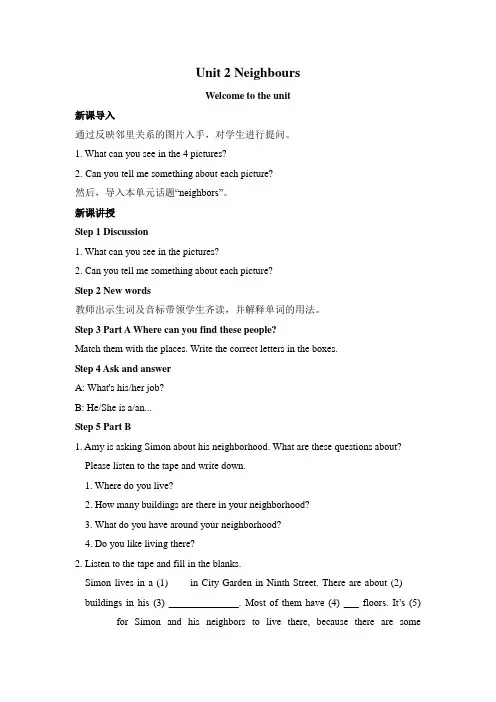
通过反映邻里关系的图片入手,对学生进行提问。
1. What can you see in the 4 pictures?
2. Can you tell me something about each picture?
然后,导入本单元话题“neighbors”。
新课讲授
Step 1 Discussion
1. What can you see in the pictures?
2. Can you tell me something about each picture?
Step 2 New words
教师出示生词及音标带领学生齐读,并解释单词的用法。
Step 3 Part A Where can you find these people?
Match them with the places. Write the correct letters in the boxes.
Step 4 Ask and answer
A: What's his/her job?
B: He/She is a/an...
Step 5 Part B
1. Amy is asking Simon about his neighborhood. What are these questions about?
Please listen to the tape and write down.
1. Where do you live?
2. How many buildings are there in your neighborhood?
3. What do you have around your neighborhood?
4. Do you like living there?
2. Listen to the tape and fill in the blanks.

Unit2 Neighbours
第一课时 Welcome to the unit
新课导入
通过四幅反映邻里关系的图片入手,对学生进行提问。
1. What can you see in the 4 pictures?
2. Can you tell me something about each picture?
然后,导入本单元话题“neighbors”。
新课讲授
过程一:生词教学
教师出示生词及音标带领学生齐读,并解释单词的用法。
过程二:听对话(漫画)一遍,然后回答问题。
(内容见课件)
过程三:听对话(漫画)第二遍,然后完成填空。
(内容见课件)
过程四:课堂讨论,回答下面问题。
1. Where do you live?
2. Do you and your neighbors often help each other?
3. Are there any shops near your home?
过程五:课堂回答,有关职业的问题。
A: What's his/her job?
B: He/She is a/an...
然后介绍生词waiter.
过程六:听对话(B)部分,然后完成填空。
(内容见课件)
过程七:对话操练
(范例见课件)
家庭作业
(内容见课件)
Reading 1
新课导入
通过讨论下面问题导入新课。
1. Where do you live?
2. How many buildings are there in your neighbourhood?
3. What do you have around your neighbourhood?
4. Do you like living there?
5. Do you often help your neighbours?
6. What are your neighbours like?
新课讲授

7B Unit 2 Neighbours Comic strip & Welcome to the unit(第一课时)
问题导学单
【教学目标】
教学目标 1.Master the names of all kinds of jobs and working places.
2.Can talk about their own towns in English.
教学重点 Words and phrases
教学难点 Write sentences about what will do
【温故知新】
根据首字母或中文提示写出单词。
1.I have two new_______(邻居).They are kind.
2. I_______(将)have noodles for supper.
3.A lot of _______(参观者)come to visit our library.
4. I'd like to live in a hotel l_______ this.
5. The man is a w_______ in the restaurant.
【预习导航】
一、找出本课中的生词,猜测词义,并注上音标试着拼读,然后听磁带读会。
二、句型转换。
1.The boy is going to see his father.(改为一般疑问句)
_______ the boy_______ to see his father?
2.Mike is going to call his brother.(同义句转换)
Mike_______ _______ his brother.
3.I am afraid that l will meet the man.(同义句转换)
I am afraid_______ _______ the man.