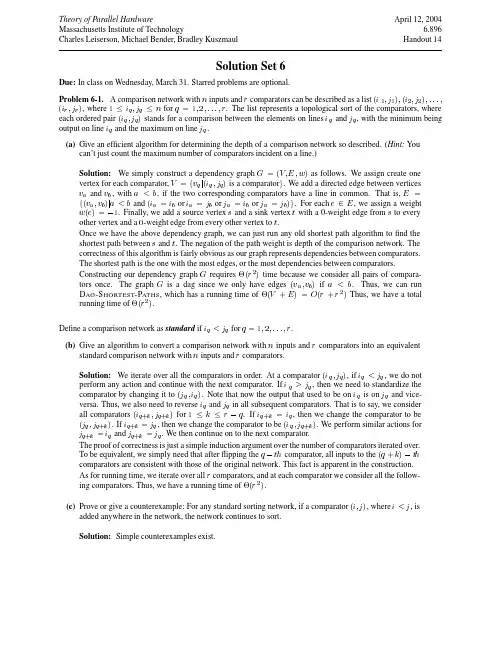
Theory of Parallel Hardware April12,2004 Massachusetts Institute of Technology 6.896 Charles Leiserson,Michael Bender,Bradley Kuszmaul Handout14Solution Set6Due:In class on Wednesday,March31.Starred problems are optional.Problem6-1.A comparison network with inputs and comparators can be described as a list ,where for.The list represents a topological sort of the comparators,where each ordered pair stands for a comparison between the elements on lines and,with the minimum being output on line and the maximum on line.(a)Give an efficient algorithm for determining the depth of a comparison network so described.(Hint:Youcan’t just count the maximum number of comparators incident on a line.)Solution:We simply construct a dependency graph as follows.We assign create onevertex for each comparator,is a comparator.We add a directed edge between vertices and,with,if the two corresponding comparators have a line in common.That is,and or or or.For each,we assign a weight .Finally,we add a source vertex and a sink vertex with a0-weight edge from to every other vertex and a-weight edge from every other vertex to.Once we have the above dependency graph,we can just run any old shortest path algorithm tofind theshortest path between and.The negation of the path weight is depth of the comparison network.Thecorrectness of this algorithm is fairly obvious as our graph represents dependencies between comparators.The shortest path is the one with the most edges,or the most dependencies between comparators.Constructing our dependency graph requires time because we consider all pairs of compara-tors once.The graph is a dag since we only have edges if.Thus,we can runD AG-S HORTEST-P ATHS,which has a running time of Thus,we have a totalrunning time of.Define a comparison network as standard if for.(b)Give an algorithm to convert a comparison network with inputs and comparators into an equivalentstandard comparison network with inputs and comparators.Solution:We iterate over all the comparators in order.At a comparator,if,we do notperform any action and continue with the next comparator.If,then we need to standardize thecomparator by changing it to.Note that now the output that used to be on is on and vice-versa.Thus,we also need to reverse and in all subsequent comparators.That is to say,we considerall comparators for.If,then we change the comparator to be .If,then we change the comparator to be.We perform similar actions forand.We then continue on to the next comparator.The proof of correctness is just a simple induction argument over the number of comparators iterated over.To be equivalent,we simply need that afterflipping the comparator,all inputs to thecomparators are consistent with those of the original network.This fact is apparent in the construction.As for running time,we iterate over all comparators,and at each comparator we consider all the follow-ing comparators.Thus,we have a running time of.(c)Prove or give a counterexample:For any standard sorting network,if a comparator,where,isadded anywhere in the network,the network continues to sort.Solution:Simple counterexamples exist.Problem6-2.A comparison network is a transposition network if each comparator connects adjacent lines.Intu-itively,a transposition network represents the action over time of a linear systolic array making oblivious comparison exchanges between adjacent array elements.(a)Show that if a transposition network with inputs actually sorts,then it has comparators.Solution:For simplicity,let’s consider an even.If the network actually sorts,then it must sort theinput.Each input has to be moved across exactly lines.In a transposition network,each comparator moves two inputs by exactly line.Thus,each input must beinvolved in comparators.Since there are inputs,and each comparator can only move two inputs,we need at least comparators.The same argument works for odd.(b)Prove that a transposition network with inputs is a sorting network if and only if it sorts the sequence.Solution:Consider an input to a transposition network and the state of the networkafter the-th comparator.We denote the data held by line after the-th comparator by.Lemma1Consider the descending input to some-input transposition network.Consider also any other input.For any pairs of lines and with,if ,then.Proof.We use induction over the comparators in order.For a base case,consider the network before any comparators.For any and with,because the input is descending.Thus,we make no claim about any of the.Assume that the claim holds after the-th comparator.Consider the-th comparator.Because wehave a transposition network,we compare two adjacent lines and.We need to show that theclaim holds(for all pairs)of lines after the-th comparator.That is,consider any two lines and with .Suppose that.Then we need to show that.We have several cases:Case1Suppose that and.Note that because of how a comparator works, so.Case2Suppose that,,,and.Then lines and are not involved in the comparator.Thus,.By our inductive assumption,we have,which yields.Case3Suppose that,and.Then we have.By the inductive assumption,and.Thus,.Case4Suppose that,but.Then we have.If,then we have.Thus,we can apply the inductive as-sumption to get and.If instead,then.Thus,the inductive assump-tion gives us.Case5Suppose that but.Similar to case4.Case6Suppose that but.Similar to case3.Problem6-3.Give an algorithm for sorting elements on an mesh in time.Solution:We label each of the processors in the mesh according to coordinates.We sort such that smallest values are stored in the plane containing processors for all.The next smallest values are inthe plane,and so on.The smallest value is in the column,the next smallest are in the column ,and so on.Finally,the smallest value is in.Essentially,we are sorting lexicographically.For any two processors and,if,then the value stored in is less than that in.If but ,then the value stored in is less than that in.Similarly,if,,and,then the value stored in is less than that in.Our algorithm proceeds in several steps:1.Sort the values in every-plane(an-plane is the set of processors,withfixed,).2.Sort the values in every-plane(an-plane is the set of processors,withfixed,).3.Sort the values in every-plane,alternating the order between planes(a-plane is the set of processors withfixed,).4.Do two steps of the1-dimensional odd-even sort on each-row(an-row is the set of processors withfixedand,).5.Sort the values in every-plane.For each of the plane sorts in steps1,2,3,and5,we use the sort we discussed in class,which takes time.Step4only takes2time,so we have a total running time of.Now we need to argue correctness a bit.1We consider only0-1inputs as per the0-1lemma.After step1,on each -plane,the’s are moved towards the smallest value of.Since the values are sorted,there can be at most one dirty-column in each plane.Thus,every-column within a single-plane has(almost)the same number of’s(to within one).In step2,we sort-planes.Thus,we pull one-column from each of the-planes.Since each of the-columns in a given plane has within one the same number of’s,the-planes differ by at most’s.Thus,after we sort the values in each-plane,almost all the-planes are clean.In fact,we can only have two adjacent dirty-planes. More specifically,all the-planes above these two dirty-planes(all-planes with greater values of)contain only’s.Similarly,all the-planes below the two dirty planes contain only’s.In step3,we sort the-planes.In alternating planes,we move the’s towards the smallest values of or the largest values of.Thus,we still have at most two dirty-planes,but now the’s of one of these planes lines up with the ’s of the other.In step4,we try to consolidate the two dirty-planes into one.Suppose that between the two dirty planes are indicated by and.WLOG,suppose that the two planes collectively contain more’s than’s.Then all the’s in plane are below a in plane.Similarly,all the’s in plane are above a in plane.Thus,when we perform two steps of an odd-even sort in the-direction,we create a plane with all’s, leaving only one dirty plane.Going into step5,there is only one dirty plane.Now we can just sort it.1A more detailed proof can be found in Tom Leighton’s book,so it seems silly to try to reproduce one here.。