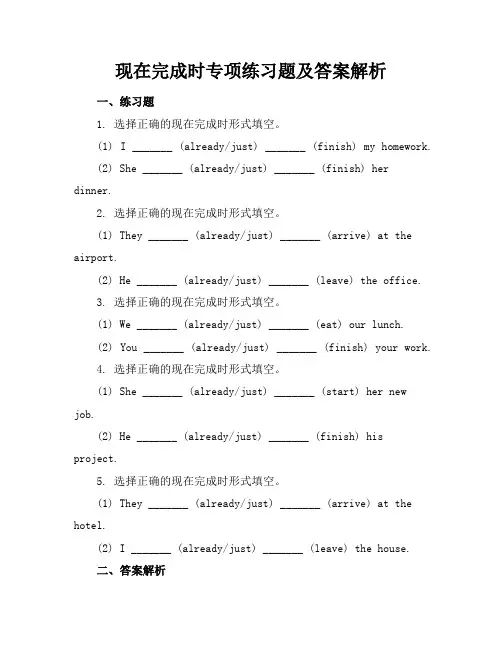
现在完成时练习题及标准答案(老师专用)(1)
- 格式:pdf
- 大小:113.30 KB
- 文档页数:5
现在完成时讲解一.现在完成时结构:
S(主语)+ have/has(单三人称用has)+p.p.(过去分词)+时间状语(for+时间段/ since +时间点/since+从句---用过去时)
1.他已经到达了北京。
2.他还没有到达北京。3.他到达北京了么?4.是的,他到了。/不,他还没到。二.P.P.过去分词1.规则动词的过去式和过去完成时是一致的。2.不规则动词的过去式和过去分词大部分一致,少数要求一一记忆(在过去式记忆清楚的基础上)。写出下列单词的过去式和过去分词watch live change study carry stay cry prefer drop AAA cut put hit AAB beat ABC fly begin write ABB buy lose dream 二.现在完成时的标志already(已经),yet(只用于否定句和疑问句句尾,用在否定句中翻译成“还没”,用在疑问句中翻译成“已经”), just(刚刚), ever(曾经),never(绝不,从不),before(之前),so far(到目前为止),since(自...以来), for+时间段1.我已经刷过牙了。2.我还没吃早饭。3.我刚刚完成了我的家庭作业。4.到目前为止我已经学习2000个单词。5.我之前从没去过北京。三.for/since since: (自…以来) 1)since+时间点1.自从下午5点以来,他就一直呆在这里。2)since+ 时间段+ ago 2.从五个小时以前他就一直呆在这里。3)since+ 从句(从句用过去时)3.她在这教英语自从她来到这里。for+时间段1.)他已经学了五年的英语了。对for或since引导的时间状语提问必须用how long, 决不能用when. 1).I have lived here for six years.(划线提问) 2).He has been in China since he came.(划线提问)四.瞬间动词和延续性动词的转化瞬间动词,也叫终止性动词、点动词、非延续性动词、短暂性动词。这类动词所表示的动作在瞬间就可以完成,不能延续下去,即动作从开始到结束所持续的时间极短。瞬间动词往往表示动作的结果,或表示短暂性、一次性的动作。(arrive, leave, borrow, buy, begin, start, die)在完成时当中瞬间动词不能和表示一段时间的状语连用(不能和since, for, how long 连用)延续性动词表示能够延续的动作。如:study, work, stand, lie,walk, keep, have, wait, watch, sing, read, sleep, live, stay 等等。那如果非要与表示时间段的时间状语连用怎么办?把瞬间动词转换成延续性动词。1.这支钢笔我已经买了五年了。2.Tom 的爷爷已经过世5年了。
3.这场电影已经开始了5分钟。但在否定句中,短暂性动词可以与时间段连用。1)我买这辆自行车还不到一年。
五.have been to /have gone to /have been in 的问题have been to ---曾经去过某地,但是现在不在那里了。常和just,ever,never搭配。
A B 说话时人在A 点I have been to Beijing.
have gone to ---- 到某地去了,不在A点,到没到B 不知道,可能到了,可能在途中,反正不在A点A B ---Where is your father? -----He has gone to Shanghai. have been in ----在某地带了一段时间,后面加时间段B Mr.Chen has been in Suzhou for three months. 陈先生在苏州呆了三个月了。但在否定句中,短暂性动词可以与时间段连用。1.)我买这辆自行车还不到一年。Exercise: I. Fill in the blanks with the proper form. 1. I____ already ____ (see) the film. I ________ (see) it last week. 2. _____ he ____ (finish) his work today? Not yet. 3. My father ____ just ____ (come) back from work. He is tired now. 4. Where’s Li Ming ? He __________ (go) to the teacher’s office. 5. I __________ (work) here since I ______ (move) here in 1999. 6. So far I _______________(make) quite a few friends here. 7. How long ________ the Wangs ______________(stay) here ? For two weeks. 8. I ________ just ___________ (finish) my homework. 9. He ________ (go) to school on foot every day. 10.____ you ______ (find) your science book yet? 11. If it ____ (be) fine tomorrow, I'll go with you. 12. The students ____________ (read) English when the teacher came in. 13. Look! The monkey __________ (climb) the tree. 14. My mother __________ (come) to see me next Sunday. 15. I've lost my pen. _________ you ________ (see) it anywhere? II. Choose the best answer. 1. How long have you _______ here? A. come B. got C. arrived D. been 2. My grandpa died _________. A. at the age of my 2 B. for 2 years C. when I was 2. D. my age was 6. 3. Jane has _____ to BeiJing. She will come back tomorrow. A. been B. gone C. went D. never been 4. It is ten years _____ I last saw her. A. after B. since C. for D. that 5.--Who will go to the station to meet Lorry? --I will. I _____ her several times. A. met B. have met C. had met D. will meet 6. --What a nice dress! How long _____ you _____ it? --Just 2 weeks. A. will, buy B. did, buy C. are, having D. have, had 7.--Do you know Lydia very well? --Yes, She and I _____ friends since we were very young. A. have made B. have become C. have been D. have turned 8. The Smiths _______ in China for 8 years. A. has lived B. lived C. have been D. live 9. --Hello, this is Mr. Green speaking. Can I speak to Mr. Black? -- Sorry. He ______ the Bainiao Park. A. has been to B. has gone to C. went to D. will go to 10. --____ you ever ____ to the US? -- Yes, twice. A. Have, gone B. Have, been C, Do, go D. were, going III. Rewrite the sentences. 1. I have been to Macau before. (改为否定句) I _________ _________ been to Macau before. 2. He hasn’t come to school because he was ill. (就划线部分提问) ______ _______ he come to school? 3. I bough a new bike just now. (用just改写) I ____ just ____ a new bike. 4. We began to learn English three years ago.(改为同义句) We ____ ____English ____three years 5. He has never surfed, _______ _______? (改成反意疑问句)6. They have been here since 2000. (对划线部分提问) _______ _______have they been here? 7. The old man _________ last year. He has _______ _______for a year. (die) (动词填空)8. Miss Gao left an hour ago. (同义句转换) Miss Gao has _______ ________ ________ an hour ago. Ⅳ. Ask the questions 1) I have been there for two days. __________ _________ __________ you __________ __________? 2) My father has lived here since 2000. _________ _________ __________ your father _________ __________? 3) He left here yesterday. _________ ________ he _________ __________? 4) They bought a book two hours ago. __________ ___________ they __________ a book? Ⅴ. Use “never, ever, already, just, yet, for, since” to fill in the blan1. I have _______ seen him before, so I have no idea about him. 2. Jack has _________ finished his homework. 3. Mr. Wang has taught in this school ________ ten years. 4. “Have you ________ seen the film?” “No, I have ________ seen it.5. “Has the bus left _______?” “Yes, it has _________ left.”