
八年级下册英语M1~3汇总
- 格式:ppt
- 大小:2.45 MB
- 文档页数:18


八年级英语下册unit1-3单元知识点八年级英语下册unit1-3单元知识点学好八年级英语每个单元的知识点,对于八年级的学生来说是非常重要的,来归纳一下八年级英语单元知识点吧。
以下是店铺给你推荐的八年级英语下册unit1-3单元知识点归纳,希望对你有帮助! unit1单元知识点:1. 形容词,副词的比较等级考查热点透视:a) 表示A与B在程度上相同时,“as+形容词或副词的原级+as”结构。
表示A不如B时,可用“not as/so+形容词或副词的原级+as”结构。
b) 表示A比B在程度上“更…..”时,可用“形容词或副词的比较级+than”结构c) 表示三者或三者以上的比较,其中一个在程度上“最…..”时,常用“the+形容词或副词的最高级”结构,后面可带“of/in的短语”来说明比较的范围。
(注意:副词的最高级在句中常省略“the”.)d) 在形容词或副词的比较级前,可以用“a little, even, far, much,still”的等词语来修饰,以加强语气。
e) 表示“越来越….”时,常用“形容词或副词的比较级+and+形容词或副词的比较级”结构,但要注意,对于多音节和部分双音节形容词,副词而言,若要表达此意时,要用“more and more+形容词或副词的原级“结构。
f) 在表示“其中最….之一“的含义时,常使用“one of+the+形容词最高级形式+名词复数”结构,其中的定冠词the不可以省略。
g) 如果强调“两者中比较…的(一个)”的意思时,可使用“the+形容词比较级+其它”结构。
h) 表示“越….越….”, 可使用“the+形容词或副词的比较级,the+形容词或副词的比较级”结构。
2 .一般将来时a) 一般将来时的构成:由助动词shall或will加动词原形构成,shall用于第一人称。
在口语中,will在名词或代词后常简略为’ll,will not常简略为won’t。
unit2单元知识点:1..loud是形容词,loud-louder-loudest意思是“响亮的”;作副词时,常与talk, sing, laugh 等词连用,如speak loud; loudly “大声地”带有喧闹的意味,常用来修饰shout, cry, call, knock等动词,通常没有比较级和最高级,作状语;aloud 副词,出声地,大声地,仅指发出声音(以使能被听得见)。
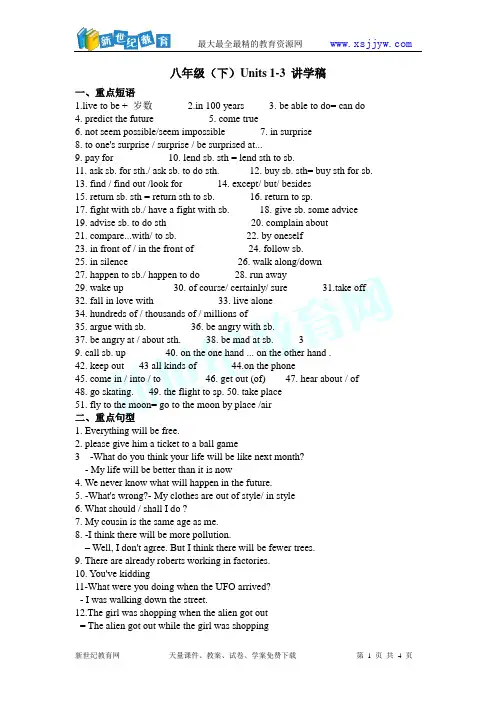
八年级(下)Units 1-3 讲学稿一、重点短语1.live to be + 岁数2.in 100 years3. be able to do= can do4. predict the future5. come true6. not seem possible/seem impossible7. in surprise8. to one's surprise / surprise / be surprised at...9. pay for 10. lend sb. sth = lend sth to sb.11. ask sb. for sth./ ask sb. to do sth. 12. buy sb. sth= buy sth for sb.13. find / find out /look for 14. except/ but/ besides15. return sb. sth = return sth to sb. 16. return to sp.17. fight with sb./ have a fight with sb. 18. give sb. some advice 19. advise sb. to do sth 20. complain about21. compare...with/ to sb. 22. by oneself23. in front of / in the front of 24. follow sb.25. in silence 26. walk along/down27. happen to sb./ happen to do 28. run away29. wake up 30. of course/ certainly/ sure 31.take off 32. fall in love with 33. live alone34. hundreds of / thousands of / millions of35. argue with sb. 36. be angry with sb.37. be angry at / about sth. 38. be mad at sb. 39. call sb. up 40. on the one hand ... on the other hand .42. keep out 43 all kinds of 44.on the phone45. come in / into / to 46. get out (of) 47. hear about / of 48. go skating. 49. the flight to sp. 50. take place51. fly to the moon= go to the moon by place /air二、重点句型1. Everything will be free.2. please give him a ticket to a ball game3 -What do you think your life will be like next month?- My life will be better than it is now4. We never know what will happen in the future.5. -What's wrong?- My clothes are out of style/ in style6. What should / shall I do ?7. My cousin is the same age as me.8. -I think there will be more pollution.– Well, I don't agree. But I think there will be fewer trees.9. There are already roberts working in factories.10. You've kidding11-What were you doing when the UFO arrived?- I was walking down the street.12.The girl was shopping when the alien got out= The alien got out while the girl was shopping13. These children may find it hard to think for themselves when they are older14. They take their children from activity to activity and try to fit as much as possible into their lives.三、重点单词probably interview company ticketfail include imagine fly-flew-flownfall-fell-fallen feel-felt-felt write-wrote-writtenteach-taught-taught catch-caught-caught buy-bought-boughtbring -brought-brought think-thought-thought say-said-saidlay-laid-laid pay-paid-paid tell-told-toldsell-sold-sold take-took-taken make-made-madefight-fought-fought take-took-taken hear-heard-heard四。

UNIT 1I. 重点短语1. talk about health problems谈论健康问题2. give advice 提建议3. have a fever 发烧4. have a cough 咳嗽5. have a (bad) cold 患(重)感冒6. have a toothache 牙疼7. have a sore throat 患嗓子疼8. talk too much 说得太多9. drink enough water 喝足够的水10. have a stomachache 胃疼11. have a sore back 背疼12. lie down and rest 躺下来休息13. drink hot tea with honey 喝加蜂蜜的热茶14. see a dentist 看牙医15. get an X-ray 拍X光片16. take one’ s temperature 量体温17. put some medicine on the cut 在伤口上面敷药18. cut oneself 割伤某人自己19. feel very hot 感到很热20. have a headache 患头疼21. sound like 听起来像22. all weekend 整个周末23. in the same way 以同样的方式24. take breaks 休息25. go to a doctor 看医生26. save an old man 拯救一位老人27. go along 沿着……走28. on the side of the road 在马路边29. shout for help 大声呼救30. without thinking twice 没有多想31. get off 下车32. have a heart problem 有心脏病33. to one’ s surprise 使某人惊讶34. thanks to 多亏了;由于35. in time 及时36. save a life 挽救生命37. hit an old man 撞了一位老人38. get into trouble 惹麻烦39. right away 立刻;马上40. because of+n.\\pron. 由于……41. get out of 从……出来42. hurt oneself 受伤43. fall down 摔倒44. put a bandage on sth. 用绷带包扎……45. run it under water 在水流下冲洗46. feel sick 感到恶心47. have a nosebleed 流鼻血48. cut his knee 割伤他的膝盖49. put your head back 把你的头向后仰50. hurt his back 伤到了后背51. rest for a few days 休息几天52. get hit on the head 头部挨打53. have problems breathing 呼吸困难54. get hit by a ball 被球击中55. get sunburned 晒伤56. mountain climbing 登山运动57. as a mountain climber 作为一名登山者58. be used to doing sth. 习惯做某事59. be used to taking risks 习惯于冒险60. run out (of) 用完;用尽61. so that 以便62. so. . . that 如此……以至于…63. be in control of 掌管;管理64. in a difficult situation 在困境中65. lose one’s life 丧命66. cut off half his right arm 切除半边右臂67. bandage himself 给他自己包扎68. keep on doing sth. 继续或坚持做某事69. the importance of ……的重要性70. make a decision 做出决定71. take risks 冒险72. give up 放弃73. have a serious accident 遇到严重的意外74. go mountain climbing 去爬山75. hurt his back playing volleyball 打排球时伤后背二、重点句型1. What’ s the matter (with you)?= What’s the trouble(with you)?= What’ s wrong with you?你怎么了?2. I have a stomachache. 我肚子疼。

八年级下册英语第一到三单元笔记全文共6篇示例,供读者参考篇1Here are some study notes on Units 1-3 of an 8th grade English textbook, written in a style suitable for elementary school students. The total word count is around 2,000 words.Unit 1: Our Colorful WorldIn this unit, we learned about colors and how they are used in different cultures and countries. Did you know that in some places, certain colors are seen as good luck? Like in China, red is a lucky color! We also read about artists who use a lot of bold, bright colors in their artwork.One of the texts was about a famous artist named Frida Kahlo. She was from Mexico and her paintings had so many beautiful colors like blues, greens, reds, and yellows. Frida loved the bright colors and patterns from Mexican culture. A fun activity was recreating one of her self-portraits by coloring it with crayons or paints.We practiced describing colors using adjectives like "vibrant," "dull," "pale," and "rich." My favorite new word was "kaleidoscope" which means a toy that shows colorful, changing patterns when you look through it. Doesn't that sound amazing?There was also a crazy tongue-twister about colored creatures! "Purple prairie prairie dogs dug up purple prairie dog houses." Try saying that five times fast without messing up!Unit 2: Animal WondersThis unit was all about incredible animals from around the world. We read descriptions of animals with strange appearances or super cool abilities. Like the glass frog whose belly issee-through so you can see its organs! Or the mimic octopus that can change shapes to look like different sea creatures.My favorite was learning about ways animals adapt to survive in harsh environments. For example, camels can go a whole month without drinking water thanks to their humped back that stores fat. And emperor penguins incubate their eggs by balancing them on their feet and covering them with a flap of skin to protect them from Antarctic blizzards!We wrote fun compare and contrast paragraphs describing two different creatures. I compared a fast cheetah to a slow sloth.Using transition words like "however," "in contrast," and "on the other hand" made my writing much clearer.There were also listening exercises where we had to identify the featured animal just from hearing its cry or call. The orca whale's eerie sounds sent chills down my spine!Unit 3: Earth ExplorersFor this unit, we pretended to be brave explorers venturing across our planet's incredible landscapes and landforms. We learned vocabulary for different enviornments like "rainforest," "desert," "glacier," "volcano" and more. Then we read first-hand accounts of what it's like to actually visit those places.One chapter was about a family who went on a camping trip deep in the Amazon rainforest. They described the dense green jungle, heard the screeches of exotic birds, and even spotted camouflaged jaguars! Another tale was about mountain climbers who struggled up a steep icy glacier in Nepal. They used special spiked boots and ropes to conquer the slippery terrain. Those explorers are so brave!My favorite activity was designing our own "Exploration Survival Pack" filled with essential gear and supplies. I made sureto pack things like a water filter, rope, flares, and freeze-dried food pouches. You can never be too prepared for adventure!We wrapped up by giving persuasive speeches to convince people to visit a certain natural landmark. Using descriptive words, I was able to paint a picture of the Grand Canyon's majestic red-rock formations and make everyone wish they could see it in person.Those are the highlights from my English notes so far this semester! Learning about our fascinating world through stories and activities has been an amazing adventure. I can't wait to see what other thrilling topics we'll explore next.篇2Here are some English study notes on Units 1-3 of the 8th grade second semester English textbook, written from a middle school student's perspective (around 2000 words):English Study Notes - 8th Grade, Second SemesterUnit 1 - My AmbitionsThis unit was all about talking about our future hopes and dreams. We learned some really useful vocabulary like ambition,aspire, pursue, and accomplished. I thought it was cool getting to discuss what careers we might want when we're older.Some new grammar we covered:Going to for future plans (I'm going to be a doctor.)Will for predictions (He will make a great lawyer.)Present continuous for future arrangements (They're visiting colleges next month.)There were some reading passages about famous people like Serena Williams and their ambitions when young. I enjoyed the conversation practice talking about our own ambitions too.Unit 2 - The Internet WorldWow, this unit on the internet and technology was super interesting! We picked up lots of great vocab like website, download, username, password, and so on. Learning about internet safety was important too.New grammar from this unit:Present perfect (I have downloaded that app.)Present perfect vs. simple past (I've used that program. I used it yesterday.)Quantifiers like some, any, no (Are there any new updates?)The discussions on things like online gaming, social media, and cyber bullying were really relevant. My favorite was the group project making our own website designs!Unit 3 - Environmental ProtectionThis unit packed a serious message about taking care of our planet. Lots of new words like conservation, renewable, global warming, and carbon footprint. It opened my eyes to environmental issues.Grammar highlights included:Modals like should, must, have to (We should recycle more.) Passive voice (Forests are being destroyed.)Expressing obligation and prohibition (You mustn't litter.)The readings on topics like air pollution, vanishing rainforests, and ocean plastic were kind of scary but veryeye-opening. I liked the fun recycling contest we did as a class too.Overall, these three units gave me useful language for discussing my future, technology, and environmental protection. The projects like the website design and recycling contest weremy favorite parts. My English skills have really improved thanks to the variety of activities we did. Onward to the next units!篇3Here are English notes for Units 1-3 of the 8th grade second semester English textbook, written from the perspective of a middle school student in around 2000 words:Unit 1 - Saving the EnvironmentThis unit was all about how we can protect the environment and fight pollution and climate change. We learned a ton of new eco-friendly vocabulary like "recycle", "reuse", "reduce waste", "carbon footprint", and "sustainable living".The readings talked about really scary stuff like the hole in the ozone layer, deforestation, endangered species, and rising sea levels. It made me realize how much damage humans have done to the planet through littering, burning fossil fuels, and just being wasteful in general.But it also gave me hope that we can turn things around if we make some changes to our daily habits. Simple things like turning off lights, taking shorter showers, walking or bikinginstead of driving, and using reusable bags or bottles can add up to make a big difference.My favorite part was the group project where we had to come up with an idea for an environmental campaign or initiative at our school. My group decided to start a recycling competition between homerooms to see who could collect the most cans, bottles and paper over one month. The winners got to pick a local park or green space to do a cleanup day. It was a lot of work but really rewarding!Unit 2 - Modern MarvelsThis unit focused on incredible engineering feats and modern technological innovations that have changed our world. We read about giant construction projects like the Panama Canal, Golden Gate Bridge, and China's high-speed rail network.Some of the vocab was pretty tricky like "causeway", "suspension bridge", "aqueduct", and "reinforced concrete". But seeing all the pictures and diagrams of how these massive structures were designed and built was fascinating.We also learned about cutting-edge tech breakthroughs in fields like renewable energy, space exploration, medical science, artificial intelligence, and more. Mind-blowing stuff like bioniclimbs, self-driving cars, reusable rockets, and CRISPR gene editing.For the unit project, we had to research one modern marvel of our choice and put together a presentation explaining how it works and its impact on society. I did mine on the Large Hadron Collider at CERN. It was intense but I geeked out learning all about particle physics and the search for the Higgs boson!Unit 3 - Cultural TraditionsThis unit was a fun deep dive into different cultures around the world and how they celebrate their histories and identities through festivals, holidays, music, art, food, and more.We learned new words for cultural concepts like "heritage", "indigenous", "ritual", "artisan", and "oral tradition". The readings exposed us to cool celebrations and customs like Spain's La Tomatina, Mexico's Día de los Muertos, the Holi festival of colors in India, and the intricate tradition of Aboriginal didgeridoo making.My favorite activity was the in-class cultural fair, where each student set up a booth showcasing a different country or ethnic group. We brought in traditional dress, music, decorations, andfood to share with our classmates. I represented Japan and made origami cranes to hand out.For the final project, we had to write a short story or comic incorporating at least three distinct cultural traditions or elements from societies we studied. I blended Mongolian throat singing, Brazilian capoeira, and Ethiopian coffee ceremonies into an cool adventure tale. Getting creative really helped solidify everything I'd learned.Overall these three units opened my eyes to the wider world in different ways - environmentalism, technological progress, and appreciation for cultural diversity. Lots to process but I feel like a became a bit of a global citizen!篇4Here are English notes for Units 1-3 of the 8th grade second semester English textbook, written in a style suitable for elementary school students, approximately 2000 words long:English Notes for 8th Grade Units 1-3Unit 1: Festivals Around the WorldFestivals are cool! People celebrate them in different ways in different countries. Some festivals are about religion, some are about seasons changing, and some are just for fun.One awesome festival is Diwali in India. It's the Festival of Lights! People decorate their homes with lots of lamps and lights. They make rangoli patterns on the floor using colored powders or sand. Rangoli designs are so pretty! People also eat delicious sweets during Diwali.Another fun festival is Lunar New Year in China and other Asian countries. Families get together and have a big meal with lucky foods like dumplings and noodles. Kids get red envelopes with money inside as gifts! There are also dragon and lion dances with bright, colorful costumes.Way down in Brazil, they have a wild festival called Carnaval! It happens right before Lent. People dance in the streets wearing crazy costumes and masks. There are huge parade floats covered in feathers, sequins and lights. The music and energy look amazing!No matter what festival it is, people celebrate by eating yummy food, wearing fun costumes, and being with family and friends. Festivals bring people together!Unit 2: Extreme SportsSome sports are not for the faint of heart! These crazy extreme sports will get your heart pumping for sure. From skiing down huge mountains to swinging through the jungle, extreme athletes love an adrenaline rush!One intense extreme sport is free solo rock climbing. Climbers scale huge rock faces without any ropes or safety gear, just using their hands and feet! Alex Honnold is a famous free solo climber who has conquered massive cliffs like El Capitan in Yosemite. His skills are insane but it looks terrifying!Kitesurfing or kiteboarding is another wild one. Riders have a board attached to their feet and use a big kite to pull them across water at high speeds! They can do crazy jumps and flips in the air. If the wind dies down, they'll crash right into the water. Ouch!Maybe the craziest extreme sport is BASE jumping - that stands for building, antenna, span and earth. Jumpers parachute off super tall objects like cliffs, skyscrapers or bridges! They freefall for just a few seconds before pulling their parachute. One small mistake and it could be a total disaster. Yikes!While these sports seem nuts, the athletes train really hard and know what they're doing. As fun as they look, maybe it's best to get your thrills on a safe rollercoaster instead!Unit 3: Our Changing PlanetOur beautiful planet Earth is always changing and shifting. Some changes happen quickly while others take place over millions of years. Learning about these changes can help us understand the world better.One major change is the movement of tectonic plates deep inside the Earth. These giant rocky plates very slowly ram into each other, pulling apart or sliding past one another. This motion, just a few inches per year, causes earthquakes, volcanoes and even creates mountains and oceans over time.The Earth's surface is also changing from erosion by wind and water. Rivers and streams carve valleys and canyons. Wind picks up sand and rocks and wears down surfaces. Coastlines shift as waves crash and reshape the land. Even raindrops can slowly eat away at rocks over long periods of time.The climate and weather patterns around the globe are shifting too. Ice caps and glaciers are melting, sea levels are rising, and we're seeing more extreme weather events likehurricanes, droughts and heatwaves. Scientists think human activities that release greenhouse gases are a big factor in these climate changes.While some of Earth's changes can be dangerous or destructive, many also create amazing scenic wonders. Change can be good! It's the endless cycles and processes that shape our dynamic planet.篇5Here are some notes on Units 1-3 of the 8th grade English textbook, written in English from the perspective of a middle school student, around 2000 words long:Units 1-3 NotesHey there! It's me again, ready to share my thoughts on the first few units of our 8th grade English textbook. Get ready for a rollercoaster ride of new words, grammar rules, and exciting stories!Unit 1: FriendshipsThis unit was all about the importance of friends and how to be a good friend. We learned a bunch of new vocabulary wordslike "loyalty," "considerate," and "trustworthy." I never knew there were so many words to describe what makes a great friend!One of the reading passages was about two best friends who had a misunderstanding and stopped talking to each other. It made me realize how valuable true friends are and that we should always try to work things out instead of letting silly arguments come between us.The grammar focus was on using relative clauses to give more details about people or things. Like, "My best friend, who loves playing basketball, is always there for me." Kinda confusing at first, but I think I've got the hang of it now.Unit 2: Outdoor AdventuresThis unit was a real adventure! We learned all about different outdoor activities like camping, hiking, and rock climbing. Some of the new words we studied were "gear," "terrain," and "navigate." I never knew there were so many fancy words for outdoorsy stuff!My favorite part was reading the story about a group of kids who got lost on a hiking trip. It was super suspenseful, and I was on the edge of my seat wondering if they'd find their way back! I also loved the descriptions of the beautiful natural scenery.Grammar-wise, we focused on using adverbs to modify verbs and adjectives. Like, "The hikers walked slowly through the densely forested area." Adverbs really help paint a clearer picture in your mind.Unit 3: Inventions and DiscoveriesThis unit was all about cool inventions and discoveries that have changed the world. We learned words like "innovative," "groundbreaking," and "revolutionary." I was blown away by how many amazing things humans have come up with over the years!One of the reading passages was about the invention of the printing press and how it made books more accessible to everyone. It was fascinating to learn about how one invention could have such a huge impact on the spread of knowledge.For grammar, we practiced using the passive voice to talk about things being acted upon. Like, "The first printing press was invented by Johannes Gutenberg." It's a different way of structuring sentences, but I can see how it's useful for putting the focus on the action rather than who did it.Overall, these first few units have been a blast! I've learned so many new words, cool grammar rules, and interesting stories.English class is definitely keeping me on my toes, but I'm loving the challenge. Bring on the rest of the year!篇6Here are some notes on Units 1-3 of the 8th grade English textbook, written in the voice of an elementary school student in about 2000 words:English Class Notes - 8th Grade Units 1-3Unit 1 - My Daily RoutineThis unit was all about talking about our daily schedules and routines. It had lots of new vocab words like "wake up", "get dressed", "have breakfast", and time words like "in the morning", "at night", etc.We learned how to use simple present tense verbs to describe habits and routines. Like "I wake up at 7 AM" or "She brushes her teeth after dinner." Using time expressions with these was important too.There were dialogues where people asked "What time do you get up?" and you had to respond with your wake up time. We also wrote paragraphs describing our typical day from when we wake up to when we go to bed.The grammar was pretty straightforward but there were some irregular verbs to watch out for, like "wake up" instead of "wake". Overall it was a good review of present tense after learning it way back in earlier grades.Unit 2 - Heroes and Role ModelsThis unit was my favorite because it was all about cool heroes and people to look up to. We read stories about firefighters, scientists, athletes, and other inspiring people.There was lots of new vocabulary for describing personalities and characteristics. Words like "brave", "determined", "intelligent", "role model". We had to pick a role model and write about why we admire them using these descriptive words.The grammar focused on using "be" verbs in present and past tense. So sentences like "He is a brave firefighter" and "She was an amazing scientist who discovered a cure for that disease."Towards the end we looked at modals like "can", "should", "have to" and how to use them correctly. Like "Teachers should be good role models" or "I have to study hard to become a scientist like Marie Curie."We also did fun activities where we drew portraits of our role models and wrote descriptive captions using the vocabulary andgrammar from the unit. I enjoyed learning about extraordinary people.Unit 3 - Let's Explore NatureOkay, this unit was about nature, animals, plants, and exploring the outdoors. We learned tons of nature words like "forest", "waterfall", "species", "extinct", and names of different plants and animals.The readings were really interesting, like articles about amazing places in nature, protecting endangered animals, and environmental problems like pollution and deforestation.There were dialogues where people talked about their camping and hiking experiences. We had to write our own too, like "Last summer, I went camping in the mountains. I saw a bear and it was scary!" Using past tense was key here.The grammar focused on comparing things using comparatives and superlatives. Like "That waterfall is taller than this one" or "The blue whale is the largest animal on Earth." We had to put adjectives in the right form.There were also "if...then" conditional sentences about nature. Like "If we recycle, then we can save trees" or "If animals' habitats are destroyed, then they will become endangered."At the end we did a fun project making posters about endangered animals using everything we learned in the unit. Some people's posters were so creative!Those are my notes on the first three units of eighth grade English. We covered a lot of useful grammar and vocabulary for daily life, describing people, and nature/animals. Can't wait to see what the next units are about!。