
新概念英语第二册第6课 完整
- 格式:ppt
- 大小:1.88 MB
- 文档页数:33
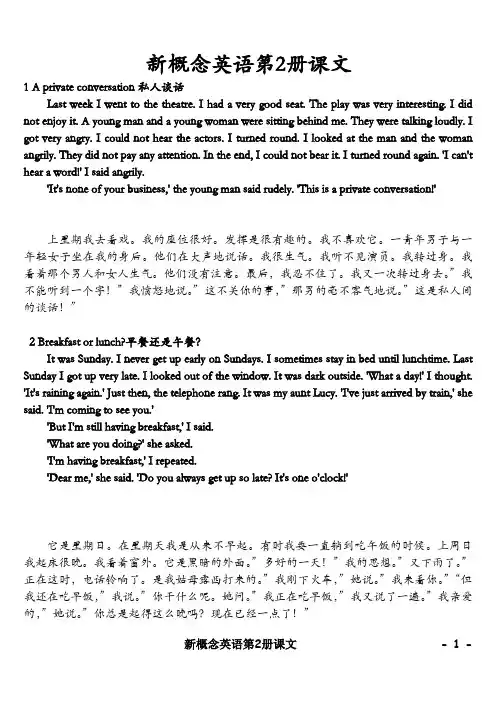
新概念英语第2册课文- 1 -新概念英语第2册课文1 A private conversation私人谈话Last week I went to the theatre. I had a very good seat. The play was very interesting. I did not enjoy it. A young man and a young woman were sitting behind me. They were talking loudly. I got very angry. I could not hear the actors. I turned round. I looked at the man and the woman angrily. They did not pay any attention. In the end, I could not bear it. I turned round again. 'I can't hear a word!' I said angrily. 'It's none of your business,' the young man said rudely. 'This is a private conversation!'上星期我去看戏。我的座位很好。发挥是很有趣的。我不喜欢它。一青年男子与一年轻女子坐在我的身后。他们在大声地说话。我很生气。我听不见演员。我转过身。我看着那个男人和女人生气。他们没有注意。最后,我忍不住了。我又一次转过身去。”我不能听到一个字!”我愤怒地说。”这不关你的事,”那男的毫不客气地说。”这是私人间的谈话!” 2 Breakfast or lunch?早餐还是午餐?It was Sunday. I never get up early on Sundays. I sometimes stay in bed until lunchtime. Last Sunday I got up very late. I looked out of the window. It was dark outside. 'What a day!' I thought. 'It's raining again.' Just then, the telephone rang. It was my aunt Lucy. 'I've just arrived by train,' she said. 'I'm coming to see you.' 'But I'm still having breakfast,' I said. 'What are you doing?' she asked. 'I'm having breakfast,' I repeated. 'Dear me,' she said. 'Do you always get up so late? It's one o'clock!'它是星期日。在星期天我是从来不早起。有时我要一直躺到吃午饭的时候。上周日我起床很晚。我看着窗外。它是黑暗的外面。”多好的一天!”我的思想。”又下雨了。”正在这时,电话铃响了。是我姑母露西打来的。”我刚下火车,”她说。”我来看你。”“但我还在吃早饭,”我说。”你干什么呢。她问。”我正在吃早饭,”我又说了一遍。”我亲爱的,”她说。”你总是起得这么晚吗?现在已经一点了!”
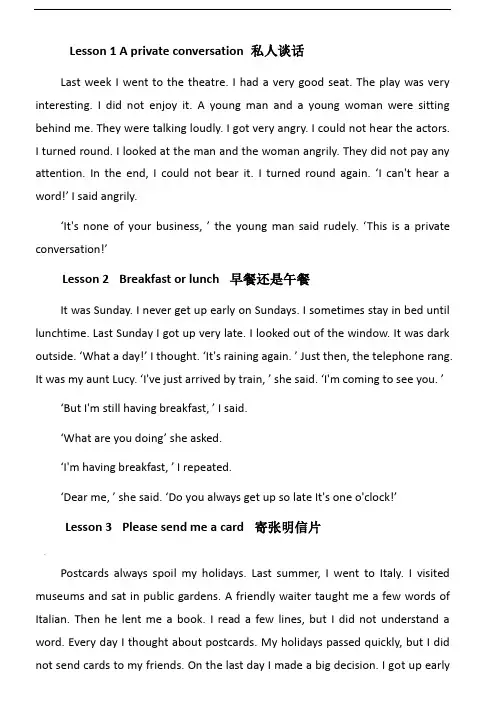
Lesson 1 A private conversation 私人谈话
Last week I went to the theatre. I had a very good seat. The play was very
interesting. I did not enjoy it. A young man and a young woman were sitting
behind me. They were talking loudly. I got very angry. I could not hear the actors.
I turned round. I looked at the man and the woman angrily. They did not pay any
attention. In the end, I could not bear it. I turned round again. ‘I can't hear a
word!’ I said angrily.
‘It's none of your business, ’ the young man said rudely. ‘This is a private
conversation!’
Lesson 2 Breakfast or lunch 早餐还是午餐
It was Sunday. I never get up early on Sundays. I sometimes stay in bed until
lunchtime. Last Sunday I got up very late. I looked out of the window. It was dark
outside. ‘What a day!’ I thought. ‘It's raining again. ’ Just then, the telephone rang.
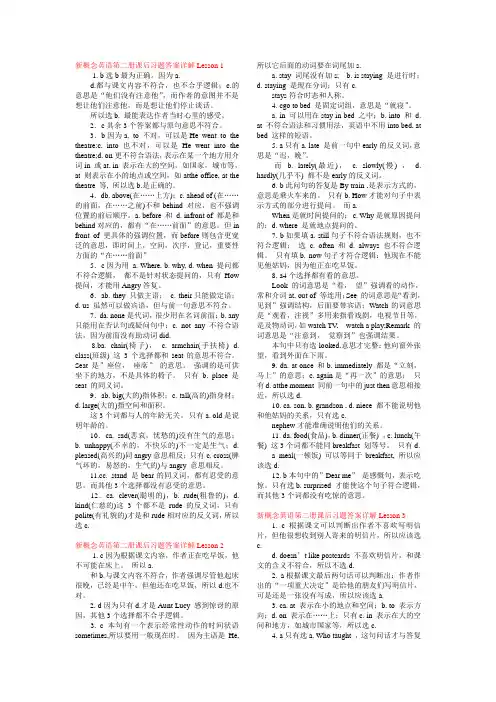
新概念英语第二册课后习题答案详解Lesson 1
1. b选b最为正确。因为a.
d.都与课文内容不符合,也不合乎逻辑;c.的意思是“他们没有注意他”,而作者的意图并不是想让他们注意他,而是想让他们停止谈话。
所以选b. 最能表达作者当时心里的感受。
2.c其余3个答案都与原句意思不符合。
3.b因为a. to 不对,可以是He went to the
theatre;c. into 也不对,可以是He went into the
theatre;d. on更不符合语法,表示在某一个地方用介词in 或at, in 表示在大的空间,如国家,城市等,at 则表示在小的地点或空间,如atthe office, at the
theatre 等, 所以选b.是正确的。
4.db. above(在……上方);c. ahead of (在……的前面,在……之前)不和behind 对应,也不强调位置的前后顺序。a. before 和 d. infront of 都是和behind对应的,都有“在……前面”的意思。但in
front of 更具体的强调位置,而before则包含更宽泛的意思,即时间上,空间,次序,登记,重要性
方面的“在……前面”
5.c因为用 a. Where, b. why, d. when 提问都不符合逻辑, 都不是针对状态提问的,只有How提问,才能用Angry答复。
6.ab. they 只做主语; c. their只能做定语;d. us 虽然可以做宾语,但与前一句意思不符合。
7.da. none是代词,很少用在名词前面;b. any
只能用在否认句或疑问句中;c. not any 不符合语法,因为前面没有助动词did.
8.ba. chair(椅子), c. armchair(手扶椅) d.
class(班级) 这3个选择都和seat的意思不符合。

新概念英语第二册复习笔记 第六课 课文讲解
move v./n.
1) 移动,改变位置
move a chair nearer to the fire 把椅子移近这堆火
2) 搬家,迁居
move from…to… 从……搬到……
move to a new house 搬进新房子
eg. He couldn’t pay his rent, so he had to move out. 他付不起房租,所以他不得不搬出。
3) 使人动心而(流泪,微笑等)
eg. Her story moved us to tears. 她的故事令我们感动得流泪。
eg. We were greatly moved by his performance of the piano concerto.
我们为他的钢琴协奏曲的演奏而感动不已。
4) 提议
eg. I moved for the suspension of further discussion. 我提议延缓进一步讨论问题。
(suspension n. 暂停,延缓)
5) (事情)进行,进展
eg. It is necessary to move on the problem soon. 立刻着手解决这个问题是很有必要的。
move about ,move around 四处走动
move away 搬家
move up 晋升
move out 迁出,搬出去
move over 挪开些
6) n. 下棋的一步棋
eg. It’s your move. 轮到你下棋了。
7) n. 手段,措施
make a move 采取行动
on the move 在进展中,在移动中
get a move on 催促前进
return
1) n. 回报,作为报答
in return for 回报
eg. I bought him a present in return for his help. 我为他买了一份礼物,作为他帮忙的回报。