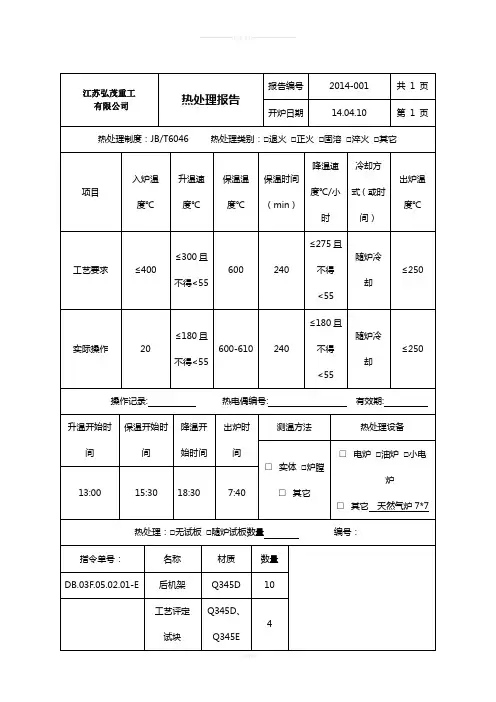
热处理报告英文模板
- 格式:doc
- 大小:12.12 KB
- 文档页数:6
热处理报告英文模板
Abstract
This report presents the findings of a heat treatment
conducted on a specimen made of [mention the material]. The
purpose of the heat treatment was to improve the mechanical
properties of the material through controlled heating and cooling
processes. The specimen was subjected to various heat treatment
methods, including annealing, tempering, and quenching. The
effects of these methods on the microstructure and mechanical
properties of the material were evaluated. The results indicate that
the heat treatment significantly influenced the hardness, strength,
and ductility of the material.
Introduction
Heat treatment is a crucial process in the manufacturing of
materials, as it can alter their microstructure and subsequently
improve their mechanical properties. The objective of this heat
treatment report is to analyze the effects of different heat
treatment methods on the material's microstructure and mechanical properties. This knowledge will enable engineers and
manufacturers to determine the appropriate heat treatment
processes for achieving desired material properties.
Experimental Procedures
1. Specimen Preparation: A specimen made of [mention the
material] was prepared using standard machining techniques. The
specimen was in the form of a [mention the shape and
dimensions].
2. Annealing: The first heat treatment method applied to the
specimen was annealing. The specimen was heated in a furnace at
a temperature of [mention the temperature] for [mention the
duration]. Subsequently, it was cooled slowly inside the furnace to
room temperature. The purpose of annealing was to relieve internal
stresses and recrystallize the material.
3. Tempering: The second heat treatment method performed
on the specimen was tempering. After annealing, the specimen was
heated to a temperature of [mention the temperature] for [mention
the duration] in the furnace. It was then cooled using forced air. Tempering aimed to improve the material's strength and toughness
by reducing its hardness.
4. Quenching: The final heat treatment method applied to the
specimen was quenching. The specimen was heated in the furnace
to a temperature of [mention the temperature] for [mention the
duration]. It was promptly immersed in a quenching medium, such
as water or oil, to rapidly cool it down. Quenching aimed to
increase the material's hardness and strength.
5. Microstructural Analysis: After each heat treatment method,
the specimen was subjected to metallographic preparation. It was
ground, polished, and etched using appropriate reagents. The
microstructure of the specimen was then examined under an
optical microscope to observe any changes induced by the heat
treatment methods.
6. Mechanical Testing: The mechanical properties of the
heat-treated specimen were evaluated using hardness testing and
tensile testing. Hardness testing was conducted using a [mention
the type of hardness tester] according to [mention the hardness testing standard]. Tensile testing was performed using a universal
testing machine following [mention the tensile testing standard].
The results obtained from these tests were compared with those of
the untreated specimen.
Results and Discussion
The microstructural analysis revealed clear differences in the
specimen's microstructure after each heat treatment process.
- Annealing: The annealed specimen displayed a refined grain
structure, indicating the recrystallization process. The grains
appeared more uniform and exhibited less deformation compared
to the untreated specimen.
- Tempering: The tempered specimen exhibited a slightly
coarser grain structure than the annealed specimen. The hardness
of the material decreased, indicating improved toughness and
reduced brittleness.
- Quenching: The quenched specimen exhibited a martensitic
microstructure, characterized by a fine needle-like pattern. The
material's hardness increased significantly, indicating enhanced strength and hardness.
The mechanical testing results further supported the
microstructural observations:
- Annealing: The annealed specimen exhibited improved
ductility, as evidenced by higher elongation at fracture during
tensile testing. However, the hardness remained relatively
unchanged.
- Tempering: The tempered specimen showed a slight decrease
in hardness compared to the annealed specimen. However, it
displayed improved toughness, as indicated by increased
elongation at fracture.
- Quenching: The quenched specimen exhibited a significant
increase in hardness and strength. However, its ductility decreased,
as evidenced by reduced elongation at fracture.