英文电子邮件的常用语
- 格式:docx
- 大小:37.31 KB
- 文档页数:3
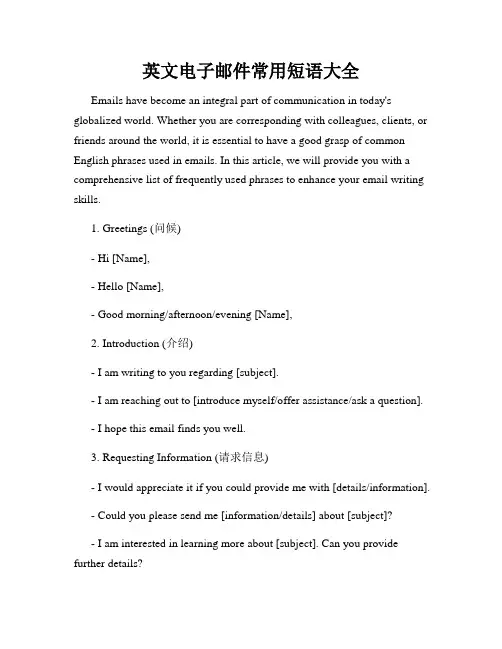
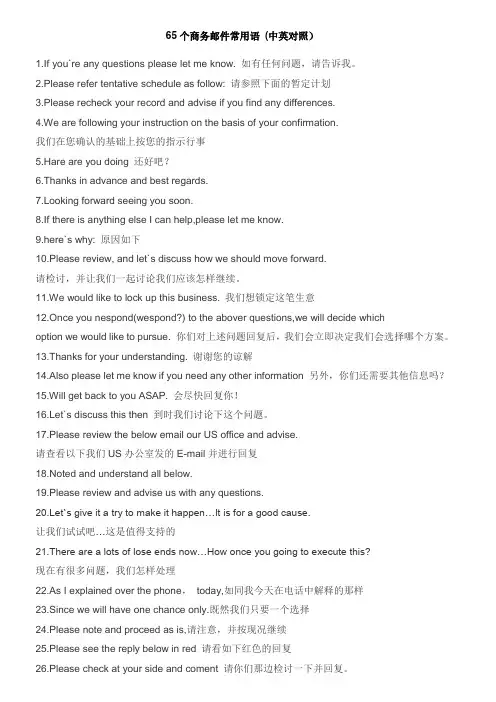
英文电子邮件的常用语
Email is an essential communication tool in today's business world.
Whether you are conducting business with international partners or simply
reaching out to colleagues in the same office, being able to compose
effective and professional emails is crucial. In this article, we will explore
some commonly used phrases in English emails, along with tips on how to
structure and format your messages.
Opening Greetings and Introductions:
1. Dear [Recipient's Name],
2. Hello [Recipient's Name],
3. Hi [Recipient's Name],
These are simple and appropriate greetings to start your email. Choose
one that suits your level of formality and your relationship with the recipient.
Opening Remarks and Purpose:
1. I hope this email finds you well.
2. I am writing to inquire about/ask for information regarding...
3. I am reaching out to discuss...
Introduce the purpose of your email clearly and concisely. Use polite
language to convey your intentions and maintain a professional tone
throughout.
Providing and Requesting Information: 1. I would appreciate if you could...
2. Could you please send me...
3. Please let me know if...
Use these phrases to express your needs or make requests politely.
Remember to be direct and specific in your message to avoid confusion.
Offering Assistance or Help:
1. If you need any further assistance, feel free to contact me.
2. I am here to help if you have any questions.
3. Please do not hesitate to reach out if you require any additional
information.
Including these phrases demonstrates your willingness to provide
support and builds a positive rapport with the recipient.
Apologies and Thank You:
1. I apologize for any inconvenience caused.
2. Thank you for your prompt response.
3. I appreciate your attention to this matter.
Expressing gratitude or apologizing, when necessary, shows respect and
professionalism. Use these phrases sincerely to maintain a friendly and
cooperative tone.
Closing Remarks and Farewell: 1. Thank you for your time and consideration.
2. I look forward to hearing from you soon.
3. Best regards,
End your email with a courteous closing remark. It helps to leave a
positive impression and shows your professionalism.
Formatting Tips:
1. Use a clear and concise subject line that summarizes the content of
your email.
2. Keep paragraphs short and well-organized to improve readability.
3. Utilize bullet points or numbered lists to present information in a
structured manner.
4. Proofread your email before sending to ensure there are no
grammatical or spelling errors.
By following these tips and incorporating the commonly used phrases
mentioned above, you will be able to compose effective and professional
English emails. Mastering email communication is a valuable skill that will
enhance your professional relationships and contribute to your overall
success in the business world.