
第二章 翻译的过程
- 格式:ppt
- 大小:134.50 KB
- 文档页数:31

1
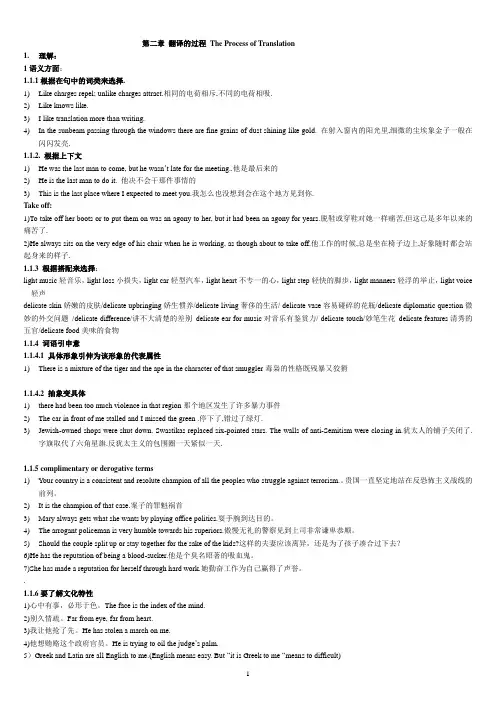
第二章 翻译的过程 The Process of Translation
1. 理解:
1语义方面:
1.1.1根据在句中的词类来选择.
1) Like charges repel; unlike charges attract.相同的电荷相斥,不同的电荷相吸.
2) Like knows like.
3) I like translation more than writing.
4) In the sunbeam passing through the windows there are fine grains of dust shining like gold. 在射入窗内的阳光里,细微的尘埃象金子一般在闪闪发亮.
1.1.2. 根据上下文
1) He was the last man to come, but he wasn’t late for the meeting..他是最后来的
2) He is the last man to do it. 他决不会干那件事情的
3) This is the last place where I expected to meet you.我怎么也没想到会在这个地方见到你.
Take off:
1)To take off her boots or to put them on was an agony to her, but it had been an agony for years.脱鞋或穿鞋对她一样痛苦,但这已是多年以来的痛苦了.
2)He always sits on the very edge of his chair when he is working, as though about to take off.他工作的时候,总是坐在椅子边上,好象随时都会站起身来的样子.
1.1.3 根据搭配来选择:
light music轻音乐,light loss小损失,light car轻型汽车,light heart不专一的心,light step轻快的脚步,light manners轻浮的举止,light voice轻声

第二章 翻译的过程
翻译的过程可以分为三个步骤: (1) 阅读并分析原文 (analysis of the source text), (2) 将原文转换成译入语(transfer from source to target language)(3) 对译文进行修订 (revision)
2.1 阅读并分析原文
把握原文的意图:原文的意图指原作者对有关题材或内容的立场或态度。作者可能会慷慨激昂,淋漓尽致地倾诉自己的立场观点,也可能采取比较隐晦的手段,在字里行间透出某种微妙的信息。
一、语法结构阐释原文的意图。 例如:
a. Police Shoot Rioting Blacks
b. Rioting Blacks Shot by Police
c. Rioting Blacks Shot
形式对意义的表达在诗歌中的作用。 例如:
40-LOVE
Roger McGough
Middle aged
couple playing
ten- nis
when the
game ends
and they
go home
the net
will still
be be-
tween them
许渊冲的译文:
四十岁的爱情
中 年
夫 妇
打 网
球 打
完 后
回 家
走 球
网 依
旧 把
人 分
左 右
二、语义分析( semantic analysis ): 即说明处在一定语境中,按照一定次序排列的词项或句项之间的语义关系,探索词项、句项的意义。 “ 我们所翻译的不是某些言词,而是看不见、听不到的东西,即意义本身。 ” ( William Hans of The Theory of Translation )
首先,分析词的概念意义( conceptual meaning ) 和关联意义( associative meaning ) 例如:

第二章练习(翻译的标准和过程)Exercise 1: Translate the following sentences
1. I read his letter with both surprise and excitement, surprise because
he is still alive, excitement because he didn’t even forget me.
2. I gave my youth to the sea and I came home and gave my wife my old
age.
3. The president stands there, hat in hand, begging the Congress for
their votes.
4. After a sleepless night, during which Joe smoked a whole pack of
cigarettes, his eyes were blood-shot, and his breath smelled of tobacco.
5. 我的导师是亚裔人,嗜烟好酒,脾气暴躁。
6. 加拿大地广人稀,国土面积比中国还大,人口却不足3000万。
Exercises 2 Improve the following translation
1.I will teach him to deceive others. 我要教他去欺骗别人。2. This thesis leaves much to be desired. 这篇文章有很多地方让人喜欢。3. A measure of calm gave signs of returning after the flood subsided. 洪水退了以后,恢复了平静的标志。4. “It’s a gloomy thing, however, to talk about one’s own past, with the day
第二章 翻译的基本概念
1.翻译的定义
• 宋僧法云《翻译名义集》:“夫翻译者,谓翻梵天之语转成汉地之言。音虽似别,义则大同。”(我国给翻译下定义第一人)
近代:
• 语言文字角度:韦氏新大学词典
To turn into one’s own language or another language
• 意义角度:牛津高阶词典
Give the meaning of (sth. Said or written) in another language
• 内容与形式角度:前苏联语言学派翻译理论家费达罗夫
翻译是一种语言将另一种语言在内容与形式不可分割统一中业已表达出来了的东西准确而完全地表达出来
• 信息角度:信息论20世纪中叶创立后奈达
从语义到文体,在译语中用最切近而又自然的对等语再现原语的信息,信息的内涵是多方面的,包括意义,思想内容,感情,修辞,文体,风格,文化及其形式。
• 思想或思维角度:张培基
用一种语言将另一种语言所表达的思想内容准确而整体地重新表达出来的语言活动。
• 文化角度:王克非
翻译是译者将一种语言文字所蕴含的意思用另一种语言文字表达出来的文化活动。
• 宏观角度:奈达早年明确提出“翻译是科学”后又认为“翻译是艺术”
对翻译定义的总结
• 作为术语使用的翻译:
翻译研究(包括理论应用,宏观微观,描述性规约性研究)
翻译产品(方式----归化异化杂合化,种类,评判标准---
作者?译者?读者?中心)
翻译行为(外部环境----权力,意识形态,文化;内部因素----原作者,译者,读者,文本)
• 以前的翻译定义过于狭窄,未涉及对翻译行为的界定。
• 翻译的新定义:
以原文和原文作者的意图为起点,受译文读者需求,译者翻译目的,译入语文化所制约的语言转换。(严格意义,内向型,大部分)