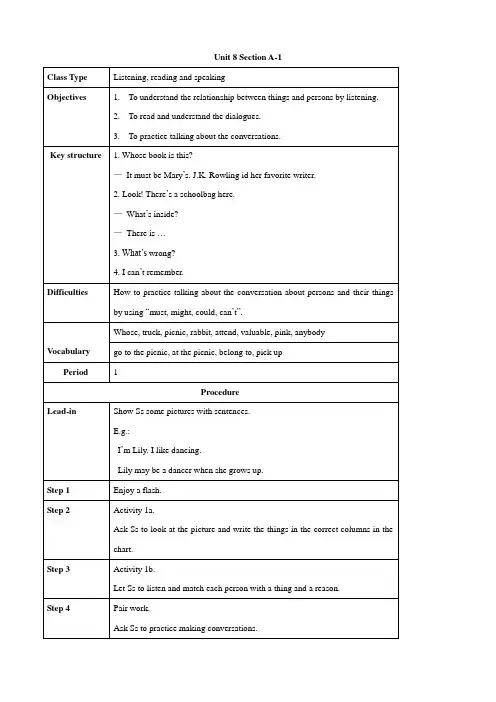
Unit8-It-must-belong-to-Carla.-教学设计教学准备1. 教学目标1.Knowledge Objects(1) Key Vocabulary:belong, belong to, plate. author, toy, picnic(2) Target Language:Whose book is this?It must be Mary\'s. Wanda Wilbur is her favorite author.2.Ability Objects(1) Train students\' listening skill.(2) Train students\' communicative competence using the target language.3.Moral ObjectsWhen you are on a picnic, remember to bring litter back to keep our environment clean and tidy.2. 教学重点/难点Teaching Key Points1.Key vocabulary2.Target languageTeaching Difficult Points1.Listen for the target language2.Oral practice using the target language3. 教学用具4. 标签教学过程The First PeriodStep Ⅰ RevisionCheck homework. Invite different studentsto say the answers to the exercises on pages 12~14 of the workbook.Step Ⅱ 1aThis activity introduces the keyvocabulary.Write the key vocabulary words on theblackboard.Ask different students to explain in theirown words the meanings of the words belong to, author and picnic.Belong means to be owned by somebody. Anauthor is a writer of a book or a play.A picnic is a meal eaten out of doors.Then invite two students to draw a plate next to the word plate and a toy carnext to toy.Focus attention on the picture. Havestudents point to each item and say its name. Call students attention to thechart with the headlines clothing. Fun things and kitchen things at the top.Invite different students to explain the meanings of the column heads.Show the correct answers on the screen bya projector.Step Ⅲ 1bThis activity gives students practice inunderstanding the target language in spoken conversation.Point out the sample answer. Say, The nameCarla in the first column connects to volleyball in the second column becausethat's the thing they are talking about. And the word volleyball in the secondcolumn connects with the sentence she loves volleyball in the third column.Play the recording the first time.Students only listen. Play the recording again. This time students listen andmatch each person with a thing and a reason.Step Ⅳ 1cThis activity provides oral practice usingthe target language.Point to the picture in Activity 1b.Invite a pair of students to say the conversation in the speech bubbles.Point out the conversation in the box.Invite another pair of students to say it to the class. Write the conversationon the blackboard.Point out the chart in Activity 1 b. Say.Now work with a partner. Start by reading the conversations in the picture andin the box. Then make conversations using the information in the chart inActivity 1b. Talk about who each thing might belong to and give a reason. Getstudents to practice in pairs. As they work, move around the classroomlistening in on various pairs and offering help with language and pronunciationas needed.After all the students have had anopportunity to ask and answer questions, stop the activity. Get different pairsof students to say their conversations to the class.Step Ⅴ SummarySay, In this class, we've learned the keyvocabulary words belong to, plate, author, toy and picnic and done muchlistening and oral practice using the target language.Step Ⅵ Homework(1) Say and remember the spelling of thevocabulary words.(2) Say the conversations in Activity 1c to get a further understandingof the target language. Step Ⅰ RevisionRevise the conversations in 1b. Getdifferent pairs of students to talk about who each thing might belong to andgive a reason.Step Ⅱ 2aThis activity provides listening practiceusing the target language. Using a hair band, teach students to practice thewords hair band. Point to the numbered list with blank lines after each number.Play the recording the first time.Students only listen. Play the recording a second time. Students write thecorrect words in each blank.Check the answers:1.T-shirt 2.hair band 3.tennis ballsStep Ⅲ 2bThis activity provides listening andwriting practice using the target language.Call students' attention to the chart.Point to the numbered list of sentences which contain a blank. Read thesentences to the class saying blank when coming to a write-on line.Play the recording. Students listen andfill in the blanks.Point to the box that contains theexplanations of how to use the words must, might, could and can't. Read theexplanations to the class.Step Ⅳ 2cThis activity provides writing practiceusing vocabulary introduced in the unit. Read the instructions to the class.Point to the list of sentences that contain a blank. Say, Please fill in theblanks with the words from this unit. Some answers will vary. Elicit the firstanswer from the class (The notebook must/might be Ming's. It was on her desk) .Get students to complete the task on theirown. As students work, move around the classroom answering any questions theymay have and offering help as needed. Check the answers.Step Ⅴ Grammar FocusAsk students to say the questions andanswers in pairs. At the same time, write them on the blackboard.Invite a student to underline the wordsmust, could, might and can't and then write them in a list on the blackboard.Repeat the process with the words might,could and can't.Ask all but four students to put theirheads down on their desks. Meanwhile, collect one item each from the fourstudents.Repeat the process with the other items.Step Ⅵ SummarySay, In this class, we've done somelistening and writing practice using the target language. And we've learned howto make inferences using the words must, might, could and can't.Step Ⅶ HomeworkMake two sentences each using the wordsmust, could, might and can't.Step Ⅰ RevisionRevise the usage of the words must,might, could and can't by checking homework.Ask students to exchange their exercisesbooks and help correct any errors with each other. As they are doing this, movearound the classroom offering language support as needed. Then invite differentstudents to say their sentences to the class.Step Ⅱ 3aThis activity provides reading practiceusing the target language.Call students' attention to the picture.Ask students to tell what's happening inthe picture.Get students to complete the task on theirown. Point out the sample answer. Say. The first sentence of the e-mail messageis I'm really anxious, because I can't find my backpack. Check the answers: 5,2,4,3,1circled words might includeanxious, symphony hall, algebra,optometrist appointment, crucial, count, dropStep Ⅲ 3bThis activity provides oral practice usingthe target language.Read the instructions to the class. Pointto the sample conversation. Invite a pair of students to say it to the class.Write the conversation on the blackboard.Practice the pronunciation of these wordsand explain the meaning of each word.Step Ⅳ Part 4This activity provides oral practice usingthe target language.Call students' attention to the picture.Get students to name each item in it. Write the new words Chinese-Englishdictionary and Oxford University on the blackboard. Point to the sampleconversation. Invite a pair of students to read it to the class.Write the conversation on the blackboard.Explain the meaning of each sentence.Focus attention on the chart with theheadlines Can't, Could/might and Must at the top. Point out the sample answer.Read the instructions to the class.Get students to complete the task inpairs. As the pairs work together, move around the classroom helping studentswith pronunciation, sentence formation or anything else they ask for help with.Ask some pairs to say their conversationsto the class.Note: Answers to the chart will vary.Step Ⅴ SummarySay, In this class, we've learned somevocabulary words, such as drop, symphony. And we've done much oral practiceusing the target language.Step Ⅵ Homework1.Read the letter in Activity 3a again for further understanding ofthe vocabulary words.2.Read the conversations in Activities 3b and 4 again for furtherunderstanding of the target language.3.Finish off the exercises on pages 15~16 ofthe workbook.Step Ⅰ Revision1.Invite a student toread the thank-you message Linda wrote to Anna to the class.2.Get different pairs ofstudents to read the conversations in Activities 3b and 4.3.Check answers to theexercises on pages 15~16 of the workbook.Step Ⅱ Part 1This activity provides writing practiceusing the target language.Read the instructions to the class. Readthe words in the box and have students repeat several times. Invite differentstudents to explain the meaning of each word in their own words.Get students to look at the three picturescarefully. Say, You are to use the words from the box to write a sentence abouteach picture. Point out where to write the sentences. Ask a student to say thesample answer to the class. Get students to complete the activity individually.As students work, walk around the classroom offering language support asneeded.Check the answers on the blackboard:Step Ⅲ 2aThis activity gives students practiceunderstanding and writing the target language in spoken conversation.Read the instructions to the class. Pointto the three pictures in Activity 1. Say, You will hear a conversation aboutthese pictures. As you listen, write a number in the box in the left corner ofeach picture to show the order of the events.Point out the sample answer in the box ofthe third picture. Say, You will hear the man is running first.Play the recording the first time.Students only listen. Play the recording again. This time students listen andnumber the pictures.Check the answers:2,3,1Encourage students to write two or threesentences to finish the story.Answers will vary. Write a sample versionon the blackboard. Ask students to use it as a model.Step Ⅳ 2bThis activity gives students practice listeningto and writing the target language. Point to the chart with sentence startersThey see … The man says … and The woman says … Say, You are to listen to thesame recording again. And complete each sentence.Point out the sample answers. Say, Theysee a man running. The man says he could be running for exercise. The womansays he might be late for work. Explain the meaning of the word creature to thestudents.Play the recording once or twice, usingthe Pause button as necessary.Show the answers on the screen by aprojector so that students can check the spelling and other details of theiranswers.Step Ⅴ 2cThis activity provides oral practice usingthe target language.Point out the sample conversation in thebox. Invite a pair of students to read it to the class.Say, Now work with a partner. Start byreading the conversation in the box with your partner. Then role playconversations using information in Activity 2b. Get students to work in pairs.As the pairs work together, walk around the classroom listening in on variouspairs and offering help as needed. Ask several pairs to say their conversationsto the class.Step Ⅵ SummarySay, In this class, we've mainly done muchlistening and writing practice using the target language.Step Ⅶ HomeworkAsk students to collect pictures ofdifferent kinds and then talk about them using must, could, might and can't.Step Ⅰ RevisionCheck homework. Collect pictures fromstudents on the teacher's desk. Hold up one at a time and ask students todescribe it using the target language introduced in the preceding classes. Forexample:T: (Holding up a picture with a boyswimming in an ocean of books) What do you think is happening to the person inthe picture?Step Ⅱ 3aThis activity provides reading practiceusing the target language.Show the key vocabulary words on page 38on the screen by a projector.Call students' attention to the article.Read it to the class. Say, Now please readthe article individually and underline what people think could be causing thestrange things that are happening in Bell Tower. Point out the sample answer.Get students to complete the taskindividually. As they work, walk around the classroom answering any questionsthey may have and offering help as needed.Check the answers:an animal, teenagers, the wind, a dogStep Ⅲ 3bThis activity provides reading andwriting practice using the target language.Get students to discuss any words orsentences they don't know in Activity 3a with one another. Call students'attention to the three sets of notes. Ask different students to read them tothe class.Answers will vary. Write the sampleversion on the blackboard.Step Ⅳ 3cThis activity provides writing practiceusing the target language.Read the title No more mystery in BellTower neighborhood to the class and explain the meaning of the word mystery.Invite a student to read the openingsentences to the class. Divide the class into groups of four to discuss whatshould be included in the article.Two or three minutes later, stop theactivity. Say, Now please finish the article about the strange events in BellTower. Use the ideas you discussed along with original ideas of your own tocomplete the article.Get students to complete the task on theirown in the exercise books. As they are writing, move around the classroomoffering help as needed. Ask some students to read their articles to the class.Collect students' works and write acomment on each paper before returning them.Step Ⅴ Part 4This activity provides reading, writing,listening and speaking practice using the target language.Read the instructions to the class. Pointto the picture. Ask students to tell what is happening in it. Invite a pair ofstudents to read the sample conversation in the box to the class.Step Ⅵ SummarySay, In this class, we've mainly done muchreading and writing practice using the target language. We've learned somevocabulary words as well.Step Ⅶ Homework1.Reread the newspaper article in Activity 3a.2.Review the paragraph in Activity 3b.The Sixth PeriodStep Ⅰ RevisionAsk several students to read thenewspaper article in Activity 3a to the class.Step Ⅱ Part 1This activity provides a comprehensivereview of vocabulary presented in the unit. Focus attention on the box Invite astudent to read the vocabulary words at the top.Ask students to fill in the blanks ontheir own.Check the answers. Five students each reada sentence, filling in the blanks. The rest of the students check their answers:Ask students to make their own sentenceswith the words, preferably sentences that are meaningful. Move around the room.Collect a few students' answers with mistakes on the blackboard.Step Ⅲ Part 2This activity provides reading, writing,listening and speaking practice using the target language.Show the vocabulary words on the screen bya projector.Read the instructions to the class.Explain to the students that a proverb is a short well-known saying that statesa general truth or gives advice.Read the first proverb to the class. Onefinger cannot lift a small stone. Elicit the interpretation from the students(It's better to have help to do even small jobs) .Get students to work in groups of four. Asthe groups work together, walk around the room to make sure that students arediscussing the topic in English. Invite different students to say what theythink each proverb means.There can be more than one interpretationfor each proverb. Check the answers by showing the sample answers on the screenby a projector.Each culture has proverbs that are uniqueto it. The saying, “If you want to know a people, know their proverbs”illustrates this.Step Ⅳ Part 3This activity focuses on the new vocabularyintroduced in this unit.Ask students to read the five lines ofwords in the box.Point out the first line. In this line,escape, chase and run are all verbs. However, the word owner is a noun. So wecircle it. Now please circle the word that doesn't belong in each line.Get students to complete the task ontheir own. As they are doing this, move around the classroom checking theirprogress and offering help as needed.Check the answers by asking a student toread. his or her circled words to the class. Answers:1.owner 2.alien 3.land 4.exercise5.lostStep Ⅴ Just for FunThis activity provides reading andspeaking practice with the target language.Ask all the students to read the cartoonstory. Ask students why it is funny. Help students to answer. The boys thinkthey are going to land on an island. Instead, they have landed on the back of awhale.Show the cartoon pictures on the screen bya projector. Ask two students to read the speech bubbles to the class. Then allthe students discuss why the cartoon is funny.Step Ⅵ SummarySay. In this class, we've practicedfilling in blanks and making sentences with some vocabulary words introduced inthis unit. And we've learned several proverbs.Step Ⅶ Homework(1) Read and remember the proverbs learnedin Activity 2.(2) Each student collects ten proverbs.(3) Finish off the exercises on pages 16~ 17 of theworkbook.课堂小结语法讲解一课时。