最新2015牛津译林版英语7B Unit7整个单元教案(7份)
- 格式:doc
- 大小:84.00 KB
- 文档页数:15
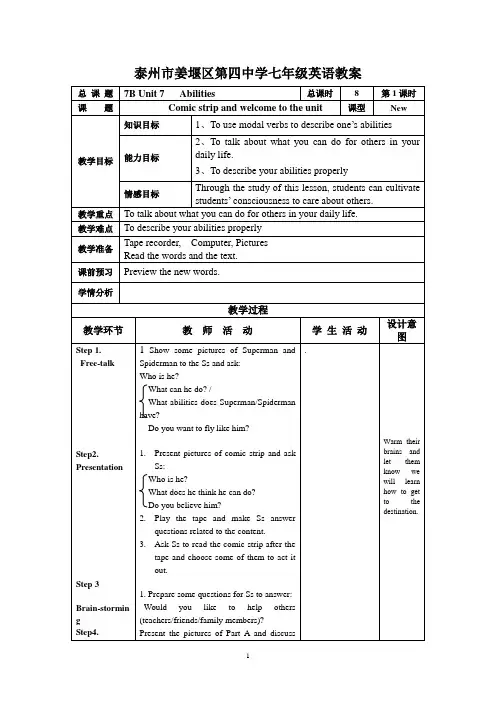
牛津7B Unit 7 教案Title:Unit 5 Can & CouldTeaching Objective: To recognize and understand how to use…can‟ and …could‟ to express ability inthe present and past.Teaching Procedure:Warm Up:Please take out the preview paper and let‟s check it out. Step 1. Please translate the phrases into Chinese.1. row a boat2. play a kike3. play tennis4. fly a kite5. speak Japanese6. play the piano7. sing English songs8. ride a horseStep 2. Please answer the questions.1. Can you speak Japanese?2. Can you play basketball?3. Can you sing English songs?4. Can you play the piano?5. Can you fly a kite?6. Can you ride a horse?7. Can you run fast?8. Can you cook?Step 3.Please read out the reports about the sports your classmates couldn‟t do last year but can do this year. Presentation:Step 1.We have learn …can‟ before and know how to use it to ex press abilities. Well, let‟s review the sentencestyles in which …can‟ is used.陈述句:sb./sth.+can+doe.g. He can dance.Millie can swim.We can sing English songs.否定句:sb./sth.+cannot/can‟t +doe.g. He cannot/can‟t dance.Millie cannot/can‟t swim.We cannot/can‟t sing English songs.一般疑问句:Can sb./sth. do?e.g. Can he dance?---Yes, he can./No, hecannot/can‟t.Can Millie swim?---Yes, she can./No, shecannot/can‟t.Can we sing English songs?---Yes, wecan./No, we cannot/can‟t.Step 2. Now, we know how to use can to express abilitiesnow, but how to express abilities inthe past. Generally speaking, we justchange …can‟ into …could‟.Tip: can-could, cannot/can‟t-couldn‟t/could note.g. He could dance.We couldn‟t /coul d not sing English songs.Could Millie swim?---Yes, she could./No, she couldn‟t.Step 3. We have know how to use both …can‟ and …could‟ now.Let‟s finish the work on the book. And then let‟scheck it out.Step 4. Do and check out the review paper. Assignments:1. Finish the preview paper.2. Review what have been learned.牛津7B Unit 7Welcome to the unit一、教学内容简介:本课选自《牛津英语》b unit 7 welcome to the unit。
这一单元的主要内容是学习怎样帮助别人的一些说法.教材以图片的形式呈现出课文的内容,如plant trees,clean up the park,visit the home for the elderly等等。
其中elderly\collect\ability\为新词。
考虑到本校学生的能力和所授知识的完整性,我对教材内容做了适当的补充;在学习课本知识外另外再加入一篇有关帮助别人的文章,从而来扩充学生的阅读量。
二、教学目标:1、知识目标:(1)理解、掌握本课中的新词:elderly\collect\ability\.要求能听懂,会说,会认读。
(2)掌握本课中的词组: visit the home for the elderly,help the old man crossthe road,give a seat to the old man,clean up thepark,plant trees,collect things for the hopeproject,members of the helping hands club.2、技能目标:能听懂并运用句型what can you do in the park/in the school/on the bus/on the road…3、情感目标:让学生在有趣的活动中体会课堂教学的乐趣,使学生愿学、爱学、乐学、积极地学。
三、教学重点:认读新词;理解、运用新句型及其回答;发言时发音正确,语音语调准确、流利、有感情。
四、教学难点:1、单词elderly\collect\ability的识记。
2、句型what can you do in the park/in the school/on the bus/on the road…?的灵活运用及回答。
五、教学设计思路:初中八年级的英语教学在基本单词、短语掌握的基础上,更应注重的学生阅读能力。
所以我除了将教学环节设计成为活动以外,还找了一篇与课文有关的阅读文章来训练。
这样,既让学生们在快乐的活动中理解语言、运用语言、习得语言,同时可以增加学生的阅读量,从而提高学生的阅读水平。
六、教学设计过程:(一)、greeting:1.t:how times flies! two months has passed. our summer holiday is over. now we come back to school again. welcome to the school! did you have a good time in your summer holiday?ss: yes.(二)、presentation:1.t: what did you do in your summer holiday?s1: I did my homework.t: what did you do in your summer holiday?s2: I watched TV.3t: what did you do in your summer holiday?s3: I went to shanghai.t: what about you?s4: I swam in the river and saw some films.t: what did you do in your summer holiday?s5: I played computer games.3.t:did you help others in your summer holiday?s1:yes.t: what did you do to help others?s1: I helped mother cook.t: did you help others in your summer holiday?s1:yes.s2: I helped my mother clean the house.t: did you help others in your summer holiday?s1:yes.s3: I helped my little brother with the lessons.(三)、looking at some pictures then discuss how to help others:1.t:what can you do on the road to help others?s1: I can help the old man cross the road.T :what can you do on the road to help others?s2: I can visit the home for the elderly.2.t:what can you do on the bus to help others?s1:I can give a seat to the old man .t: what can you do on the bus to help others?s2:I can help the old man go upstairs.t: what can you do on the bus to help others?s3:I can give a seat to the woman with a baby.3.t:what can you do in the park to help others?s1:I can clean up the park .t: what can you do in the park to help others?s2:I can plant trees. .4.t:what can you do in the school to help others?s1:I can pick up rubbish..t: what can you do in the school to help others?s2:I can clean the school.t: what can you do in the school to help others?s3:I can help teachers clean the bikes.t: what can you do in the school to help others if they want to go to school but they don‟t have much monkey?s1:I can collect things for the hope project.5.t: you are great! i think you can be members of the helping hands club.6. ss: according to the pictures ,ask and answer in pairs:s1: what can you do on the bus//in the park// in the school// on the road to help others?s2: I can …6.ss:ask some pairs to act it out.(四)、extending:1.t: different people have different abilities. they can do different things to help others .I hope everyone of you can help others when they are in trouble. please show love to others.2.ss: read a text about how to help others.(五)、homework:read and recite the useful expressions.(六)、板书设计:what can you do in the park/in the school/on the bus/on the road…?I can…help the old man cross the roadvisit the home for the elderlygive a seat to the old manhelp the old man go upstairsgive a seat to the woman with a babyclean up the parkplant treespick up rubbishcollect things for the hope projectmembers of the helping hands clubshow love to othersability---abilities(七)、教学后记:本课的知识点不多,课堂上通过图片导入、小组操练等形式,学生对本课的单词、短语及基本句型有了比较深刻的印象。