
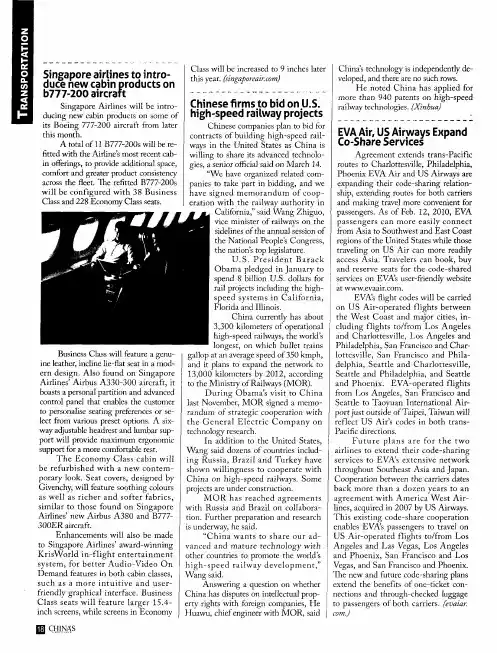
Chinese firms to bid on U.S. high-speed railway projects
- 格式:pdf
- 大小:84.82 KB
- 文档页数:1
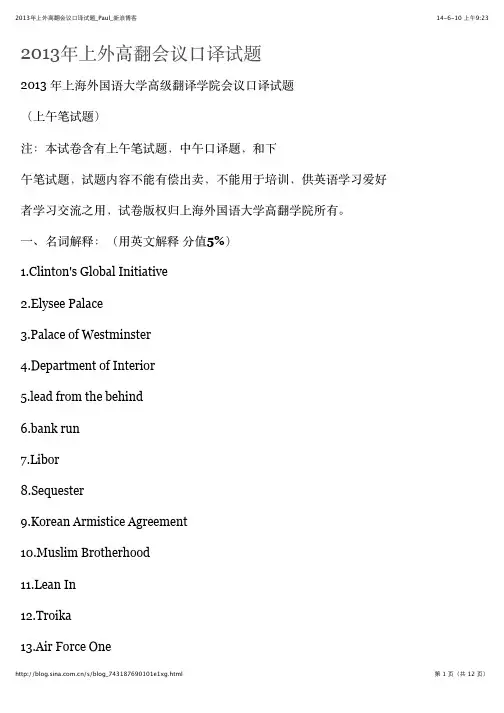
201320135%1.Clinton's Global Initiative2.Elysee Palace3.Palace of Westminster4.Department of Interior5.lead from the behind6.bank run7.Libor8.Sequester9.Korean Armistice Agreement10.Muslim Brotherhood11.Lean In12.Troika13.Air Force One14.PM2.515.Anonymous (an organisation)16. China Railway Corporation5%1.2.3.4.5. .6. 5007.8.9.10.11. 5+112.13.14.Global Markets' Time Factor21 March 2013BARCELONA – In recent months, the dichotomy between booming financial markets, on the one hand, and sluggish economies and dysfunctional politics, on the other, has loomed large. Yet insufficient attention is being devoted to a critical factor – time, and who controls it – that could well mean the difference between an orderly global resolution of today’s growing inconsistencies and a return to a more troubled phase.Markets have been understandably buoyant in the first quarter of 2013. Most economic data confirm that, after the trauma caused by the global financial crisis, the United States’ economy is healing, and doing so in an accelerated fashion.The sequence is now well established. It started with large multinational companies, which are on as solid a financial footing as I can remember. Smaller firms are gradually recuperating; banks have rebuilt their capital cushions and reduced their dubious assets; the housing sector has stabilized; and a growing number of households are reestablishing healthier balance sheets, especially as employment gradually picks up.This private-sector recovery is helping government finances. The US budget deficit has been on a downward trend for now, helped by both higher revenues and lower pressure on spending (for example, payments to the unemployed have fallen as joblessness has declined).The healing process is also evident in Europe, though, unfortunately, it is effectively limited only to sovereign-bond markets. The real economy remains under enormous pressure in several countries, as economies contract and unemployment remains alarmingly high.After flirting with disaster last July, interest-rate spreads for eurozone bonds have generally been subdued, and financial segmentation has been slowly reversed (that is, at least before European officials embarked on the controversial path of trying to impose losses on guaranteed bank deposits in Cyprus). Moreover, as Ireland’s highlysuccessful €5 billion ten-year bond issue in mid-March demonstrated, some countries are in the process of restoring normal access to capital markets.The impact on markets of these trends has been turbocharged by central banks, which are risk markets’ best friends. This is not because they wish to play that role; rather, it is because higher asset prices are essential if central bankers stand any chance of delivering the desired economic outcomes of higher growth and stronger job creation.This is most evident in the US, where markets love the Federal Reserve’s trifecta of near-zero policy interest rates (negative in real terms), aggressive forward policy guidance, and asset purchases – all of which push investors to take more risk. Markets also welcome the fact that the Fed’s hyperactive experimentation is forcing other central banks around the world to pursue more expansionary policies.Indeed, from the Bank of Japan’s dramatic policy U-turn to the Bank of Mexico’s surprise interest-rate cuts, the Fed’s approach is affecting central banks in a growing number of countries. Pushed further away from best-case scenarios, they are unable to ignore the global liquidity impact of the Fed’s policies, yet they lack the right policy tools to address it.The mix of endogenous healing and strong central-bank tailwinds, including from a “whatever it takes” European Central Bank, has also helped markets shrug off troubling political uncertainties. Be it the US Congress’s paralyzing polarization or Italy’s protest vote against the established political order, politicians are being given time to overcome their dysfunction, thereby minimizing any immediate disruptive impact.Understandably, investors have interpreted all of this as a green light to take more risk. And with the hype this month over eight successive records for the Dow Jones index (and many other records around the world), excitement induces more investors to enter riskier asset markets.The excitement is not anxiety-free, however, and rightly so. Investors worry about the longer-term consequences of political dysfunction, another year of Europeaneconomic contraction, disastrously high unemployment, unprecedented – and thus untested – central bank policies, and increasing global tensions. And the recent bungling of the Cyprus rescue does not help. No wonder some have called the recent market rally “one of the most unloved” in history.This mix of excitement and anxiety is, in fact, a sign of the looming crossroads that faces investors. One road, involving a relatively orderly handoff from policy-assisted recovery to self-sustaining growth, offers the possibility of even greater financial rewards, as rapidly improving economic and political conditions validate current artificial pricing and drive it higher.The other road is a lot less attractive. With insufficient endogenous healing and no economic escape velocity, the effectiveness of central banks’ policies wanes and political dysfunction increases, leading to financial losses, volatility spikes, and huge risk-management challenges.Given current policy and political uncertainties – and the multiple equilibria that they entail – it is difficult to predict with a high degree of confidence which road eventually will be taken and when. Those who claim otherwise may well fail to appreciate fully the exceptional nature of the current situation.In these circumstances, timing may not be everything, but it may prove to be a key determinant of the probabilities. If the journey to the crossroads is accelerated by a large geopolitical shock (originating in, say, the Middle East or North Korea) and/or a serious political breakdown in Europe (for example, a meltdown in Cyprus or prolonged political paralysis in Italy), the probability of taking the adverse path rises to an uncomfortably high level. If, however, central banks can contain domestic and global inconsistencies long enough, the combination of endogenous healing and eventual political progress would significantly improve the probability distribution.Have no doubt: today’s markets rely heavily on the old adage that “time heals all wounds.” The timekeepers are central banks. But their control of the clock is less than perfect; and it will become increasingly ineffective if economic improvement faces additional political headwinds in the months ahead.20%Think carefully about the issue presented in the following excerptand the assignment below.Nowadays nothing is private: our culture has become tooconfessional and self-expressive. People think that to hide one’sthoughts or feelings is to pretend not to have those thoughts orfeelings. They assume that honesty requires one to express everyinclination and impulse.Adapted from J. David Velleman, “The Genesis of Shame”Assignment: Should people make more of an effort to keep some things private?Plan and write an essay in which you develop your point of view on this issue.Support your position with reasoning and examples taken from your reading,studies, experience, or observations.2013201325%)The Crumbling BRICSNew Delhi-In 2001, when Jim O’Neill of Goldman Sachs coined the acronym BRIC to refer to Brazil, Russia, India, and China, the world had high hopes for the fouremerging economies, whose combined gross domestic product was expected to reach$128.4 trillion by 2050, dwarfing the United States’ projected GDP of $38.5 trillion. When the four countries’ leaders gather tomorrow in South Africa – which joined their ranks in 2010, contributing the ‘ S ’ – for the fifth BRICS summit, their progress and potential will be reassessed.The summit ’ s hosts have set ambitious goals, reflected in the summit ’ s theme:“ BRICS and Africa – a partnership for development, integration, andindustrialisation.” They seek to advance national interests, further the African agenda,and realign the world’s financial, political, and trade architecture – an agenda that encompasses objectives from previous summits, while reflecting South Africa’s goal of harnessing its membership to benefit all of Africa.But, while strengthening ties with African countries might seem like the kind of pragmatic development issue that should bring consensus, the seeds of doubt are already being sown. Lamido Sanusi, the governor of Nigeria ’ s central bank, has called for Africans to recognise that “their romance with China” has helped to bring about “a new form of imperialism”.Moreover, the central item on the summit ’ s agenda, a proposed “ BRICS development bank”, is one that has gone nowhere at previous summits. This time, armed with a “feasibility study” put together by the five BRICS finance ministers,some progress may at last be made. With trade, both among the BRICS countries and between the BRICS and the rest of Africa, expected to increase from roughly $340 billion in 2012 to more than $500 billion in 2015, there is also much to discuss on the commercial front.So far, the goal of “global realignment” away from the advanced countries has catalysed these five very disparate countries’ efforts to forge their own bloc. But the primacy given to“advancing national interests” has always precluded real concerted action, at least until now.This is why the idea of establishing a BRICS development bank has taken on such importance. And the recently conducted feasibility study might spur long-awaited progress. But toward what end?According to China ’ s official news agency, the development bank ’ s primary objective would be “to direct development in a manner that reflects the BRICS’priorities and competencies”. Once the bank is established, a working group will be tasked with building the necessary technical and governance capacity.But this stock rhetoric fails to address the discrepancies between the BRICS ’interests, or to define the bank’s role in reconciling and advancing them.The fact that China is already Africa ’ s top trading partner, for example, invites questions about the proposed bank’s potential contributions. And China’s answer –that the bank would foster the “development of more robust and inter-dependent tiesbetween the BRICS” – provides little substance. Is the bank supposed to serve as acounterweight to global multilateral development financiers such as the World Bank,or to reduce American and European dominance over the Bretton Woods institutions?Whatever the underlying objective, it must be identified, and its concomitant risks addressed, if the BRICS are to make genuine progress. For example, if the proposed bank is simply an additional funding institution aimed at supporting the BRICS ’s development agenda, the participating countries’ leaders must establish how it will interact with national institutions, such as the Brazilian Development Bank, the China Development Bank, and the Export-Import Bank of India.But the problem of aligning the BRICS’ interests is a much deeper one. Consider India ’ s need for massive investments in infrastructure, made evident in itsjust-proposed 2013-14 budget. Some hopeful Indians see a BRICS bank as a way to channel China’s surplus funds – as well as its expertise and experience – to such investments (especially railways), as well as to strengthen Sino-Indian ties. But given the two countries ’ many serious bilateral problems, will either government really want to bind itself so closely to the other? Although Wen Jiabao, in his final address as prime minister, highlighted the enduring obstacles to China ’ s economic development (many of which its fellow BRICS share), China’s new president, Xi Jinping, insists that his country will not sacrifice its “ sovereignty, security, ordevelopment interests” for the sake of more trade.Meanwhile, Russia’s impaired democracy and resource-driven economy are a poor example for its fellow BRICS – and, in fact, could serve as a warning to the others about the risks of excessive reliance on the state. And Brazil, like India a genuine democracy, also seems sui generis. Despite the commodities boom of the last decade,its industrial output relative to GDP is no higher than it was when the effort to create aBRICS bloc began.The BRICS’ ambitions – and the world’s expectations for them – may yet be fulfilled. But shared potential does not translate into collaborative action. On the contrary, each of the BRICS will have to pursue its goals, and confront its challenges, individually.25%30 “ ” “” “ ”10 38.9%1970-1980 10.5% 2001-2010 57.7%30 1.44-3 1.4-2.6 ;20“ ”“ ”。

china's higher英语作文China’s higher education system has undergone significant transformations over the past few decades, positioning itself as a formidable force in the global academic arena. From the historical roots of its esteemed institutions to the modern innovations driving forward-thinking curricula, China’s universities and colleges are becoming increasingly prominent on the world stage. This essay explores the various aspects of China’s higher education, including its history, structure, challenges, and future prospects.The history of higher education in China dates back over a thousand years. The Imperial Examination System, established during the Sui Dynasty (581–618 AD), is one of the earliest forms of higher education globally. This meritocratic system aimed to select the most capable individuals for government positions, emphasizing knowledge of Confucian classics. Despiteits abolition in the early 20th century, the legacy of rigorous academic selection continues to influence China’s educat ional ethos.In the early 20th century, China began to adopt Western educational models, resulting in the establishment of modern universities such as Peking University (founded in 1898) and Tsinghua University (established in 1911). These institutions aimed to blend traditional Chinese scholarship with Western scientific and humanistic disciplines, setting the stage for the comprehensive educational reform that would follow.China’s higher education system is hierarchical, with a clear distinction between various levels of institutions. At the top are the key universities, often referred to as the “Double First-Class” universities, which include world-renowned institutions like Tsinghua University, Peking University, and Fudan University. These universities receive substantialgovernment funding and are tasked with achieving world-class status.Below the key universities are the provincial universities, which cater primarily to students from their respective regions. These institutions provide a wide range of programs and often have strong ties to local industries and businesses, playing a crucial role in regional development.Additionally, vocational colleges and technical institutes focus on providing practical skills and training to meet the demands of the labor market. These institutions are crucial for fostering a workforce capable of supporting China’s rapidly growing economy.The Chinese government has implemented several reforms to enhance the quality and global competitiveness of its higher education system. One of the most significant initiatives is the “Double First-Class” project, launched in 2015, aimed atdeveloping a group of elite universities and disciplines into world-class institutions by 2050. This initiative builds on previous projects, such as Project 211 and Project 985, which aimed to elevate the standards of higher education in China.Another notable policy is the expansion of higher education enrollment. Since the late 1990s, China has drastically increased the number of students admitted to universities, transitioning from an elite to a mass education system. This expansion has made higher education more accessible to a broader segment of the population, contributing to the country’s socio-economic development.Despite significant pr ogress, China’s higher education system faces several challenges. One of the most pressing issues is the imbalance between the supply of graduates and the demand in the job market. With millions of students graduating each year, competition for high-quality jobs is fierce, leading to underemployment and job mismatches.Another challenge is the disparity in educational quality between urban and rural areas. While top-tier universities in major cities receive ample funding and resources, institutions in less developed regions often struggle with limited infrastructure and faculty shortages. This urban-rural divide exacerbates inequalities and limits opportunities for students from disadvantaged backgrounds.Furthermore, the pressure on students to perform well in the National College Entrance Examination (Gaokao) remains intense. The Gaokao is a high-stakes exam that determines university admissions, leading to a highly competitive and stressful environment for students. Critics argue that this system places excessive emphasis on rote memorization and undermines creativity and critical thinking.China’s higher education system is becoming increasingly internationalized. The number of Chinese students studying abroad has surged over the past few decades, withmany returning to China with valuable skills and international perspectives. Additionally, Chinese universities are attracting a growing number of international students and faculty, fostering cross-cultural exchanges and collaborative research.Programs such as the Belt and Road Initiative (BRI) have also influenced the international landscape of Chinese higher education. Through the BRI, China has established partnerships with universities in participating countries, promoting educational exchanges and joint research projects. These collaborations enhance China’s soft power and contribute to global knowledge production.Looking ahead, China’s higher education system is poised for further transformation and growth. The government’s commitment to educational excellence, coupled with substantial investments in research and development, positions China as a potential leader in various academic fields. Innovations in technology and digital learning are also expectedto play a significant role in shaping the future of Chinese higher education.Moreover, efforts to address the challenges of educational inequality and job market mismatches are likely to continue. Policies aimed at improving the quality of education in rural areas and aligning academic programs with industry needs will be crucial for ensuring that higher education contributes effectively to China’s socio-economic development.In conclusion, China’s higher education system has made remarkable strides over the past few decades, evolving from a traditional, elitist model to a dynamic, inclusive, and globally connected system. While challenges remain, the ongoing reforms and international collaborations promise a bright future for Chinese higher education. As China continues to invest in its academic institutions and cultivate talent, its universities are set to play a pivotal role in the global knowledge economy.。

为什么中国比其他国家更加乐观的英语作文China has long been known for its resilience and optimism in the face of adversity. Despite facing numerous challenges throughout its history, the Chinese people have consistently demonstrated a strong sense of optimism and a willingness to overcome obstacles. This optimism can be attributed to a variety of factors, including the country's rich cultural heritage, its rapid economic development, and the government's focus on promoting social stability and well-being.One of the primary reasons for China's optimism is its deep-rooted cultural traditions. The influence of Confucianism, Taoism, and Buddhism has instilled in the Chinese people a strong sense of resilience and a belief in the power of harmony and balance. These philosophical traditions emphasize the importance of maintaining a positive outlook, adapting to change, and finding meaning in the face of adversity. This cultural foundation has helped the Chinese people to weather economic, political, and social upheavals throughout their history, and has contributed to a national character that is often described as optimistic and forward-looking.In addition to its cultural heritage, China's rapid economic development over the past few decades has also played a significant role in shaping the country's optimistic outlook. The country's transition from a centrally planned economy to a market-oriented one has led to a remarkable transformation, with millions of people lifted out of poverty and a growing middle class that enjoys a higher standard of living than ever before. This economic progress has instilled a sense of confidence and optimism in the Chinese people, who see their country as a rising global power with the potential to achieve even greater success in the future.Moreover, the Chinese government has made a concerted effort to promote social stability and well-being, which has contributed to the country's optimistic outlook. The government's focus on improving public services, reducing income inequality, and investing in infrastructure has helped to create a sense of security and opportunity among the Chinese people. This, in turn, has fostered a positive outlook on the future and a belief that the country is headed in the right direction.Another factor that contributes to China's optimism is the country's strong sense of national identity and pride. The Chinese people have a deep respect for their cultural heritage and a strong belief in the country's unique place in the world. This sense of national pride has helped to foster a positive outlook on the future and a belief thatChina is destined to play a leading role on the global stage.Furthermore, the Chinese people's resilience and adaptability have also played a significant role in shaping the country's optimistic outlook. Throughout its history, China has faced numerous challenges, from natural disasters to political upheaval, and the Chinese people have consistently demonstrated a remarkable ability to adapt and overcome these challenges. This resilience has instilled a sense of confidence and optimism in the Chinese people, who believe that they have the strength and determination to overcome any obstacle that may come their way.Finally, the Chinese government's focus on promoting social stability and well-being has also contributed to the country's optimistic outlook. The government's efforts to reduce poverty, improve public services, and invest in infrastructure have helped to create a sense of security and opportunity among the Chinese people. This, in turn, has fostered a positive outlook on the future and a belief that the country is headed in the right direction.In conclusion, China's optimism can be attributed to a variety of factors, including its rich cultural heritage, its rapid economic development, the government's focus on promoting social stability and well-being, the country's strong sense of national identity and pride, and the resilience and adaptability of the Chinese people.These factors have all contributed to a national character that is often described as optimistic and forward-looking, and have helped to make China a global leader in terms of economic and social progress.。

Good morning! It is a great honor to stand before you today to deliver a speech on the theme of "Inspiring China." As young Chinese high school students, we are the future of our nation, and it is our responsibility to not only learn from the past but also to shape the future. Today, I would like to share with you some thoughts and inspirations that can guide us on this journey.Firstly, let us reflect on the rich history of our great nation. China, with its long and storied past, has been a cradle of civilization. Throughout the centuries, our ancestors have created a culture that is deeply rooted in tradition, wisdom, and resilience. From the Great Wall, the Terra Cotta Warriors, to the ancient philosophies of Confucius, Laozi, and Zhuangzi, our heritage is a testament to the strength and perseverance of the Chinese people.One of the most inspiring aspects of our history is the spirit of innovation. Our ancestors were not afraid to challenge the status quo and seek new solutions to the problems they faced. Take the invention of paper, gunpowder, the compass, and printing—these are just a few examples of the groundbreaking contributions made by ancient Chinese scholars and inventors. This spirit of innovation has been a driving force behind China's rise as a global power.In the modern era, China has continued to embrace innovation and progress. The last few decades have seen a remarkable transformation in our country, with economic growth, technological advancements, andsocial development. This progress has been the result of the hard work, dedication, and perseverance of our people. As young students, we must carry on this legacy and strive to be the innovators and leaders of tomorrow.To be an innovator, we must first cultivate a mindset of curiosity and openness. We should never be afraid to ask questions, to explore new ideas, and to challenge the conventional wisdom. As Confucius once said, "I hear and I forget; I see and I remember; I do and I understand." True learning comes from doing, and it is through our actions that we can make a difference in the world.Education is another key factor in fostering innovation. As high school students, we are fortunate to have access to a wealth of knowledge and resources. We must take full advantage of these opportunities and strive for excellence in our studies. Remember, knowledge is power, and it is our responsibility to use this power to improve ourselves and contribute to society.In addition to innovation, there are several other qualities that we, as young Chinese students, should strive to cultivate. The first is resilience. Life is full of challenges, and it is how we respond to these challenges that defines us. As Chinese saying goes, "When life gives you lemons, make lemonade." We must learn to turn obstacles into opportunities and never give up on our dreams.Another important quality is integrity. As Confucius also said, "A man without virtue is like a tree without roots." Integrity is the foundation of a strong character, and it is essential for building trust and respect among others. We must always act with honesty, fairness, and compassion, and we must hold ourselves to the highest moral standards.Leadership is also a crucial skill for us to develop. As young students, we may not be in positions of power yet, but we can still lead by example. We can inspire others through our actions, and we can take initiative to make positive changes in our communities. Remember, leadership is not about titles or status; it is about the impact we have on those around us.Lastly, let us not forget the importance of cultural heritage. China is a nation with a diverse and vibrant culture, and it is our duty to preserve and promote this heritage. We should be proud of our traditions and customs, and we should learn from the wisdom of our ancestors. By doing so, we can contribute to the richness of our culture and pass it on to future generations.In conclusion, as young Chinese high school students, we have a great responsibility to shape the future of our nation. We must embrace the spirit of innovation, cultivate qualities such as resilience, integrity, and leadership, and preserve our cultural heritage. By doing so, we cannot only inspire ourselves but also inspire others to join us in this noble cause.Let us remember the words of Deng Xiaoping, the great leader of modern China: "To achieve modernization, we must first have confidence in ourselves." With confidence, determination, and a shared vision, we can create a bright future for China and for the world.Thank you for your attention, and may we all be inspired to achieve great things in our lives.Long live China!Long live the youth!Thank you.。