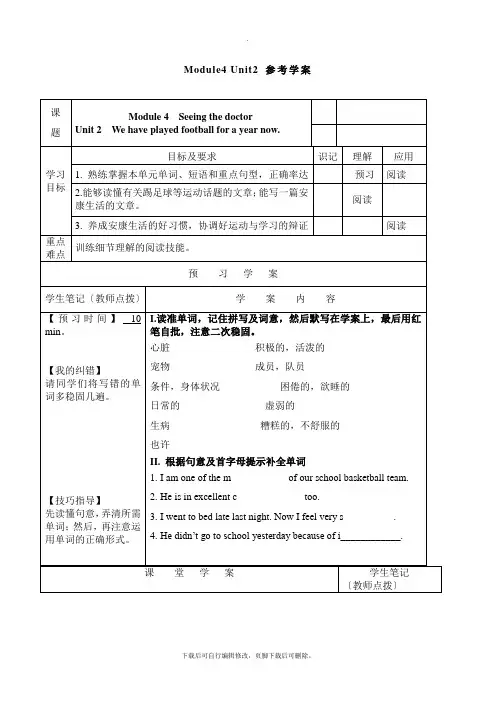
外研社八年级英语 下册m4u2学案
- 格式:doc
- 大小:30.50 KB
- 文档页数:5
Module 4 Unit 2
If a snake bites you, take a photo.
Learning aims:
1. Knowledge aims(知识目标):
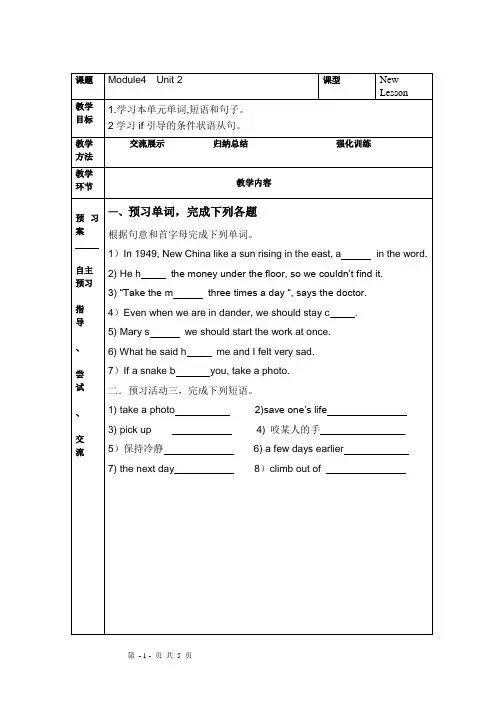
(1) Key words and phrases:bite, dish appear, hide, cool ,chest ,hurt ,wrong ,medicine, suggest ,
save one’s life, pick up, take a photo of…, bit him on the hand, the surprising advice, stay cool,
turn on
(2) Grammar: If从句+祈使句
2. Ability aims(技能目标):
(1)Get information from the passage
(2)To improve the reading ability
(3) To improve the writing ability
3. Feeling aims(情感目标):生活中学会如何处理突发事件
Step (一)单词检测:
1、If a dog b you ,go to the hospital in a hurry .
2、Tom h his hand when he cut an apple .
3、Take the m three times a day ,and then you’ll be OK .
4、You mustn’t t away the waste .It’s very dirty .
5、What s news !She’s got the first .
6、I (建议)you should try it again.
7、You know a fox cannot (藏)its tail .
8、The boy stayed c in front of the snake.
9、Are you sure that the thief ( 出现 )yesterday ?
10、There is something w with my watch .
Step (二) Discuss:
What can you use a mobile phone to do?
We can use a mobile phone to 1. call people
2. send messages
3. listen to the radio
4. play music
5. take photos ( video )
6. wake you up (叫醒你起床) 7. tell the time and the date
8. see a film
9. play games
10. write down the telephone number
11. calculate (计算)
12. explore the Internet(上网)
Step(三) Reading
1. Skimming:
要求:阅读时不能从头到尾、一字不漏地读下去,而是采用跳跃式的默读方法,搜寻相关信息,并对文章的内容有一个总体的了解
1)What happened to Henry Jackson one day?
2)What saved his life?
2. Fast reading:
快速阅读并判断正(T)误(F)
( ) 1) A mobile phone is very useful.
( ) 2) The snake bit Henry Jackson on the head.
( ) 3) He took a photo of the snake with a camera.
( ) 4) He left hospital after three days.
3.Reading carefully: Choose the best answer.
( )1.When the snake bit Mr. Jackson, it was______.
A. hiding in a box of bananas B. climbing out of a box of bananas
C. lying under a dish D. climbing into the fridge
( ) 2. Mr. Jackson threw the snake across the room probably because ______ .
A. he was surprised B. he wanted to get a better photo
C. his chest began to hurt D. the fridge door was open
( ) 3. Mr. Jackson closed the fridge door so that ______ .
A. he could take a photo B. the snake couldn’t go back to the zoo
C. the snake became cool D. he was safe from the snake
( ) 4. The doctor gave Mr. Jackson the right medicine when ______ . A. London Zoo told them what kind of snake it was
B. B. Mr. Jackson sent the photo to the hospital
C. he left hospital the next day D. the snake bit him
4、Useful expressions:
1.给…照相
2.用…照相
4.咬伤了他的手
5.几天前
6.保持冷静 7.怎么了
8.拾起,捡起
9.挽救某人的生命
10对症下药
美句欣赏
1) If a snake bites you, take a photo.
2) This is the surprising advice of a British cook.
3) He picked up a dish from the table..
4) Suddenly, a snake appeared…and hit him on the hand
5) I threw it across the kitchen, and it landed in the fridge .
6) Then his chest began to hurt.
5、Language points:
1)This is the surprising advice of a British cook.
surprising “令人惊奇的”,用来修饰物。
如:The news is surprising. 这则消息令人惊奇。
surprised “感到惊奇的”,用来修饰人。
如:I was surprised at you. 我对你感到惊奇。
2)If a snake bites you, take a photo with your mobile phone.
此句是一个复合句,主句为祈使句,祈使句表达的动作是尚未发生即将来的动作;if引导的是条件状语从句,在条件状语从句中用一般现在时代替一般将来时 ,主语为第三人称单数或单数名词时谓语用三单 。例如: 如果他来这儿,我们就一起玩个痛快。
If he (come) here, we will have a good time together.
①take a photo of 给…拍照
大明正在动物园里拍一张老虎的照片. Daming is taking a photo of a tiger in the zoo.
②take a photo with 用…拍照
大明正在动物园里用手机给一只老虎拍照片.
Daming is taking a photo of a tiger with a mobile phone in the zoo.
3) He picked up a dish from the table, and suddenly a snake appeared…and bit
him on the hand.
pick up意为:捡起、拾起 。在短语中,up 为副词, 是由“动词﹢副词”构成的词组,当宾语是代词时,必须放在短语的中间,宾语是名词时,则放在短语的中间或后面 。如:地上有几本书,我们把它们捡起来吧。
There are a few books on the ground. Let’s pick them up
bite sb. on the hand 意为“咬某人的手”。这种结构为“动词+宾语+介词+the+身体某一部位”,其中的介词为in, on, 等。
如:那个淘气的男孩打了她的头 The naughty boy bit her on the head.
Jim 打了Peter的脸 Jim bit Peter in the face.
Complete the following sentences
1.如果你有照相机,能为我照个相吗?
____ you have a camera, can you ____ _______ ______ of me?
2.请帮我拾起那支钢笔。 Please help me ______ _______ that pen.
3.那条蛇咬了他的手。
That snake ____ ____ ____ ____ ___.
4.我们用眼睛看。
We see ____ ______ _____.
5.你的自行车有什么问题?
_____ _______ _______ your bike?