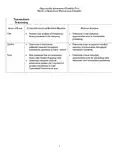
Opportunity Assessment Checklist Tool Detail of Operational Performance ChecklistTransactions ProcessingAreas of Focus Cost Collect Information/ Establish Baseline Perform cost analysis of transactionheavy processes in the company Perform Analyses Determine if cost reduction opportunities exist in transactions processing Determine ways to improve validity/ accuracy of information throughout transaction processes Determine if time reduction opportunities exist by calculating time associated with transactions processingQualityDetermine if information collected/received throughout transactions processes is valid/ correct Map processes that are transactionheavy (See Process Mapping tool) Determine resources (human, information system, etc.) required to process transactions in each Operational Performance areaTime 1Opportunity Assessment Checklist Tool Detail of Operational Performance ChecklistReporting and ControlsAreas of Focus Cost Quality Collect Information/ Establish Baseline Not directly applicable to this area Identify high level capability of management reporting/ information systems Map high-level reporting relationships throughout organization Ask interviewees or select group of employees from throughout company to find out if information/reports they receive are adequate/timely Determine ability of management reporting/ information systems to meet needs of organization Determine management reporting improvement areas (e.g., access to information, timeliness, adequacy/ usefulness of information, etc.) Perform AnalysesQuality, Time 2Opportunity Assessment Checklist Tool Detail of Operational Performance ChecklistPlanningAreas of Focus Cost Collect Information/ Establish Baseline Days of sales of finished goods inventory by SKU and associated stocking rules (reorder points, EOQs, safety stock, forecasting error rate, etc.) Identify frequency and method for forecasting, paying special attention to longer term “forecasting,” versus shorter term production “scheduling” Production orders launched by SKU by month Production output by SKU by month (e.g., FGs to stocking locations or customers) Finished goods inventory list by SKU with associated sales and quantity volumes (profitability by SKU is also desirable, but difficult to obtain) Returns and warranty history by SKU Customer list by sales volume by month Customer orders by SKU by month Customer shipments by SKU by month Customer backorders by SKU by month Customer order changes (within and outside the production lead time window) Returns and warranty history by customer Perform Analyses Determine opportunities to reduce inventory levels due to mismatches in mathematical relationships between forecasting error, safety stock, EOQs and reorder points versus actual inventory and production results Conduct ABC analysis of FG inventory listings (performed based on sales dollar, quantity and profitability to see if significant differences exist using different analysis parameters) Determine if lowest performing finished goods products are worth retaining (i.e., the „Ds‟ or lowest „Cs‟ may not be economically viable, or cause too much complexity) Conduct ABC analysis of customers (performed based on sales dollar, quantity and profitability to see if significant differences exist using different analysis parameters) Determine if lowest performing customers are worth retaining (i.e., the „Ds‟ or lowest „Cs‟ may not be economically viable, or cause too much complexity)3Opportunity Assessment Checklist Tool Detail of Operational Performance ChecklistPlanning (continued)Areas of Focus Quality Collect Information/ Establish Baseline Identify information technology and/or current processes used for demand analysis Perform Analyses Determine high level capability of current information technology and/or current processes used (transaction systems, use of modeling and decision support tools, access to customer level sales data, etc.) Determine if techniques might be used to decrease the lead time for gathering customer demand data and translating it (and other key data) into production schedules Determine opportunities to reduce cycle time by utilizing segmented forecasting, planning and scheduling rules by ABC classification (more rigorous and aggressive on „As‟ versus „Bs‟ versus „Cs‟)TimeMap existing processes (activities, sequence, lead time, responsibilities, information/ paper flows) and high level material flows through the plant(s) and stocking locations Document associated policies (approvals, cut off dates, decision points, etc.)4Opportunity Assessment Checklist Tool Detail of Operational Performance ChecklistFinanceAreas of Focus Overall Company Collect Information/ Establish Baseline Review financial statements for overview of company financial health Use GBP‟s Financial Performance Review Diagnostic to compute key ratios (e.g., ROI, ROA, quick ratio, etc.) Obtain indicators of financial performance of similar companies Obtain Finance budget and actual spending Perform Analyses Investigate problem areas revealed in financial statements and ratio analysis to determine root causes Compare financial performance to that of similar companiesCost Identify reasons for significant gaps between budgeted and actual spending Identify areas for potential cost reduction in Finance function Determine ability of information system to meet needs of finance organization and overall company Analyze results of diagnostic to determine improvement areasQualityIdentify high level capability of finance/ treasury information systemUse GBP‟s Finance and Accounting Diagnostic Tool to benchmark the finance function against other companies Map processes, including closing the books, budgeting, SEC reporting, annual report production, risk management, general ledger management, planning, etc.TimeDetermine opportunities to increase efficiency in finance function processes5Opportunity Assessment Checklist Tool Detail of Operational Performance ChecklistMISAreas of Focus Collect Information/ Establish Baseline Perform AnalysesOverall Company CostSee Information Technology Performance Checklist Review IS budget and actual spending Obtain comparable industry standardsSee Information Technology Performance Checklist Determine reasons for significant gaps in budgeted and actual spending Compare IS spending with industry standards Analyze reasons for variations in IS spending compared with industry norms Analyze user surveys and determine utilization of software and automation of tasks Analyze customer satisfaction levels and identify shortfall areas QualityConduct workshop/ interviews with IS department management and selected users to brainstorm service delivered and levels reached Perform IS Customer Satisfaction/ User Survey Collect IS Helpdesk statistics Determine comparable Helpdesk statistics Determine adequacy/effectiveness of service level agreements provided by internal IS department and outsourcing companies Identify trends within Helpdesk calls to identify areas causing most user requests Compare service levels provided by AS department or outsourcing company with expected levels Identify areas where service level agreements are not sufficient or not present Determine IS ability to work to schedule Identify factors that cause IS department to fall behind in project schedules TimeReview IS adherence to project schedules Note: Gartner Group and Computer Economics statistics are good sources of data about software, hardware, IS trends in specific industries, etc., that can be used in the above analyses6Opportunity Assessment Checklist Tool Detail of Operational Performance ChecklistHuman Resource Management & DevelopmentAreas of Focus Overall Company Collect Information/ Establish Baseline Obtain employee turnover statistics Obtain average cost of training new employees Obtain industry turnover benchmarks, if available Inquire about reasons employees leave Obtain employee absenteeism statistics Obtain industry absenteeism benchmarks, if available Inquire about reasons employees are absent Perform Analyses Compare company turnover to industry statistics Determine if company needs to improve employee retention efforts Determine potential root causes of turnover Compare company absenteeism to industry statistics Determine if company needs to improve attendance efforts Determine potential root causes of absenteeism Compute lost time due to on-the-job accidents Determine if company needs to improve safety efforts Determine potential root causes for employee satisfaction/ dissatisfaction Obtain statistics of on-the-job accidents, including time lost due to accidents and workers‟ compensation claims Review safety efforts and policies Obtain company information concerning employee satisfaction Inquire about reasons for employee satisfaction/ dissatisfaction 7Opportunity Assessment Checklist Tool Detail of Operational Performance ChecklistHuman Resource Management & Development (continued)Areas of Focus Cost Collect Information/ Establish Baseline Review HR budget and actual spending Obtain HR expenses as a percent of total company expenses Review cost of training and training investment per employee Perform Analyses Identify reasons for significant gaps between budgeted and actual spending Identify areas for potential cost reduction in HR function Determine if training expenditures are too high or too low, given training provided Determine if recruiting expenditures are too high or too low, given current recruiting program Determine overall effectiveness of company training effortsReview cost of recruiting and investment per recruitQuality Obtain information about company training efforts (e.g., goals, subjects, plans, etc.) Determine how company measures effectiveness of training Obtain information about company recruiting efforts (e.g., goals, methods used to recruit, company materials provided, etc.) Determine how company measures effectiveness of recruiting Obtain HR department strategy Obtain HR department goalsDetermine overall effectiveness of company recruiting efforts Evaluate alignment of HR strategy with overall company strategy Evaluate effectiveness of HR in achieving established department goals Determine high level capability of current information system used for HR and identify performance gaps Determine opportunities to streamline/ improve HR processesIdentify information system for HR department processesTimeMap HR department processes (e.g., benefits administration, performance appraisal, compliance with government programs, new employee set-up/ termination, 401K administration, etc.)8Opportunity Assessment Checklist Tool Detail of Operational Performance ChecklistResearch and DevelopmentAreas of Focus Overall Company Collect Information/ Establish Baseline Obtain revenue and profitability by product/ service and date of market entry Obtain new product development project listing including project description, time frame, cost and responsibilities Perform Analyses Analyze new development success and failure rates (e.g., revenues derived from products/ services introduced in the last 2-3 years, ex post accuracy of project targets: project cost, quality, market entry data/ development lead time; achievement of initial business plan: market share, revenues, profitability) Determine effectiveness of new product development team (e.g., effective structure, innovative, risk taking, etc.) Identify responsibility structure for success and failure of new product development projects as well as the position of the typical project leader in the hierarchy of the company Determine the corporate culture for innovation and openness to new ventures Understand the management attitude to risk and problem solving Review R&D budget and actual spendingCost Identify reasons for significant gaps between budgeted and actual spending Identify areas for potential cost reduction in R&D function Determine effectiveness of financial justification calculation method for new product/ servicesObtain method of calculating financial impact of new products/ services9Opportunity Assessment Checklist Tool Detail of Operational Performance ChecklistResearch and Development (continued)Areas of Focus Quality Collect Information/ Establish Baseline Identify the existing process related performance measures (e.g., time to market, activity based cost and product/ service risk detection through quality reviews) Identify crossfunctional relationships and flow of information Determine the integration of customers and suppliers in the process (if possible based on limited interviews with customers and suppliers) Identify the use of existing information technology (e.g., CAD, CAM, digital prototyping) Perform Analyses Determine ability of new product/ service development to meet/ exceed performance measures Determine effectiveness of crossfunctional relationships and information flow Determine effectiveness of incorporation of customer/suppliers in the process Determine if current information technology meets the needs of new product/ service development Assess the use of information technology applications to improve cycle time and quality Compare existing product/ service development process with Best Practices (e.g., automotive, computer industries) Prepare value added versus non-value added direct labor activity analysis Determine alternatives for reducing cycle time TimeMap the existing high level end-to-end development process from defining market/customer needs to market entry (build on existing project management policies/ handbooks) 10。