
Customer Satisfaction Sore Matrix_After Market
- 格式:xls
- 大小:25.50 KB
- 文档页数:2
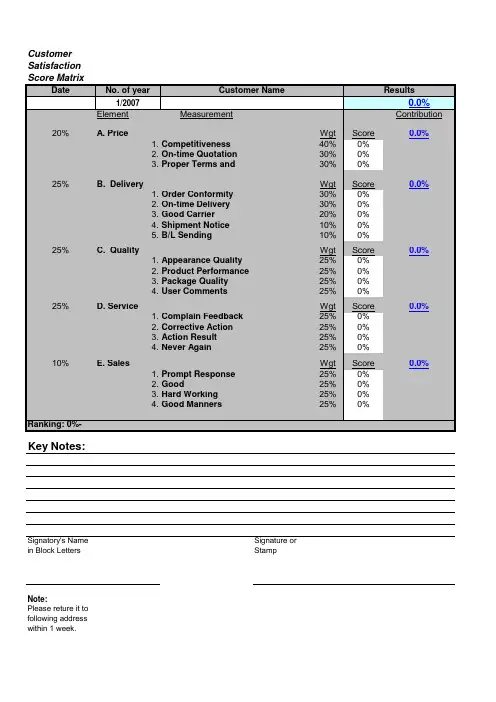

questionnaire term :2010 H11.1 Can Founder verify the bills(orders or invoices)in time during the account checking? 3%1.2 Does Founder confirm and reply the order and lead time in time?3%1.3 Do the Founder's buesiness assitant provide right information about the PCB on line(WIP) or at trip ?4%1.4 if there is any problem during the production,can Founder positively communicate with customer in time ? 4%1.5 Can Founder provide promptly respond for emergent case ? 4%2.1 Is lead time of samples competitive comparing with your other suppliers? 3%2.2 How about the leadtime of samples in general? 5%2.3 Is the leadtime of mass production competitive?3%specific casesdecription:specific casesdecription:specific casesdecription:specific casesdecription:specific casesdecription:specific casesdecription:specific casesdecription:specific casesdecription:Ⅱ交付服务delivery service (19%)CUSTOMER SATISFACTION QUESTIONNAIREDear Customer:Thank you very much for you kindly cooperation during these years!In order to improve our quality of our service, we have a customer satisfaction investigation for everyhalf year, so as to overview the satisfaction of our customer, find out our weakness and improve our workand service accordingly.please kindly help us to finish this questionnaire!Part AⅠ商务服务 business service (18%)very bad and passive slightly passive and not efficient basically meet the requiremenpositive and goodNo,generallyNo, occasionally Yes, but need to be pushed yes, good No,most informaion is wrongNO,occasionally wrong yes,but need too much time yes,good No,only ask when need No,ask too urgentlyYes,can notice yes,can efficiently notice No,very bad No,performance is unstable yes,similar with other supplie yes,good No,very disappointedoccasionally delay.Yes,in general yes,goodNo,very badNo,performance is unstable yes,similar with other supplier yes,good No,can't meet at allNo, not good as expect No such requirement Yes,generally No such problem yes, good。

Customer satisfaction and dissatisfaction in retail banking:Exploring the asymmetric impact of attribute performancesAlessandro ArboreÃ,1,Bruno Busacca2Bocconi University,Via Bocconi,8,20136Milan,Italya r t i c l e i n f oKeywords:Retail bankingCustomer satisfactionThree-factor theorya b s t r a c tThe paper presents the results of an extensive study on the determinants of customer satisfaction for aretail bank.In doing so,it uses a revised version of the traditional analyses based on derived measures ofattribute importance.The need for a revised methodology is prompted by the insights of the two-andthree-factor theories of customer satisfaction,such as Kano’s framework.Indeed,the evidence from5000customers of a prominent Italian bank confirms a non-linear and asymmetric relationshipbetween attribute performances and overall customer satisfaction.The results from both a traditionaland our revised approach are compared.While this approach can be applied across different industries,it should not be assumed that the numerical results presented in the paper apply to contexts withsubstantially different underlying characteristics.General trends and implications for banking servicesare reported in the conclusions.&2009Elsevier Ltd.All rights reserved.1.IntroductionThe relevance of customer satisfaction infinancial services hasbeen widely investigated and assessed by the literature.Followingan increase in positive evidence,the focus on customer satisfactionhas become a primary goal,especially in the retail bankingindustry.A full understanding of its antecedents has thereforebecome a critical issue for both researchers and practitioners.This paper presents the results of an extensive study on thedeterminants of customer satisfaction in a prominent Italian bank.It uses a revised version of the traditional analyses,based onderived measures of attribute importance(e.g.Dolinsky,1991).Theneed for a revised methodology is prompted by the intuitions ofthe two-and three-factor theories,which demonstrated a non-linear and asymmetric relationship between attribute perfor-mances and overall customer satisfaction(Anderson and Mittal,2000;Brandt,1988;Gale,1994;Johnston,1995;Kano,1984;Matzler and Sauerwein,2002;Oliver,1997).2.Background and literature review2.1.Customer satisfaction in the banking industryA growing number of retail banks are directing their strategiestowards customer satisfaction.In fact,researchers have demon-strated that customer satisfaction serves as a link to criticalconsumer behaviors,such as cross-buying offinancial services,positive word-of-mouth,willingness to pay a premium-price,andtendency to see one’s bank as a‘‘relationship’’bank(Winstanley,1997;Ehigie,2006;Ndubisi,2006).Ultimately,these behaviors proved to have a positive impact onkey corporate outcomes,such as retention rates,average depositamounts,cost to the bank of providing services,and futureearnings(Winstanley,1997;Nagar and Rajan,2005;Manrai andManrai,2007).These results are consistent with a broaderliterature assessing the positive relationship between customersatisfaction andfirm profitability(cf.Anderson et al.,1994;Fornell et al.,1996;Johnson et al.,1996;Ittner and Larcker,1998;Eklof et al.,1999;Zeithaml,2000).Following the evidence from these studies,the value ofidentifying the most influential factors to trigger satisfaction anddissatisfaction in retail banking becomes especially clear.Thisinformation allows thefirm to steer and optimize its marketingefforts given its limited resources,keeping in mind that market-based assets,in turn,will increase shareholder value(Day andFahey,1988;Srivastava et al.,1998).Over time,researchers have identified many antecedents ofcustomer satisfaction in different service industries(e.g.Oliver,1993;Levesque and McDougall,1996;Varki and Colgate,2001).Contents lists available at ScienceDirectjournal homepage:/locate/jretconserJournal of Retailing and Consumer Services0969-6989/$-see front matter&2009Elsevier Ltd.All rights reserved.doi:10.1016/j.jretconser.2009.02.002ÃCorresponding author.Tel.:+390258366529;fax:+390258363790.E-mail addresses:*******************************(A.Arbore),***************************(B.Busacca).1Alessandro Arbore is Assistant Professor of Management at BocconiUniversity and Professor of Marketing at SDA Bocconi School of Management.Heis senior researcher at the Customer and Service Science Lab,Bocconi University.2Bruno Busacca is Full Professor of Marketing at Bocconi University.He isDirector of the Masters Division at SDA Bocconi School of Management.Journal of Retailing and Consumer Services16(2009)271–280Several studies,for example,have emphasized the link between satisfaction and the‘‘service quality’’construct(Taylor and Baker,1994;Levesque and McDougall,1996;Johnston,1997; Jamal and Naser,2002;Ndubisi,2006;Lassar et al.,2000; Oppewal and Vriens,2000).The traditional operationalization of service quality(Parasuraman et al.,1985,1988)includesfive dimensions:reliability,tangibles,responsiveness,assurance, and empathy.Building on the work of Parasuraman et al.,other research in the banking literature distinguishes between two main dimensions affecting customer satisfaction:the quality of the core service provided by the bank and the quality of the relationship with the bank.Relevant drivers within the first dimension include‘‘reliability’’,‘‘security’’,‘‘functionality’’,‘‘accuracy’’,and‘‘speed’’(cf.Levesque and McDougall,1996; Winstanley,1997;Jamal and Naser,2002,2003;Jones, 2004;Ndubisi,2006).Relationship drivers seem to be even more important and include‘‘responsiveness’’,‘‘competences’’,‘‘assur-ance’’,‘‘trust’’,‘‘friendliness’’,‘‘courtesy’’,‘‘availability’’,‘‘commit-ment’’,‘‘flexibility’’,and‘‘communication’’(cf.Levesque and McDougall,1996;Johnston,1997;Winstanley,1997;Jamal and Naser,2002,2003;Lassar et al.,2000;Jones,2004; Oppewal and Vriens,2000;Ndubisi,2006;Manrai and Manrai, 2007).Another recurrent key factor is the perception of costs, specifically‘‘price fairness’’and‘‘price-quality ratio’’(Levesque and McDougall,1996;Winstanley,1997;Varki and Colgate, 2001;Matzler et al.,2006).Further satisfaction drivers are peripherals like the‘‘location’’,both in terms of convenience and accessibility(Oppewal and Vriens,2000;Manrai and Manrai, 2007).More controversial is the significant impact of other ‘‘tangibles’’,such as the‘‘physical layout’’of the bank(Johnston, 1997;Oppewal and Vriens,2000;Jones,2004;Manrai and Manrai, 2007).Finally,researchers emphasize the positive role played by problem-handling skills,like‘‘capability to avoid potential con-flicts’’,‘‘efficient and effective handling of complaint’’,‘‘efficiency of solving problems’’,and‘‘speed offinding and restoring errors’’(Levesque and McDougall,1996;Ndubisi,2006;Manrai and Manrai,2007).A summary of this literature review is offered in Table1.2.2.The three-factor theory of customer satisfactionMost of the studies reported on the pages above use indirect measures to assess the importance of attributes in retail banking. Typical indirect measures are the coefficients of a multiple regression where the dependent variable is an overall performance rating(e.g.overall customer satisfaction),and the independent variables are specific performance ratings for each attribute (Dolinsky,1991;Wittink and Bayer,1994;Anton,1996;Taylor, 1997;Lowenstein,1995).However,the implicit importance estimated this way would be an average importance and would overlook any asymmetric relationship between attribute performance and overall customer satisfaction(Mittal et al.,1998;Matzler et al.,2004;Deng et al., 2008).This is a relevant shortcoming of the previous literature, which conflicts with both evidence and theory.Studies on customer satisfaction demonstrate that product attributes may affect overall satisfaction in a non-linear way. Preliminary studies from the1970s and1980s were successful in testing a two-factor theory of customer satisfaction(Swan and Combs,1976;Maddox,1981;Cadotte and Turgeon,1988).They demonstrated that consumers judge products on a limited set of attributes,some of which are relatively important in determining satisfaction,while others are not critical to consumer satisfaction but unsatisfactory performance in these attributes may lead to dissatisfaction.Kano(1984)was thefirst to formalize these intuitions,adding original contributions to the theory.Kano’s model was later refined by other studies(Anderson and Mittal,2000;Brandt,1988; Gale,1994;Johnston,1995;Matzler and Sauerwein,2002;Oliver, 1997).These authors distinguish three categories of attributes: basic factors,excitement factors,and performance factors(Fig.1).Basic factors(or Kano’s dissatisfiers)are minimum requirements that do not have a positive impact on satisfaction if expectations are exceeded,but generate dissatisfaction if they are not fulfilled. Excitement factors(or Kano’s satisfiers)are delighting attributes that have no impact on dissatisfaction,but can foster satisfaction if delivered.Finally,performance factors(or Kano’s one-dimensional factors)have a symmetric impact on both satisfaction and dissatisfaction,in proportion to their level of fulfillment.Table1Drivers of customer satisfaction in retail banking.Dimension Attributes Authors MethodFunctionalquality Reliability,speed,accuracy,security,functionality Levesque and McDougall(1996),Winstanley(1997),Jamal and Naser(2003),Jones(2004),and Ndubisi(2006)Factor analysis,ordinary least squares(OLS)regression,stepwise regression,OLS regressionRelationalquality Responsiveness,assurance,friendliness,courtesy,commitment,communicationLevesque and McDougall(1996),Johnston(1997),Winstanley(1997),Lassar et al.(2000),Oppewal andVriens(2000),Jamal and Naser(2002),Jamal andNaser(2003),Jones(2004),and Ndubisi(2006)Structural equation model(SEM),critical incident technique(CIT),OLSregression,conjoint analysis,stepwiseregressionConvenience Opening hours,travel distance,queuing time,parking places,ATM availability Manrai and Manrai(2007),Levesque and McDougall(1996),Oppewal and Vriens(2000),Jones(2004),Manrai and Manrai(2007)Factor analysisEconomics Charges/interest rates,price-quality ratio,pricefairness Levesque and McDougall(1996),Varki and Colgate(2001),Nagar and Rajan(2005),Manrai and Manrai(2007),Matzler et al.(2006)Structural equation model(SEM),multivariate linear regression,multiple linear regression analysisTangibles Phisycal layout and furniture,phisycal facilities,de`cor of branch environment,atmosphere of branchenvironment,cleanliness of branch environment,sizeand furnishing of customer space,dress of thepersonnel Positive impact on customer satisfaction:Levesqueand McDougall(1996),Jamal and Naser(2002),Jamaland Naser(2003),no impact on customer satisfaction:Wakefield and Blodgett(1999),Oppewal and Vriens(2000),and Jones(2004)OLS regressionProblem handling and recovery Capability to avoid potential conflicts,efficient andeffective handling of complaint,efficiency of solvingproblems,speed offinding and restoring errors Levesque and McDougall(1996), Winstanley(1997),Ndubisi(2006), and Manrai and Manrai(2007)A.Arbore,B.Busacca/Journal of Retailing and Consumer Services16(2009)271–280 272Below is given annual work summary, do not need friends can download after editor deleted Welcome to visit againXXXX annual work summaryDear every leader, colleagues:Look back end of XXXX, XXXX years of work, have the joy of success in your work, have a collaboration with colleagues, working hard, also have disappointed when encountered difficulties and setbacks. Imperceptible in tense and orderly to be over a year, a year, under the loving care and guidance of the leadership of the company, under the support and help of colleagues, through their own efforts, various aspects have made certain progress, better to complete the job. For better work, sum up experience and lessons, will now work a brief summary.To continuously strengthen learning, improve their comprehensive quality. With good comprehensive quality is the precondition of completes the labor of duty and conditions. A year always put learning in the important position, trying to improve their comprehensive quality. Continuous learning professional skills, learn from surrounding colleagues with rich work experience, equip themselves with knowledge, the expanded aspect of knowledge, efforts to improve their comprehensive quality.The second Do best, strictly perform their responsibilities. Set up the company, to maximize the customer to the satisfaction of the company's products, do a good job in technical services and product promotion to the company. And collected on the properties of the products of the company, in order to make improvement in time, make the products better meet the using demand of the scene.Three to learn to be good at communication, coordinating assistance. On‐site technical service personnel should not only have strong professional technology, should also have good communication ability, a lot of a product due to improper operation to appear problem, but often not customers reflect the quality of no, so this time we need to find out the crux, and customer communication, standardized operation, to avoid customer's mistrust of the products and even the damage of the company's image. Some experiences in the past work, mentality is very important in the work, work to have passion, keep the smile of sunshine, can close the distance between people, easy to communicate with the customer. Do better in the daily work to communicate with customers and achieve customer satisfaction, excellent technical service every time, on behalf of the customer on our products much a understanding and trust.Fourth, we need to continue to learn professional knowledge, do practical grasp skilled operation. Over the past year, through continuous learning and fumble, studied the gas generation, collection and methods, gradually familiar with and master the company introduced the working principle, operation method of gas machine. With the help of the department leaders and colleagues, familiar with and master the launch of the division principle, debugging method of the control system, and to wuhan Chen Guchong garbage power plant of gas machine control system transformation, learn to debug, accumulated some experience. All in all, over the past year, did some work, have also made some achievements, but the results can only represent the past, there are some problems to work, can't meet the higher requirements. In the future work, I must develop the oneself advantage, lack of correct, foster strengths and circumvent weaknesses, for greater achievements. Looking forward to XXXX years of work, I'll be more efforts, constant progress in their jobs, make greater achievements. Every year I have progress, the growth of believe will get greater returns, I will my biggest contribution to the development of the company, believe inyourself do better next year!I wish you all work study progress in the year to come.。

When writing an essay about company evaluations in English, its important to structure your thoughts clearly and provide specific examples to support your points. Heres a sample outline to help you get started:Title: Evaluating a Companys Performance: A Comprehensive Approach Introduction:Briefly introduce the concept of company evaluations.State the purpose of your essay and the key aspects you will discuss.Body Paragraph 1: Financial PerformanceDiscuss the importance of financial health in company evaluations.Include metrics such as revenue, profit margins, and return on investment.Body Paragraph 2: Customer SatisfactionExplain how customer satisfaction is a critical measure of a companys success.Mention customer feedback, reviews, and loyalty programs as indicators.Body Paragraph 3: Employee Engagement and RetentionHighlight the significance of employee satisfaction and turnover rates.Discuss how a companys culture and employee benefits can impact its performance. Body Paragraph 4: Innovation and AdaptabilityArgue the role of innovation in a companys ability to stay competitive.Provide examples of companies that have successfully adapted to market changes. Body Paragraph 5: Social Responsibility and EthicsDiscuss the impact of a companys social and ethical practices on its reputation and evaluations.Include points on corporate social responsibility CSR and ethical business practices. Body Paragraph 6: Market Position and Brand ImageAnalyze how a companys market position and brand image contribute to its overall evaluation.Discuss brand recognition, market share, and competitive advantages.Conclusion:Summarize the key points discussed in the essay.Emphasize the importance of a holistic approach to company evaluations.Suggest that a balanced view of financial, social, and operational factors is essential for afair assessment.Sample Essay:In the dynamic landscape of business, company evaluations are an essential tool for investors, stakeholders, and the companies themselves. This essay aims to explore the multifaceted approach to evaluating a companys performance, focusing on financial health, customer satisfaction, employee engagement, innovation, social responsibility, and market position.Financial performance is often the first indicator of a companys success. Metrics such as revenue growth, profit margins, and return on investment ROI provide a snapshot of the companys financial stability and profitability. However, a companys financial health alone does not paint the whole picture.Customer satisfaction is another critical measure, as it directly impacts a companys reputation and sales. Positive customer feedback, high ratings, and loyalty programs are indicative of a company that values its customers and is likely to experience sustained growth.Employee engagement and retention are equally important. A company with high employee turnover may struggle to maintain a consistent level of service and innovation. Conversely, a positive work culture and competitive benefits can lead to a more dedicated workforce, which in turn can drive company success.Innovation and adaptability are key to a companys longterm viability. Companies that embrace change and invest in research and development are better positioned to respond to market shifts and consumer demands.Social responsibility and ethical practices are increasingly important in todays global market. Consumers and investors alike are more conscious of a companys impact on society and the environment. A strong CSR program and adherence to ethical business practices can enhance a companys reputation and contribute to its overall evaluation.Lastly, a companys market position and brand image are integral to its success. A strong brand can command higher prices, attract top talent, and secure strategic partnerships. Market share and competitive advantages are also significant factors in determining a companys standing within its industry.In conclusion, evaluating a company requires a comprehensive approach that considersfinancial performance, customer satisfaction, employee engagement, innovation, social responsibility, and market position. By taking a holistic view, stakeholders can gain a deeper understanding of a companys strengths, weaknesses, and overall potential for success.。