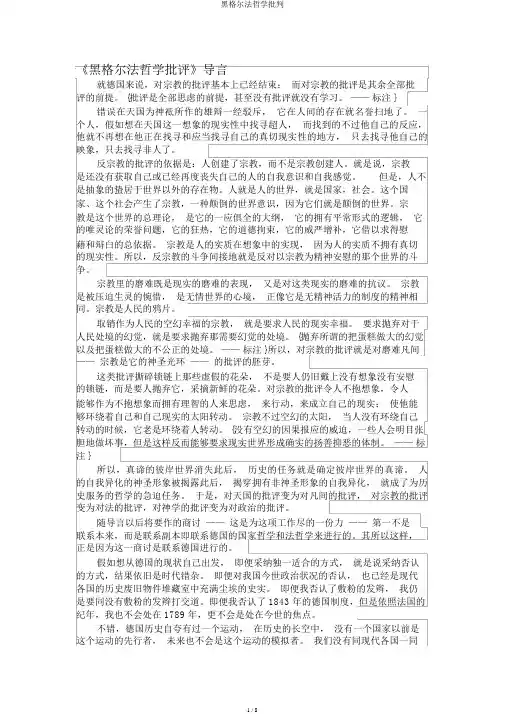
黑格尔法哲学批判导言英语
- 格式:docx
- 大小:36.83 KB
- 文档页数:2
黑格尔法哲学批判导言英语
Introduction to Hegel's Critique of Legal Philosophy
Hegel's Critique of Legal Philosophy, also known as Hegel's Legal
Philosophy, is a seminal work in the field of jurisprudence. In this
philosophical treatise, Hegel delves into the essence and
foundations of law and legal systems, exploring their philosophical
underpinnings and implications.
The central aim of Hegel's Critique is to uncover the contradictions
and limitations inherent in traditional legal theories and practices.
Hegel argues that the prevailing approach to law fails to grasp its
dynamic and dialectical nature, resulting in an incomplete
understanding of its role in society.
Drawing from his broader system of thought, Hegel critiques the
"abstract formalism" that dominates legal philosophy at the time.
He argues that by reducing the law to a set of static principles and
formal categories, legal theorists overlook its connection to social,
historical, and cultural contexts. According to Hegel, law should be
understood as an evolving and organic phenomenon, shaped by the
ongoing development of human consciousness and societal
relations.
Hegel also challenges the notion of individual rights as the
foundation of legal systems. He argues that the rights of
individuals must be reconciled with the needs and interests of the
community as a whole. This requires a dynamic and dialectical
process of negotiation and mediation, where the tensions between
individual freedoms and communal responsibilities are resolved.
Moreover, Hegel emphasizes the role of the state in enforcing and
upholding legal norms. In his view, the state represents the
embodiment of universal reason, mediating between the conflicting
interests and desires of individuals. This leads Hegel to advocate
for a strong and authoritative state, capable of creating and
maintaining a just legal order.
Overall, Hegel's Critique of Legal Philosophy serves as a
foundational text in the study of law and legal theory. Its emphasis
on the dialectical and historical dimensions of law, as well as the
importance of the state in governing society, has had a profound
influence on subsequent legal philosophers and scholars.