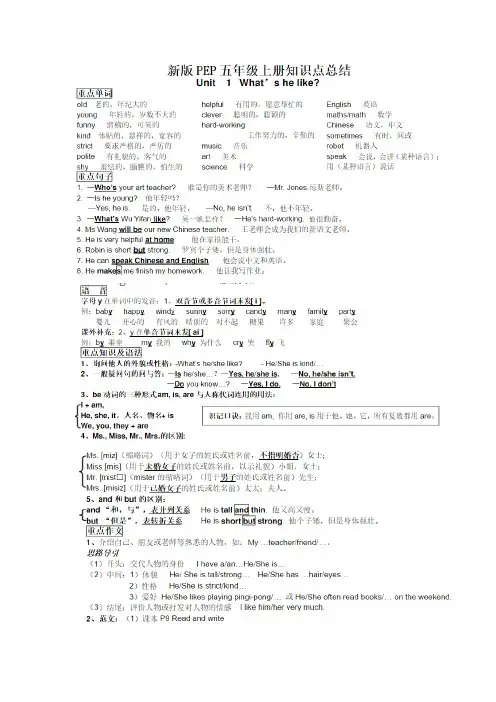
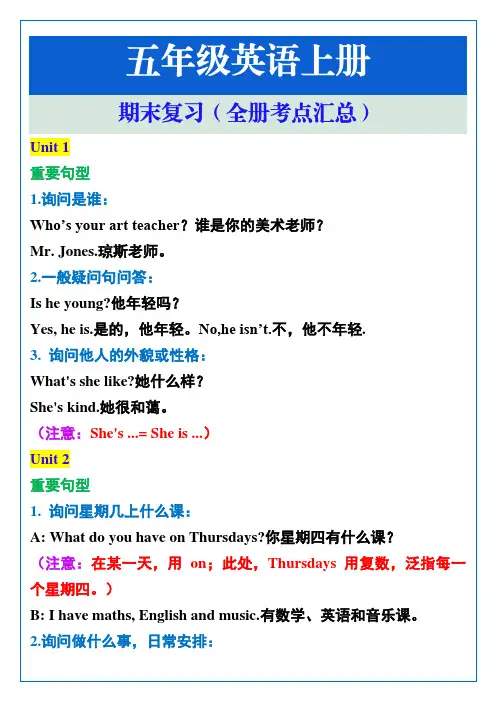
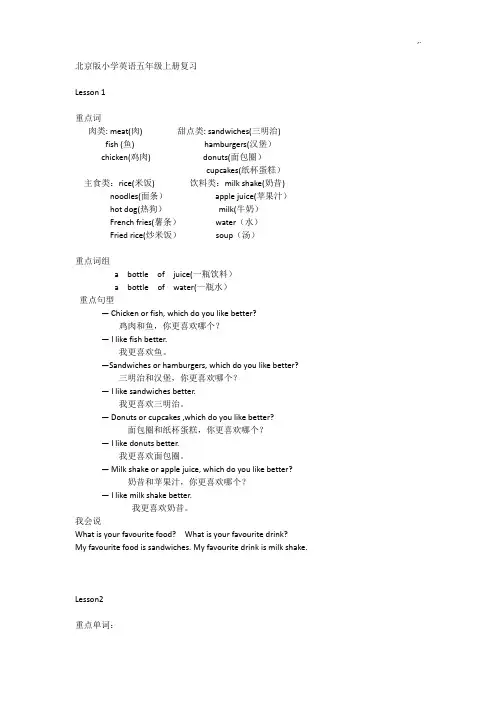
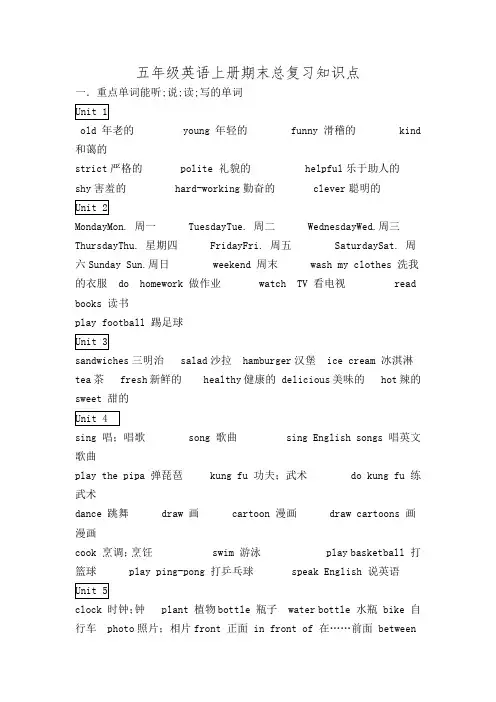
小学五年级英语复习材料
- 格式:docx
- 大小:22.17 KB
- 文档页数:9
小学五年级英语复习材料本学年重点时态:一般过去时一.动词的过去式(一)规则动词的过去式变化如下:1. 一般情况下,动词词尾加-ed ,如:work ---worked play---played wanted wanted act acted2、以不发音的-e 结尾动词,动词词尾加-d ,如:live---lived m ove moved taste---tasted hope---hoped3、以辅音字母+ y结尾的动词,把-y变为-i再加-ed,如:study---studied copy---copied cry---cried carry---carried4、以一个辅音字母结尾的重读闭音节动词,双写词尾辅音字母,再加-ed ,如:stop ---stopped skip ——skipped5、不规则动词的过去式变化规律性不强,须多加记忆。
go - went make - made get - got buy - bought come - came fly-flew(二)不规则动词的过去式的构成1把动词原形中的i改为a,变成过去式。
如:begin —began,drink —drank ,give —gave,ring —rang ,sing —sang,sit —sat ,swim—swam2. 把重读开音节中的i改为o,变成过去式。
如:drive —drove , ride —rode , write —wrote3. 改动词原形中的aw / ow为ew,变成过去式。
如:draw —drew, grow —grew , know —knew, throw —threw (动词show除外,show—showed)4. 动词原形中的e改为o,变成过去式。
如:get —got , forget —forgot5. 动词原形中的ee改为e,变成过去式。
如:feed —fed , meet —met6. 动词原形中的eep 改为ept ,变成过去式。
如:keep —kept , sleep —slept , sweep —swept7.动词原形中的eak 改为oke ,变成过去式。
如:break —broke ,speak —spoke8.动词原形中的ell 改为old ,变成过去式。
如:sell —sold ,tell —told9. 动词原形中的an改为oo,变成过去式。
如:stand —stood ,understand —understood10. 以ought 和aught 结尾,且读音是〔:t 〕的过去式。
如:bring —brought , buy —bought , think —thought , catch —caught , teach —taught11. 以ould结尾且读音为〔ud〕的情态动词过去式。
如:can—could , shall —should , will —would12. 把动词原形中的o改为a,变成过去式。
如:come—came, become —became13. 在动词原形后加d 或t 变成过去式,并且发生音变。
如:hear〔hi 〕—heard〔h :d〕, say 〔sei〕—said〔sed〕, mean〔mi:n〕—meant〔ment〕14. 动词的过去式与动词原形一样。
如:let —let , must —must, put —put , read —read 〔red 〕15. 不符合上述规律的动词过去式。
如:am, is —was, are —were , build —built , do —did , eat —ate , fall —fell , feel —felt , find —found , fly —flew , go —went, have /has—had, hold —held , leave —left , make —made, may —might , run —ran , see —saw, take —took 过去式“ -ed”的发音规则(1)动词词尾为“ t, d” 时,发/ id / 音,want T wan ted 要)need t needed (需要)(2)动词词尾为清辅音时,发/ t / 音。
help t helped (帮助)laugh t laughed (笑)look t looked (看)kiss tkissed (吻)wash t washed (洗)watch t—watched (注视)(3)动词词尾为t , d以外之浊辅曰或元曰时,发/ d / 音。
call t called (叫)stay t stayed (停留)cry t cried (哭)般过去时的一般疑问句及回答、肯定句与否定句、特殊疑问句:1.Did you/she/he/they/we .... ?Yes, I /she/he/they /we did.No,I/she/he/they /we didn ' t.a. he play football?b. Did you TV last night? No, he Yes, I2. Last year, Lingling went to 英国). She (visit) Big Ben and the London Eye. She (send) Daming a postcard.In July, Daming to Hainan. Hainan is the south of China. Hein the sea.Yesterday is Sunday. We go th school. We stayed at home anda book. We watch TV(England visited sent went in swam didn ' t read didn 't)3. What did you /he/she /they/we do/eat..?A.B.A.B. Where did you /he/she /they/we go?How did you /he/she /they/we go there?What did you do three days ago?Where did heHe. (went to school. ...)yesterday?to a children 's theatre.A. How did he go there?B. He went there ______ _______ .(乘公共汽车)一般将来时:一般将来时的特殊疑问句与回答:Where are you/they/we going to go ?Where is he/ she going to go?What are you/they/we going to do/ take?What is he/ she going to do /take?When are you/they/we going to go there?When is he /she going to go there?1. Where is Daming going to go? He is going to ______________ ____ ______ .(2. What are you going to eat? I am going to eat a ___________________ .(香肠)3. When are we going to go to the patk?We are going to go to the park at nine o 'clock tomorrow morning.(be going to = will)I ____ be home at seven o 'clock.I will ____ ________ (做作业) after school.现在进行时:(be 动词加现在分词)现在分词的构成:1一般加ing: walking flying; 2. 以e 结尾的词去 e 加-ing :write-writing have-having take-taking; 3. 以重读闭音节或r 音节结尾,有一个福辅音字母的词,要双写这个辅音字母再加-ing :run-running swimswimming; 4. 以ie 结尾的重读开音节的词,变ie为y,再加-ing : die-dying.What are you/they doing now?What is he /she doing now?I am writing a letter. What are you doing now? _______________________ (Iam doing homework ..... )Look ,what ____ he doing now? He is ____ ( eat eating ) an ice cream. 去美国)末尾只一般现在时:在一段时间重复做的动作。
1. 一般现在时,第一、二人称、第三人称复数用动词原形,否定形式don 't 加动词原形:I go to school every day. 我每天都去上学。
You study Chinese and Maths evrey day. 你每天都学语文数学。
They play basketball in the afternoon. 他们下午都打篮球。
We don 't have lunch at 11 o 'clock.第三人称单数(动词要加s 或es ;否定形式doesn 't 加动词原形。
She likes dolls very much. 她非常喜欢洋娃娃。
Lingling goes to school at seven o 'clock. 林玲7 点钟上学。
He doesn 't like reading books. 一般现在时的一般疑问句:Do you /they watch a play? Yes, I /they do. /No, I/they don 't.Does he /she / Daming go to the school? Yes, he/she does. /No, he/shedoesn 't.Can 的运用:人称加can 加动作:She can take some photoes and she can send emails.人称加can 't 加动作:We can 'tgo out because it 's raining now. 我们不能出去因为现在在下雨。