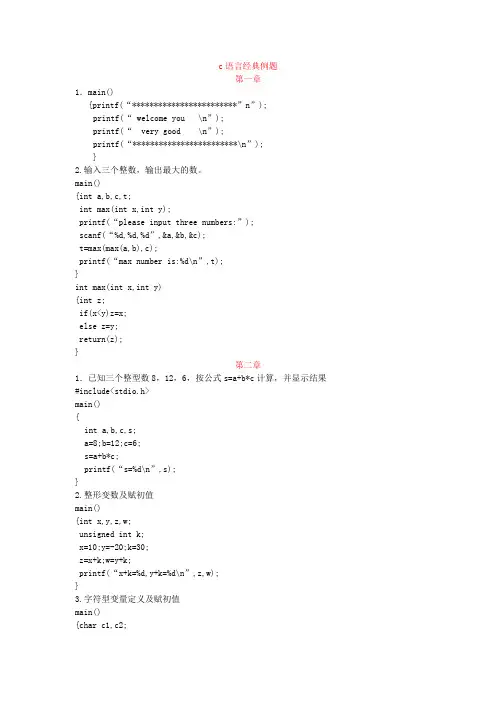
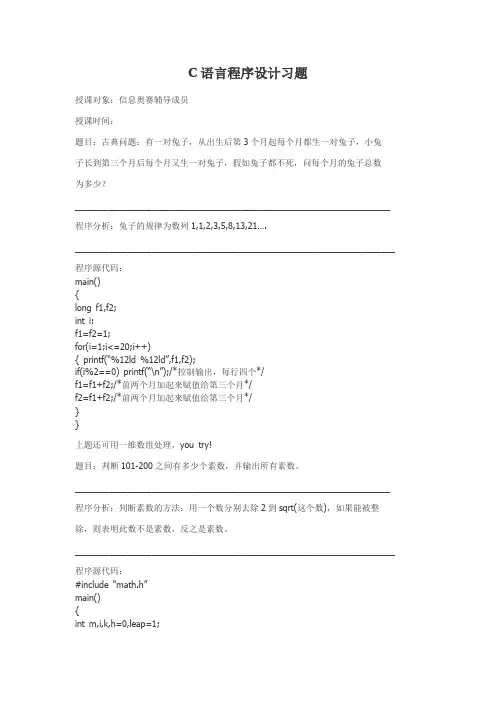
c语言经典题目
- 格式:docx
- 大小:13.11 KB
- 文档页数:7
c语言经典题目
C语言经典题目-数学问题_c语言经典数学问题编程例题-CSDN博客
1、一个整数x的全部因子(包括1,不包括x本身)之和等于y;并且正数y的全部因子(包括1,不包括y本身)之和等于x,则将整数x和y称为亲密数,求3000以内的全部的亲密数
#include
int getDivisorSum(int n) { // 计算n的所有因子之和
int sum = 0;
for (int i = 1; i <= n / 2; i++) {
if (n % i == 0) {
sum += i;
}
}
return sum;
}
int main() {
for (int i = 1; i <= 3000; i++) {
int y = getDivisorSum(i); // 计算i的因子和
if (getDivisorSum(y) == i && i < y && y <=
3000) { // 判断i和y是否为亲密数
printf("(%d, %d)\n", i, y); // 输出亲密数
}
}
return 0;
} 2、c语言:判断1-200之间的素数
#include
#include
bool isPrime(int n) { // 判断n是否为素数的函数
if (n <= 1) {
return false;
}
for (int i = 2; i * i <= n; i++) {
if (n % i == 0) {
return false;
}
}
return true;
}
int main() {
for (int i = 1; i <= 200; i++) {
if (isPrime(i)) { // 判断i是否为素数
printf("%d ", i); // 输出素数
}
}
printf("\n");
return 0;
}
3、求最大公约数和最小公倍数
//辗转相除法
#include
int main()
{
int a = 0; int b = 0;
scanf("%d %d", &a, &b);
int z = a * b;
//求最大公约数:
int c = 0;
while (a % b != 0)
{
c = a % b;
a = b;
b = c;
}
printf("最大公约数为:%d\n", b);
//求最小公倍数:
int min = z / b;
printf("最小公倍数:%d\n", min);
return 0;
}
4、进制转换
进制转换是人们利用符号来计数的方法。进制转换由一组数码符号和两个基本因素“基数”与“位权”构成。基数是指进位计数制中所采用的数码(数制中用来表示“量”的符号)的个数。位权是指进位制中每一固定位置对应的单位值。
• 将p进制数x转换为十进制数y
int y = 0,product = 1;
while(x != 0)
{
y = y + (x % 10)*product; //(x%10)获取个位数 x = x / 10; //去掉个位数
product = product * p; //p代表位权
}
• 将十进制数y转换为Q进制数
int array[111];
int num = 0;//余数的位数
do{
array[num++] = y%q;//除基取余
y /= q;
} while(y != 0) //当商不为0时进行循环
//然后再注意逆序输出数组即可
5、c语言:给你两个字符串:ransomNote 和 magazine ,判断 ransomNote 能不能由 magazine 里面的字符构成。
如果可以,返回 true ;否则返回 false 。
magazine 中的每个字符只能在 ransomNote 中使用一次
#include
#include
bool canConstruct(char * ransomNote, char * magazine){
int count[26] = {0}; // 使用数组记录magazine中每个字符出现的次数
while (*magazine != '\0') { // 遍历magazine字符串,统计每个字符出现的次数
count[*magazine - 'a']++;
magazine++; }
while (*ransomNote != '\0') { // 遍历ransomNote字符串,检查每个字符是否可以使用
if (count[*ransomNote - 'a'] > 0) {
count[*ransomNote - 'a']--;
} else {
return false;
}
ransomNote++;
}
return true;
}
int main() {
char ransomNote[] = "aa", magazine[] = "aab";
bool result = canConstruct(ransomNote, magazine);
if (result) {
printf("ransomNote字符串可以由magazine字符串中的字符构成\n");
} else {
printf("ransomNote字符串无法由magazine字符串中的字符构成\n");
}
return 0;
}
注释:在C语言中,字符是一个整数类型,每个字符都对应一个ASCII码值,该值在0到127之间。其中,小写字母a到z对应的ASCII码值为97到122。因此,当我们使用表达式
*magazine - 'a' 时,实际上是将magazine指针指向的字符减去字符'a'的ASCII码值,得到一个0到25之间的整数,这个整数就可以用来作为一个数组的下标,用来记录magazine中每个字符出现的次数。例如,当magazine中出现了一个字符'b'时,我们可以使用表达式 count['b'-'a']++ 将count数组中下标为1的元素加1,表示字符'b'在magazine中出现了一次。
6、c语言:给你单链表的头结点 head ,请你找出并返回链表的中间结点。
如果有两个中间结点,则返回第二个中间结点
#include
#include
struct ListNode {
int val;
struct ListNode *next;
};
struct ListNode* middleNode(struct ListNode* head) {
struct ListNode *slow = head, *fast = head;
while (fast != NULL && fast->next != NULL) { // 快慢指针遍历链表
slow = slow->next;
fast = fast->next->next;
}
return slow;
}
int main() {
// 构造一个单链表
struct ListNode *head = (struct ListNode*)
malloc(sizeof(struct ListNode));
head->val = 1;
head->next = (struct ListNode*)
malloc(sizeof(struct ListNode)); head->next->val = 2;
head->next->next = (struct ListNode*)
malloc(sizeof(struct ListNode));
head->next->next->val = 3;
head->next->next->next = (struct ListNode*)
malloc(sizeof(struct ListNode));
head->next->next->next->val = 4;
head->next->next->next->next = (struct ListNode*)
malloc(sizeof(struct ListNode));
head->next->next->next->next->val = 5;
head->next->next->next->next->next = NULL;
// 输出链表中间结点的值
struct ListNode *middle = middleNode(head);
printf("链表中间结点的值为:%d\n", middle->val);
return 0;
}