
Passive voice
- 格式:ppt
- 大小:776.50 KB
- 文档页数:30


文章标题:深度解析Passive Voice语法表
在英语语法中,Passive Voice(被动语态)是我们学习和掌握的重要内容之一。通过Passive Voice的运用,我们可以使句子结构更加灵活多样,表达方式也更加丰富。在本文中,我将从Passive Voice的定义、结构、使用场景以及与Active Voice的比较等多个角度进行全面评估,帮助你更全面、深入地掌握Passive Voice的语法表。
1. Passive Voice的定义
Passive Voice是指句子的宾语成为主语,而动作的执行者则变成了句子的主语。在Passive Voice的句子结构中,通常使用助动词be(am/is/are/was/were)加上动词的过去分词形式来构成。“The
letter is written by Tom.”(这封信是汤姆写的),其中,“The
letter”成为主语,而“Tom”则成为了主语的补语。
2. Passive Voice的结构
Passive Voice的句子结构通常为:“被动语态助动词(am/is/are/was/were)+ 及物动词的过去分词+ by + 动作执行者”。需要注意的是,当动作执行者未知或不重要时,也可以省略by短语。另外,需要注意的是在句子的时态转换和语态转换过程中,时态和语态的一致性也是需要额外注意的。
3. 使用场景 Passive Voice通常用于以下几种情况:
- 当动作执行者未知或不需要指出时。
- 当动作执行者不重要,只需要突出动作的发生时。
- 当强调对象而非主语时。
4. 与Active Voice的比较
与Active Voice相比,Passive Voice在句子结构和语法使用上有所不同。在Active Voice中,执行者在句子中占有主要位置,而在Passive Voice中,对象或接受动作的人或事物在句子中更加突出。
总结回顾
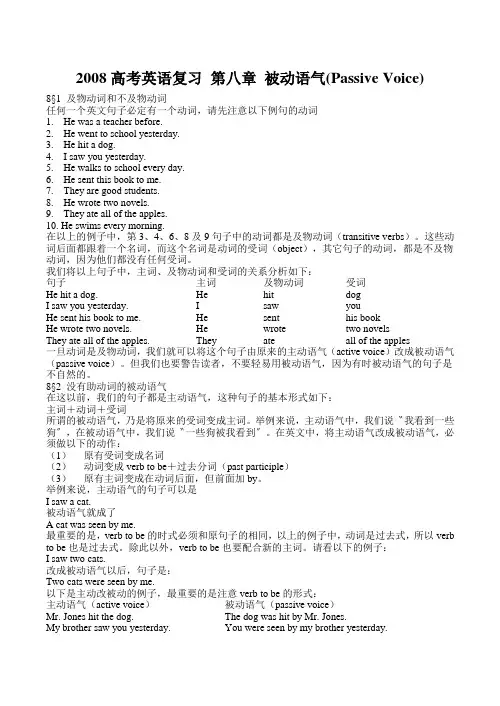
2008高考英语复习 第八章 被动语气(Passive Voice)
8§1 及物动词和不及物动词
任何一个英文句子必定有一个动词,请先注意以下例句的动词
1. He was a teacher before.
2. He went to school yesterday.
3. He hit a dog.
4. I saw you yesterday.
5. He walks to school every day.
6. He sent this book to me.
7. They are good students.
8. He wrote two novels.
9. They ate all of the apples.
10. He swims every morning.
在以上的例子中,第3、4、6、8及9句子中的动词都是及物动词(transitive verbs)。这些动词后面都跟着一个名词,而这个名词是动词的受词(object),其它句子的动词,都是不及物动词,因为他们都没有任何受词。
我们将以上句子中,主词、及物动词和受词的关系分析如下:
句子 主词 及物动词 受词
He hit a dog. He hit dog
I saw you yesterday. I saw you
He sent his book to me. He sent his book
He wrote two novels. He wrote two novels
They ate all of the apples. They ate all of the apples
一旦动词是及物动词,我们就可以将这个句子由原来的主动语气(active voice)改成被动语气(passive voice)。但我们也要警告读者,不要轻易用被动语气,因为有时被动语气的句子是不自然的。

莆田雷丁英语,预约免费试听体验课程: /
雷丁英语是中国实用型英语培训机构,通过全英语环境与外教一对一的模式提高学员英语口语水平,提供英语口语培训,成人英语培训,商务英语培训,青少年英语等课程。 被动语态详解
被动语态 Passive voice
语态(voice)是动词的一种形式,用以表示主语和谓语之间的关系。
英语语态分为两种,一种是主动语态(active voice)另一种是被动语态(passive voice)主动语态表示,主语是动作的执行者。
Yesterday I parked my car outside the school.
被动语态表示主语时动作的承受者。
A sound of piano is heard in the adjoining room.
被动语态常由助动词be以及及物动词的过去分词所构成。被动语态可以用在各种时态里,最常见的有以下几种种。
一般现在时 You are wanted in the office. I am not so easily deceived.
一般过去时 I was invited to the concert. Our house was built in 1969.
一般将来时 We hope that an agreement will be arrived at.
现在完成时 My car has been repaired. The part has been planned since the
New Year.
过去完成时 I looked at the lanterns that had been lighted and placed near the opening.
现在进行时 The question is being discussed at the meeting. The children are being

被动语态(Passive voice)讲解
By Rebecca
一、被动语态的基本时态变化
1) am/is/are +done (过去分词) 一般现在时
例Visitors are requested not to touch the exhibits.
2) has /have been done 现在完成时
例All the preparations for the task have been completed, and we're ready to start.
3) am/is /are being done 现在进行时
例A new cinema is being built here.
4) was/were done 一般过去时
例I was given ten minutes to decide whether I should reject the offer.
5) had been done 过去完成时
例 By the end of last year, another new gymnasium had been completed in Beijing.
6) was/were being done 过去进行时
例A meeting was being held when I was there.
7) shall/will be done/ be going to be done/ be about to be done一般将来时
例Hundreds of jobs will be lost if the factory closes.
8)带情态动词的被动结构。其形式为:情态动词+be+过去分词。
例The baby should be taken good care of by the baby-sitter.