
初中英语的八大时态的一张表
- 格式:docx
- 大小:36.08 KB
- 文档页数:1
初中英语的八大时态的一张表
时态 名称
一般现在时 Present Simple
一般过去时 Past Simple
现在进行时 Present Continuous
过去进行时 Past Continuous
现在完成时 Present Perfect
过去完成时 Past Perfect
将来时 Future Simple
过去将来时 Future Perfect
初中英语的八大时态的一张表
时态 名称
一般现在时 Present Simple
一般过去时 Past Simple
现在进行时 Present Continuous
过去进行时 Past Continuous
现在完成时 Present Perfect
过去完成时 Past Perfect
将来时 Future Simple
过去将来时 Future Perfect
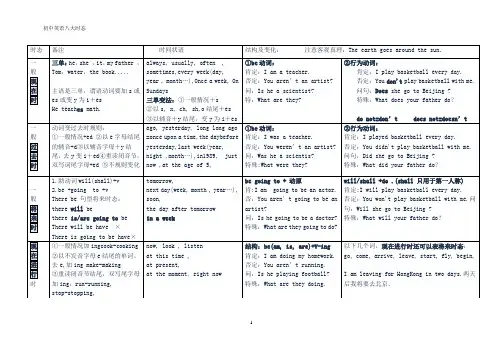
初中英语八大时态
1 时态 备注 时间状语 结构及变化: 注意客观真理:The earth goes around the sun.
一
般
现
在
时 三单:he,she ,it,my father ,Tom,water,the book.....
主语是三单,谓语动词要加s或es或变y为i+es
He teaches math. always, usually, often ,
sometimes,every week(day,
year , month…),Once a week, On
Sundays
三单变法:①一般情况+s
②以s, x, ch, sh,o结尾+es
③以辅音+y结尾,变y为i+es ①be动词:
肯定:I am a teacher.
否定:You aren’t an artist?
问:Is he a scientist?
特:What are they?
②行为动词:
肯定:I play basketball every day.
否定:You don't play basketball with me.
问句:Does she go to Beijing ?
特殊:What does your father do?
do not=don’t does not=doesn’t
一
般
过
去
时 动词变过去时规则:
①一般情况+ed ②以e字母结尾的辅音+d③以辅音字母+y结尾,去y变i+ed④重读闭音节,双写词尾字母+ed ⑤不规则变化 ago, yesterday, long long ago
=once upon a time,the daybefore
yesterday,last week(year,
night ,month…),in1989, just
now ,at the age of 5, ①be动词:
肯定:I was a teacher.

初中英语八大时态总结
英语时态是英语的一个重要部分,时态使用正确与否,直接影响着句子的准确表达。初中阶段的学生应该掌握八大基本时态,包括:
1. 一般现在时(Simple Present):表示经常性的、习惯性的动作或存在的状态。
结构:主语 + 动词原形 / 动词第三人称单数形式(s或es)
例如:I go to school every day.(我每天上学。)
He likes playing football.(他喜欢踢足球。)
2. 一般过去时(Simple Past):表示过去发生的动作或存在的状态。
结构:主语+动词过去式
例如:She walked to the park yesterday.(昨天她走到公园。)
3. 一般将来时(Simple Future):表示将来会发生的动作或存在的状态。
结构:主语 + will / shall + 动词原形
例如:We will go camping next weekend.(我们下周末去野营。)
4. 现在进行时(Present Continuous):表示正在进行的动作。
结构:主语 + am / is / are + 现在分词(动词-ing形式)
例如:They are watching TV now.(他们现在正在看电视。)
5. 过去进行时(Past Continuous):表示过去其中一时间正在进行的动作。 结构:主语 + was / were + 现在分词
6. 将来进行时(Future Continuous):表示将来其中一时间将要进行的动作。
结构:主语 + will be + 现在分词
7. 现在完成时(Present Perfect):表示过去的其中一时间开始,一直延续到现在的动作或状态。
结构:主语 + have / has + 过去分词
例如:We have lived here for ten years.(我们在这里已经住了十年。)

英语主动语态八大时态结构
在英语中,动词的时态对于表达事件发生的时间和语气非常重要。英语中共有八种主要时态结构,分别是简单现在时、进行时(现在进行时)、完成时(现在完成时)、一般过去时、过去进行时、过去完成时、一般将来时和将来进行时。
一、简单现在时(Simple Present Tense):表示经常性或习惯性的动作或状态,也用于陈述事实、观点等。
结构:主语 + 动词原形(第三人称单数形式需加-s/-es) 【例子】I eat an apple every day.(我每天吃一个苹果。)
二、进行时(Present Continuous Tense):表示正在进行的动作,用于临时性或短暂性的动作,强调动作的进行过程。
结构:主语 + am/is/are + 动词-ing形式 【例子】She is
watching TV now.(她正在看电视。)
三、完成时(Present Perfect Tense):表示过去发生的动作对现在造成的影响或结果,或强调过去的经验。
结构:主语 + have/has + 过去分词 【例子】He has finished his
homework.(他已经完成了他的作业。)
四、一般过去时(Simple Past Tense):表示过去发生的动作或状态。
结构:主语 + 动词过去式 【例子】We played football yesterday.(我们昨天踢足球。)
五、过去进行时(Past Continuous Tense):表示在过去一些时间正在进行的动作。 六、过去完成时(Past Perfect Tense):表示过去一些动作已经发生在另一个动作之前。
结构:主语 + had + 过去分词 【例子】I had already eaten
dinner when she arrived.(她到达时我已经吃过晚饭了。
七、一般将来时(Simple Future Tense):表示将来一些时间或将来经常性的动作。

名称肯定句否定句一般疑问句①主语+ am/is/are动词+ 其他;主语+ am/is/are + not + 其他; Am/is/are+主语+ 其他②主语+ 动词(原形)+ 其他主语(三单)+动词(三单)+其他主语+don't+动词(原形)+其他,主语(三单)+doesn't+动词(原形)+ 其他;Do+主语+ 动词(原形)+ 其他Does+主语+ 动词(原形)+ 其他①主语+ was/were + 其他;主语+ was/were + not + 其他; Was/were +主语+ 其他②主语+动词(过去式)+ 其他主语+didn't+动词(原形)+其他,Did+ 主语+动词(原形)+ 其他现在进行主语+ am/is/are + doing + 其他.主语+am/is/are+not+doing+其他. Am/is/are+主语 + doing + 其他过去进行主语+ was/were + doing + 其他.主语+was/were+not+doing+其他.Was/were+主语+ doing + 其他①主语+am/is/are/goingto+do+其他;①主语+am/ia/are+not+goingto+do + 其他;Am/is/are/+主语+goingto+do+ 其他;②主语+ will/shall + do + 其他.②主语+will/shall+not+do+其他 Will/shall +主语+ do + 其他.①主语+was/were/goingto+do+其他;①主语+was/were+not+goingto+do + 其他;Was/were/+主语+goingto+do+其他;②主语+would/should+do+其他.②主语+would/should+not+do+其他.②Would/should+主语+ do + 其他.
现在完成主语+ have/has + done + 其他.主语+ have/has + not +done + 其他. Have/has +主语+ done + 其他.