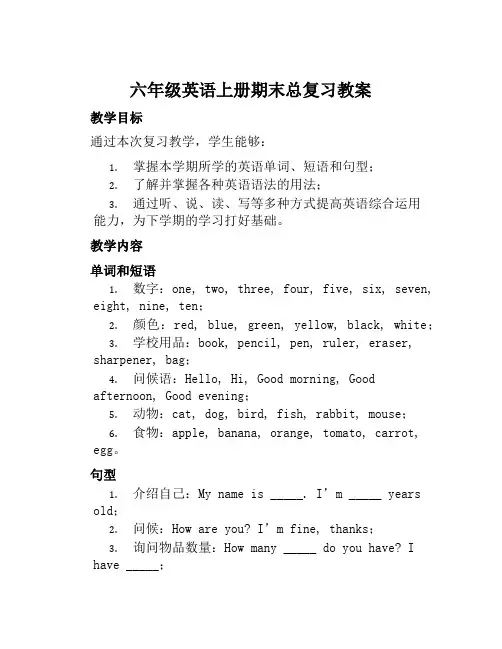
六年级英语总复习课教案范文
- 格式:docx
- 大小:28.38 KB
- 文档页数:18
六年级英语总复习课教案范文
在教学中,谨慎备课,谨慎阅读教科参考书,结合自己的教学经历与学生的学习状况,谨慎编写好教案制定好教学打算。在传授学生学问的同时,关怀爱惜学生,特殊是差生,课堂亲密留意他们,教育他们求学勿半途而废。以下是我带来的六年级英语总复习课教案内容,感谢您的阅读,盼望能协助到您!
六年级英语总复习课教案1
Lesson 1
A:What time is it?
B:It’s 12:00. It’s time for lunch.
A:Do you have lunch at 12:00?
B:Yes, I do.
A:What do you have for lunch?
B:I have rice for lunch.
Lesson 2
A:Do you do your homework on Sundays?
B:Yes, I do.
A:Do you watch TV in the evening?
B:No, I dont.
A:Does Lele do sports every day? B:Yes, he does.
A:Does he play football after lunch?
B:No, he doesnt.
Lesson 3
A:Do you come from Chengjiao?
B:No, I dont. /Yes, I do.
A:Where do you come from?
B:I come from Baitugang.
A:Do you live in Baitugang?
B:No, I dont. /Yes, I do.
A:Where do you live?
B:I live in Nanyang.
A:Does he come from Chengjiao?
B:No, he doesnt. /Yes, he does.
A:Where does he come from?
B:He comes from Baitugang.
A:Does he live in Baitugang?
B:No, he doesnt. /Yes, he does.
A:Where does he live?
B:He lives in Nanyang.
Lesson 4
A:Do you usually get up at 7:00? B:No, I dont. /Yes, I do.
A:What time do you get up?
B:I get up at 6:30.
A:Does he go to school at 7:00?
B:No, he doesnt. /Yes, he does.
A:When does he go to school?
B:He goes to school at 7:30.
Lesson 5
A:Do you go to school by bike?
B:No, I dont. /Yes, I do.
A:How do you go to school?
B:I go to school on foot.
=I walk to school.
A:Does he go to Beijing by car?
B:No, he doesnt. /Yes, he does.
A:How does he go to Beijing?
B:He goes to Beijing by train.
Lesson 7
A:Do you like apples?
B:Yes. Pass me one, please.
A:Here you are.
B:Thank you. A:Would you like beef?
B:Yes. Give me some, please.
A:Here it is.
B:Thank you.
Lesson 8
A:Is your mother tall or short?
B:She’s tall.
A:Is she fat or thin?
B:She’s thin.
A:Is she young or old?
B:She’s not young, but not very old.
A:Is her hair long or short?
B:Her hair is short.
Lesson 9
A:Who is taller, Lele or Lili?
B:Lili is taller.
A:Which is faster, a bus or a car?
B:A car is faster.
A:Which hotel is cleaner?
B:The bigger one is cleaner.
A:Which one is cheaper?
B:The smaller one is. Lesson 10
A:Who is younger, Gege or Meimei?
B:Gege is much younger than Meimei.
A:Which is taller, the giraffe or the deer?
B:The giraffe is much taller than the deer.
Lesson 11
(It’s December 25.)
A:Merry Christmas.
B:Merry Christmas.
A:Wow, what a beautiful tree!
And so many presents on it.
B:Gege, this toy dog is for you.
Meimei, these books are for you.
六年级英语总复习课教案2
教学目标:
1、能够听、说、读、写短语:on foot, by bike, by
bus, by train。
2、能够听、说、认读短语:by plane, by ship, by
subway。
3、能用句子 “how do you go to school? how do
you go to canada/…?”
来替换询问别人的出行方式;并能够用句子 “i go by…” 进展答复。
4、听懂、会吟唱lets chant的歌谣。
5、协助学生了解交通规那么,并在生活中自觉遵守交通规那么。
教学重难点:
驾驭四会短语和a lets learn局部中运用某种交通工具去某地的表达法,并能替换关键词进展问答。
课前打算:
1、老师打算lets start局部和主情景图的教学课件。
2、老师打算录音机和本课时的录音带。
3、老师打算a lets learn局部的单词卡片。
教学步骤:
一、热身(warm-up)
1、复习副词:always,usually,often,sometimes,never的读音与词义。
t: when do you get up? / when do you go to
school? …
(引导学生用always,usually,often,sometimes答复)
2、t:today i go to school by bus. i usually go to
school on foot.
老师利用肢体动作协助学生理解句子意思。 t:what about you? do you go by bike or by bus?
do you go on foot? or by
car? 师生之间自由会话,引出几种常见的交通方式。引导学生看本课lets start局部的标图并回答下列问题。
二、预习(preview)
1、lets chant
老师放本课lets chant局部的录音,唱到on foot时,全班跺跺脚;唱到by car/ bike/ bus/ plane/
train的时候,学生做出相应的动作。然后老师依据歌谣内容随机出示lets learn局部的单词卡片加深学生印象,全班学生再跟录音边唱边做一遍。
三、新课呈现(presentation)
lets learn
1、老师做动作,自问自答: “how do i go to school?
i go to school by bike.” 并在黑板上写下:by
bike。老师再重复刚刚的句子并问某一学生: what
about you? how do you go to school? 老师协助学生说出完整的句子:
“i go to school by…” 并将相应的短语写在黑板上。
2、看短语贴卡片嬉戏
老师依次出示画着不同交通工具的短语卡片,让学生快速地贴在黑板上的by短语旁边,老师领读短语和句子 “l go to school by...”
3、“快速反响” 嬉戏
老师说出某个短语,如:by bike,让学生做相应的动作并说出句子,如:i go to school by bike.
4、老师拿出刚刚学生可能没有提到的交通工具的图片,如:by plane/subway/ ship/
boat等,呈现和练习这些短语。然后指着课本上的配图问:“what can you see in the pictures?” 留意引导学生理解地铁的含义:
“its an underground railway in a city. it travels very
fast.” 老师领读新学短语。
5、学生听录音,跟读lets learn局部的内容。老师留意订正学生的语音、语调。