情态动词+have done
- 格式:pdf
- 大小:198.38 KB
- 文档页数:8
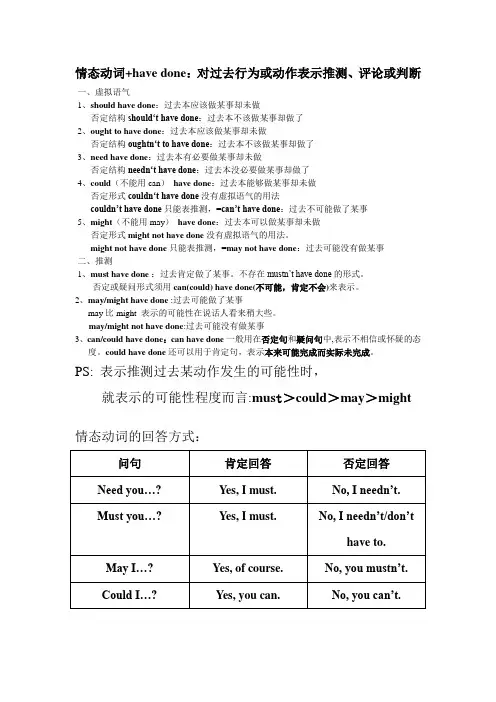
情态动词+have+done是历年高考的重点和难点之一,现将其用法总结归纳如下: 一、 “must+have+done”表示对过去事情的肯定推测,译成“一定做过某事”,该结构只用于肯定句。 1. It must have rained last night, for the ground is wet.昨晚一定下雨了,因为地面还是湿的。 2. You must have been mad to speak to the servant. 你和仆人说话,一定是发疯了。 二、 “can't+have+done”表示对过去事情的否定推测,译成“不可能做过某事”。 1. Mr. Smith can't have gone to Beijing, for I saw him inthe library just now. 史密斯先生不可能去北京了,我刚才还在图书馆见过他。 2. Mary can't have stolen your money. She has gonehome. 玛丽不可能偷你的钱,她回家去了。 三、 “can+have+done”表示对过去行为的怀疑,用于疑问句,译成“可能做过……吗?”。 1. There is no light in the room. Can they have gone out?屋里没有灯,他们可能出去了吗? 2. There is nowhere to find them. Where can they havegone? 到处找不到他们,他们可能到什么地方去呢? 四、 “could+have+done”是虚拟语气,表示对过去事情的假设,意思是本来能够做某事而没有做。 He could have passed the exam, but he was too careless.本来他能够通过考试,但是他太粗心。 五、 “may+have+done”表示对发生过的事情的推测,意思是“可能已经”或“也许已经”,用于肯定句中。 —What has happened to George? —I don't know. He may have got lost. —乔治发生了什么事? ——我不知道,他可能迷路了。 六、 “might+have+done”表示对过去事情的推测,might与may意思相同,但可能性更小。多用于虚拟语气结构中。 1. He might have given you more help, even though hewas busy. (MET90) 他或许会多给你一些帮助,即使他很忙。 2. She might have achieved greater progress, if you hadgiven her more chances. 如果你多给她点机会,她可能已经取得更大的成绩。 七、 “would+have+done”虚拟语气,表示对过去事情的假设,意思是“本来会做”。 1. I would have told you all about the boy's story, butyou didn't ask me. 我本来会告诉你这个小男孩的故事,但是你没有问我。 2. Without your help, I wouldn't have achieved so much.没有你的帮助,我是不会取得如此大的成绩。 八、 “should+have+done”意思是“本来应该做某事,而实际没做。” “shouldn't+have+done”表示本来不应该做某事,而实际做了。含有指责对方或自责的含意。 1. Tom, you are too lazy. The work should have beenfinished yesterday. 汤姆,你太懒惰了,这项工作本来应该昨天就做完的。 2. Look, Tom is crying. I shouldn't have been so harsh onhim. 看,汤姆哭了,我本来不应该对他如此严厉。 九、 “ought to+have+done”表示过去应该做而实际并没有做,译成“理应做……”,往往表示遗憾。与“should+have+done”用法基本一样。 I ought to have gone home last Sunday. 我理应上星期日回家。 You ought not to have given him more help. 你不应该帮助他那么多。 十、 “need+have+done”表示本来需要做某事而没有做。“needn't+have+done”则表示“本来不需要做某事而做了”。 I needn't have bought so much wine—only five peoplecame. 我本来没有必要买这么多酒,只来了五个人。 He need have hurried to the station. In that case, bewouldn't have missed the train. 他本来需要快点去车站,那样的话,他就不会误了火车。
英语:“情态动词+have done”的用法
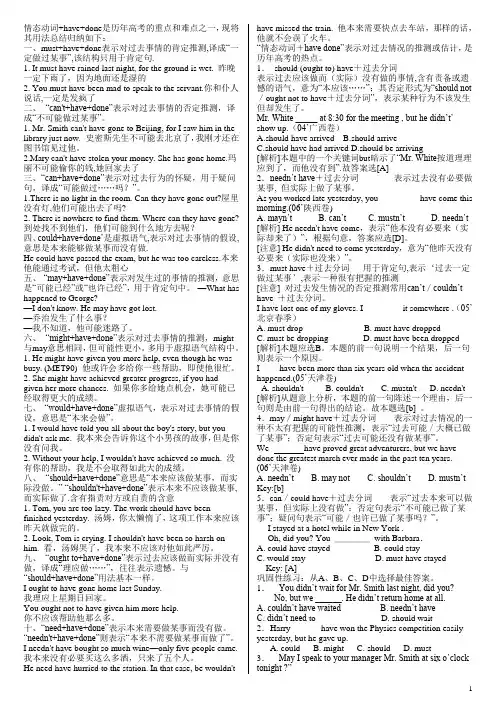
“情态动词+have done”表示对过去情况的推测或估
计,是历年高考的热点。现就这一语言现象作如下归纳:
1. should (ought to) have+过去分词
表示过去应该做而(实际)没有做的事情,含有责备或
遗憾的语气,意为“本应该……”;其否定形式为“should
not/ought not to have + 过去分词”,表示某种行为不
该发生但却发生了。
Mr. White _____ at 8:30 for the meeting , but
he didn’t’ show up. (04’广西卷)
A. should have arrived B. should arrive
C. should have had arrived D. should be arriving
[解析]本题中的一个关键词but暗示了“Mr. White按道
理理应到了,而他没有到”。故答案选[A]。
2.needn’t have+过去分词
表示过去没有必要做某事, 但实际上做了某事。
As you worked late yesterday, you_________
have come this morning. (06’陕西卷)
A. mayn’t B. can’t C. mustn’t
D. needn’t
[解析] He needn't have come,表示“他本没有必要
来(实际却来了)”,根据句意,答案应选[D]。
[注意] He didn't need to come yesterday,意
为“他昨天没有必要来(实际也没来)”。
3.must have+过去分词
用于肯定句,表示“过去一定做过某事”,表示一种很有
把握的推测。
[注意] 对过去发生情况的否定推测常用can’t/
couldn’t have +过去分词。I have lost one of my gloves. I ________ it
somewhere . (05’北京春季)
A. must drop B. must have dropped
C. must be dropping D. must have been
dropped
[解析]本题应选B。本题的前一句说明一个结果,后一句
则表示一个原因。
I _______have been more than six years old
when the accident happened. (05’天津卷)
A. shouldn't B. couldn't C. mustn't
D. needn't
[解析]从题意上分析,本题的前一句陈述一个理由,后
一句则是由前一句得出的结论。故本题选[B] 。
4.may/might have+过去分词
表示对过去情况的一种不太有把握的可能性推测,表
示“过去可能/大概已做了某事”;否定句表示“过去可能还
没有做某事”。We have proved great adventurers, but we
have done the greatest march ever made in the
past ten years. (06’天
津卷)
A. needn’t B. may not C. shouldn’t
D. mustn’t Key:[B]
5.can/could have+过去分词
表示“过去本来可以做某事,但实际上没有做”;否定句
表示“不可能已做了某事”;疑问句表示“可能/也许已做了
某事吗?”。
--- I stayed at a hotel while in New York .
--- Oh, did you? You ____ with Barbara.
(NMET’98)
A. could have stayed B. could stayC. would stay D. must have
stayed Key: [A]
巩固性练习:从A、B、C、D中选择最佳答案。
1.---You didn’t wait for Mr. Smith last night,
did you?
---No, but we ______. He didn’t return home at
all.
A. couldn’t have waited B. needn’t have
C. didn’t need to D. should wait
2.Harry ______ have won the Physics
competition easily yesterday, but he gave up.
A. could B. might C. should D. must
3.---May I speak to your manager Mr. Smith at
six o’clock tonight ?”---“I’m sorry, Mr. Smith to a conference
before then.”
A. will have gone B. had gone C.
would have gone D. has gone
4.---Tom took away our teacher’s cell phone
without being permitted.
--- Really? I can’t imagine that he _______
have done such a thing.
A. must B. may C.
can D. should
5.--- Was it you that made the suggestion?
--- It have been. I can’t remember.
A. need B. must C.
should D. may
6.The weather turned out to be fine yesterday.
I_________ the trouble to carry my umbrella with