四年级英语上册Module3Unit3Aclasspicnicperiod3教案沪教牛津版
- 格式:doc
- 大小:37.50 KB
- 文档页数:2
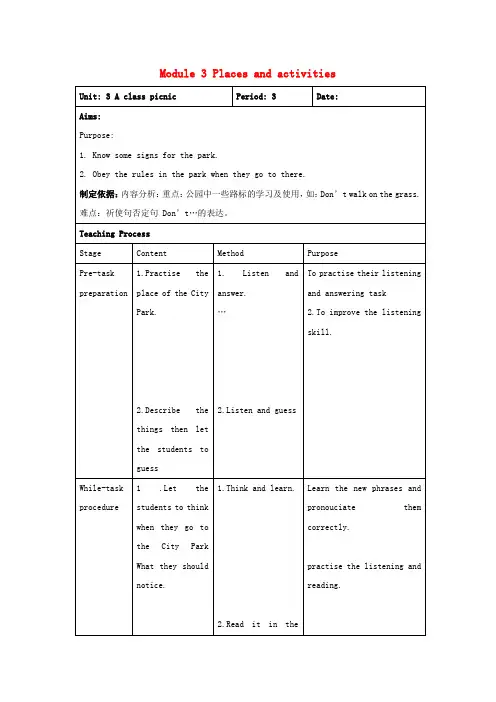

Module3PlacesandactivitiesUnit:3Aclasspicnic Period:4 Date:Aims:thecorrectprepostioninthesentences. therightsentencescancommunicatewiththeotherstudentsallofthesentencesinthisunit.制定依据:内容分析:重点及难点:运用本单元所学句型在交流中正确的表达想法并把其运用到日常生活中。
TeachingProcessStage Content Method PurposePre-task the 1.Read andTopractise reading andpreparation exercises onpagewrite writing33.improvethestudents’the speaking.“gr,fr,tr〞soundscorrectly andtell the otherwords pronoucethesameasthesewords.While-task1.Let the andact Learntousethesesentencesprocedure students to use〞properlyinthelife.What,where,howmuch,howmany〞to make a1dialoguepractise the listening andit inthe reading.whole classto the thencheckittape and repeatafterthetapePost-task Finish thework,activity exercisespapers thencheckit practice what they havelearnedinthisunit..板书:inonunderThinking &Rebuilding两年前的某个早上,开完科会,主任迷之微笑地对我说了一句话,啊勉,从明天开始,你每天发一句英语让大家读。

牛津英语(沪教版)四年级第一学期Module3 Unit3教案A Class Picnic【教学内容】义务教育课程标准试验教科书·牛津英语(沪教版)四年级上册第三单元第三课“A Class Picnic”【教学目标】1、知识与技能:能正确听说读写look and learn 部分的词汇能自如的使用“——What have you got? ——I've got…”句型掌握祈使句和介词的用法2、过程和方法:在预设的“a class picnic”的虚拟情景中,学生学会所学的知识,并能创造性的运用到日常会话中。
3、情感态度价值观:培养学生对英语学习的兴趣及增进学生之间的合作与交流,培养学生用英语对话的能力与意识。
【重点难点】1、重点:祈使句的构成及用法,介词的选择2、难点:What’s…got? I’ve/he’s got…句型如何区分’s的含义。
【教学思路】通过预设的“a class picnic”的虚拟场景下,把学生们带入到第一个公园野餐的场景中,用图片代替实物分发给学生,同时把学生分为几个小组进行对话,操练What’s…got? I’ve /he’s got…句型。
利用多媒体播放第二场city park 的场景,利用图片教学生本课的新词,及用in on under 说些简单的句子,用新词对Where be 句型作出回答,同时引出祈使句的用法。
播放野餐的照片,引出第三个野餐后一起看照片的场景,再次练习介词in on under的用法。
最后练习gr-、fr-、tr-的正确发音。
【教学过程】环节学生活动教师活动设计意图教学时间创设情境导入课程观看老师播放的内容,思考、回答自己想带什么去参加班级野餐用多媒体播放野餐图片导入这节课的主题,“a class picnic”,进入情景,询问学生想要带什么东西去野餐。
学习一些生词sunglass等,提起学生对这节课的兴趣和热情,让学生真正投入到情境中去。

英语四年级上册《A class picnic》优秀教案英语四班级上册《A class picnic》优秀教案教学内容:Look and write教学目标:1. 知识目标:学习用动词来描述动作2. 能力目标:运用标志来发命令3. 情感目标:培育学生遵守纪律的习惯重点难点:Using imperatives to express prohibitions教学准备:tape, radio, some picture cards教学过程:一、Warming-up1. Daily talk2. Act out the dialogue二、Revision1. Some phrases: in the pond on the river under the tree2. Some drills: Where is the fountain? It’s near the tree. Where are the birds? They’re in the aviary.3. Ask and answer: Where is the…? It’s in the…三、Presentation1. Teaching the sign “ close the door” Open the door of the classroom, then draw a sign: Close the door on the board. Say and write: Close the door. Prompt an individual student to close the door. Introduce: a sign Show some signs to the students2. Draw other signs in Look and read on one side of the board. Don’t feed the birds. Don’t pick the flowers. Don’t climb the trees. Don’t walk on the grass. Don’t play in the pond.Read these signsLook and sayGuessing game3. Draw a park scene on the board, then practice the signsTalk about the parkAsk students to copy the signs you have drawn on the board and put them in the right places in the park.Encourage the students to include other signs that they might find in the park.四、Consolidation1. Listen and repeat2. Have the students work in pairs to write the numbers of the signs in the appropriate red circles.3. Distribute a copy of photocopiable page 36 to each student.Find the correct signs.。