
深港版五年级上册Unit1Goodfriends第一课时(杨慧娟)概要
- 格式:ppt
- 大小:2.90 MB
- 文档页数:22

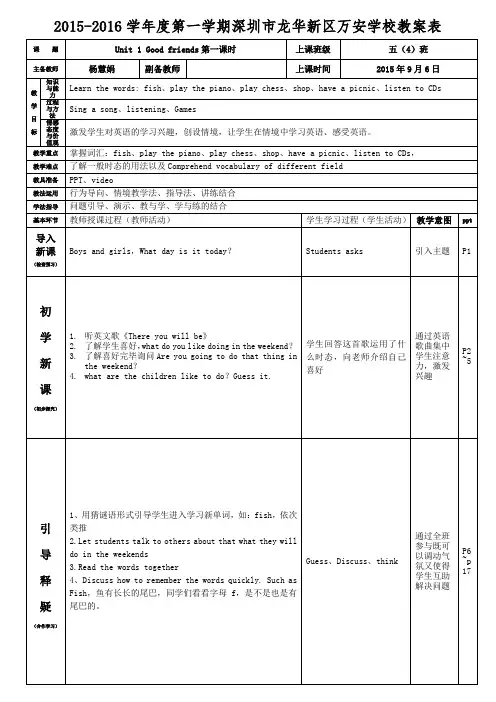
2015-2016学年度第一学期深圳市龙华新区万安学校教案表课题Unit 1 Good friends第一课时上课班级五(4)班主备教师杨慧娟副备教师上课时间2015年9月6日教学目标知识与能力Learn the words: fish、play the piano、play chess、shop、have a picnic、listen to CDs过程与方法Sing a song、listening、Games情感态度与价值观激发学生对英语的学习兴趣,创设情境,让学生在情境中学习英语、感受英语。
教学重点掌握词汇:fish、play the piano、play chess、shop、have a picnic、listen to CDs,教学难点了解一般时态的用法以及Comprehend vocabulary of different field教具准备PPT、video教法运用行为导向、情境教学法、指导法、讲练结合学法指导问题引导、演示、教与学、学与练的结合基本环节教师授课过程(教师活动)学生学习过程(学生活动)教学意图ppt导入新课(检查预习)Boys and girls,What day is it today?Students asks 引入主题P1 初学新课(初步探究)1.听英文歌《There you will be》2.了解学生喜好,what do you like doing in the weekend?3.了解喜好完毕询问Are you going to do that thing inthe weekend?4.what are the children like to do?Guess it.学生回答这首歌运用了什么时态,向老师介绍自己喜好通过英语歌曲集中学生注意力,激发兴趣P2~5引导释疑(合作学习)1、用猜谜语形式引导学生进入学习新单词,如:fish,依次类推2.Let students talk to others about that what they willdo in the weekends3.Read the words together4、Discuss how to remember the words quickly. Such asFish,鱼有长长的尾巴,同学们看看字母f,是不是也是有尾巴的。
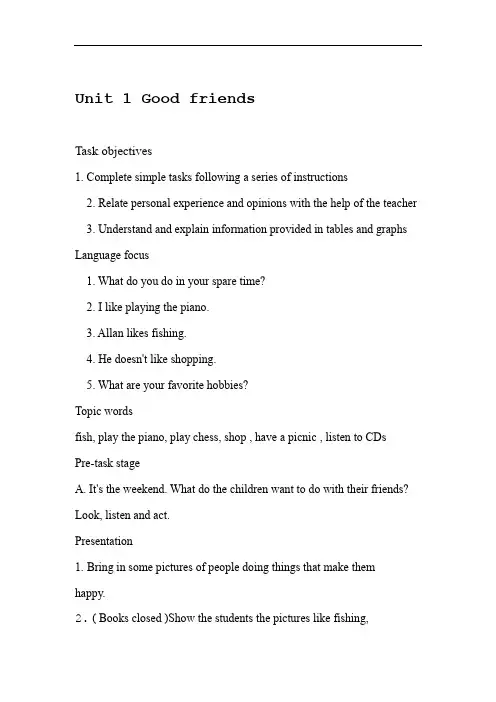
Unit 1 Good friendsTask objectives1. Complete simple tasks following a series of instructions2. Relate personal experience and opinions with the help of the teacher3. Understand and explain information provided in tables and graphs Language focus1. What do you do in your spare time?2. I like playing the piano.3. Allan likes fishing.4. He doesn't like shopping.5. What are your favorite hobbies?Topic wordsfish, play the piano, play chess, shop , have a picnic , listen to CDsPre-task stageA. It's the weekend. What do the children want to do with their friends? Look, listen and act.Presentation1.Bring in some pictures of people doing things that make them happy.2.( Books closed )Show the students the pictures like fishing,shopping, ect. Ask the students what are these people doing? Encourage the students to answer like this: He is fishing. She is listening to CDs. And practice other sentences.3.Write the verbs for the activities .Ask the students What do you want to do this weekend?4.Show Transparency. Play the tape .And ask the students to repeatafter it.Practice1.Show Transparency. Point to the people on the page and reviseor teach the verbs and the places.2.Read aloud or play the tape. Ask the students to repeat the wordsafter you.5.Ask the students to take turns or work in pairs to ask each otherand answer about what they want to do.B1 Tim received a letter from his new pen friend. Read the letter and complete Tim's notes.Presentation1.Photocopy the letter, put it in an envelope addressed to Tim.2.Show the students the envelope. Ask them to guess what isinside.3.Repeat the name on the envelope .Tell the students it is fromTim's pen friend.PracticeShow Transparency. Point out to the students that when sb likes1.a hobby or an activity and often does it , we put –ing on theverb , e.g. Allan likes playing the piano . I like swimming. Helikes reading. etc.2.Tell the students to read the letter again .Ask them to complete Tim's note about Allan's hobbies by writing likes or doesn't likenext to each of the activities.3.Check the answers with the students.4.Ask the students to work in pairs and take turns to make sentences using the notes to check if they have the same answers.B2 The students are talking about what they like doing in their spare time. Listen, say and act.Presentation1.Find out some interesting activities the members of the classlike doing.2.Tell the students about one hobby a member has e.g. ___ likes–ing . He or she thinks it's fun . Then ask another member ofthe class Do you like –ing ? Do you think it is fun? If thestudent answers negatively, tell the class ___ doesn't like –ing .He or she thinks it is boring.3.Write the words fun and boring on the board.Practice1.Show Transparency. Read the conversation and ask thestudents to read after the teacher.2.Tell the students to work in pairs and continue the conversation.B3 Listen to Candy. Then write T for true or F for false after each sentence.1.Read the rubric to the students. Ask them to take time to readthe sentences.2.Play the tape for the students.3.Check their answers.C.A story:Does Bob like sports ?1.Ask the students to describe the boys.2.Ask the students to cover picture 6. Read the characters'words with the students up to and including picture 5. Askthe students to re-read and tell the teacher what games Bobsays he likes playing in picture 1.3. Play the tape and they repeat the sentences.4. Role –play and act in pairs.D. Read the story again. And then read the sentences below .Write T foror F for false.1.Read the story again.Check the answer with the students. Ask them to make the 2.correct sentences for false sentences.E. Read the symbols and say the words.1.Write and explain the words to the students.2.Play the tape.3.Say the words slowly and clearly.While – task stageF. Do a survey.1.Tell the students to work in groups of four and choose a group leader.2.The group leader makes a survey what his members like or are their favorite hobbies.3.The group leader tells the class about their activities.G. Listen and chant and write the correct days.1.Play the tape for the students to listen to the chant.2.Ask the students to join in with the words .Then ask the students to write the correct day of the week under each picture.3.Tell the students to say the chant again to check theirH. Think about it.Tell the students that different countries have different names for the money they use .With more able classes the teacher can teach the namesof the countries: Ireland, Australia and the United Kingdom (the UK). Get the students to match the flags of the countries and the money signs underneath.Post –task stageI. Further reading1.Arouse interest in the passage by asking Who likes collecting stamps? Tell the students that they can learn many things from stamps. Ask Do you know where these stamps are from?2.Tell the students to find out more about the two stamps on thepage as they read.3.Ask the students to answer the questions .Check the answerswith the students.Homework1.Copy the words twice.2.Make a survey. What do your parents or your neighbours likedoing best? Write them down.3.Copy the text.4.Recite the words and phrases.本单元的重点在一般将来时态: What are you going to do? I'm going to….学生对这个句型掌握得较好,特别是说这个句型说得很流利很学生无论是说这。
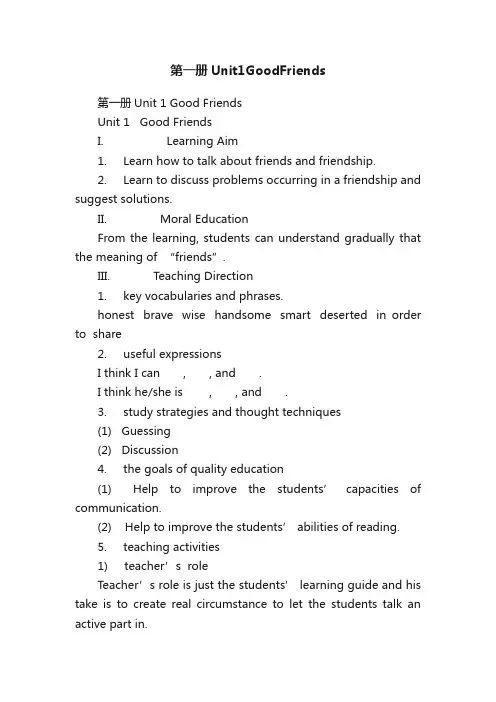
第一册Unit1GoodFriends第一册Unit 1 Good FriendsUnit 1 Good FriendsI. Learning Aim1. Learn how to talk about friends and friendship.2. Learn to discuss problems occurring in a friendship and suggest solutions.II. Moral EducationFrom the learning, students can understand gradually that the meaning of “friends”.III. Teaching Direction1. key vocabularies and phrases.honest brave wise handsome smart deserted in order to share2. useful expressionsI think I can , , and .I think he/she is , , and .3. study strategies and thought techniques(1) Guessing(2) Discussion4. the goals of quality education(1) Help to improve the students’ capacities of communication.(2) Help to improve the students’ abilities of reading.5. teaching activities1) teacher’s roleTeacher’s role is just the students’ learning guide and his take is to create real circumstance to let the students talk an active part in.Teacher’s role is a friend of students’. He appreciates and evaluates the students’ performances actively and positi vely.2) students’ rolesStudents act as explorers to learn by themselves independently.Students’ cooperate with their partners in groups during their study.Students’ grasp the teaching contents in an investigational way.6. teaching toolsrecorder cassette picturesIV the Design of T eaching ActivitiesStep 1 warming – up1) Ask the students to describe a good friend or themselves encourage the students to try to use more adjectives.2) Guessing GameAsk the students to describe the appearance and characteristics of a friend or themselves. And let the other students guess who is being described.This activity is used as a brainstorming session done either in groups or with the whole class. And it is designed to encourage students to think about friends and friendship and to activate relevant vocabulary.Step 2 Pre—readingExplain the situation to the students and give them time to think about what they would bring. The activity should generate different choices and opinions, thus making it a good opportunity for discussion. Ask the students to work in groups.The activity is designed to get the students to think about what it would be like to be alone on a deserted island. It is usedas a previous part of the unit. And it gives the students an opportunity to practise giving opinions and making decisions.Step 3 Reading1) Scanning2) Extensive reading3) Ask the students to answer the questions.4) Explain the new words and phrases in the content.By doing this, students can improve their reading abilities.Step 4 Post—reading1) an interviewAsk two students to do this interview. One is a reporter. The other is Mr. Chuck Then make an interview according to the text.By doing these, students can understand the main idea of the text better.2) a debateCreate a real circumstance about the debate. Suppose four students represent four people and try to persuade the others that he or she should be given the parachute.After doing the debate, students can consolidate what they’ve learned in class, and develop their capabilities of communication and the abilities of logical thought.Step 5 Homeworkan essayAsk the students to write an essay about the debate. By writing it, students can raise the writing abilities.第一册Unit 1 Good Friends。
