
小学六年级一般过去时与一般现在时对比讲解练习
- 格式:pptx
- 大小:70.34 KB
- 文档页数:10
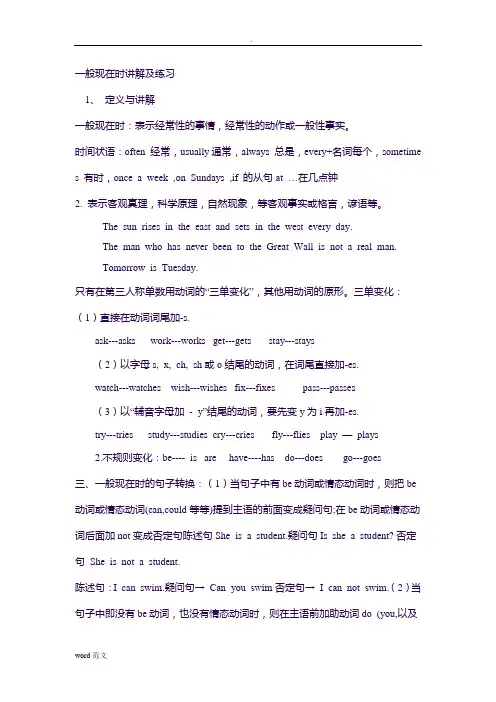
一般现在时讲解及练习1、定义与讲解一般现在时:表示经常性的事情,经常性的动作或一般性事实。
时间状语:often 经常,usually通常,always 总是,every+名词每个,sometime s 有时,once a week ,on Sundays ,if 的从句at …在几点钟2. 表示客观真理,科学原理,自然现象,等客观事实或格言,谚语等。
The sun rises in the east and sets in the west every day.The man who has never been to the Great Wall is not a real man.Tomorrow is Tuesday.只有在第三人称单数用动词的“三单变化”,其他用动词的原形。
三单变化:(1)直接在动词词尾加-s.ask---asks work---works get---gets stay---stays(2)以字母s, x, ch, sh或o结尾的动词,在词尾直接加-es.watch---watches wish---wishes fix---fixes pass---passes(3)以“辅音字母加- y”结尾的动词,要先变y为i再加-es.try---tries study---studies cry---cries fly---flies play —plays2.不规则变化:be---- is are have----has do---does go---goes三、一般现在时的句子转换:(1)当句子中有be动词或情态动词时,则把be 动词或情态动词(can,could等等)提到主语的前面变成疑问句;在be动词或情态动词后面加not变成否定句陈述句She is a student.疑问句Is she a student? 否定句She is not a student.陈述句:I can swim.疑问句→ Can you swim否定句→ I can not swim.(2)当句子中即没有be动词,也没有情态动词时,则在主语前加助动词do (you,以及复数), does(单数she,he,it)变成问句;在主语后谓语动词前加助动词don’t(I, you,以及复数), doesn’t(单数she,he,it)变成否定句,助动词后的动词要变成动词原形。
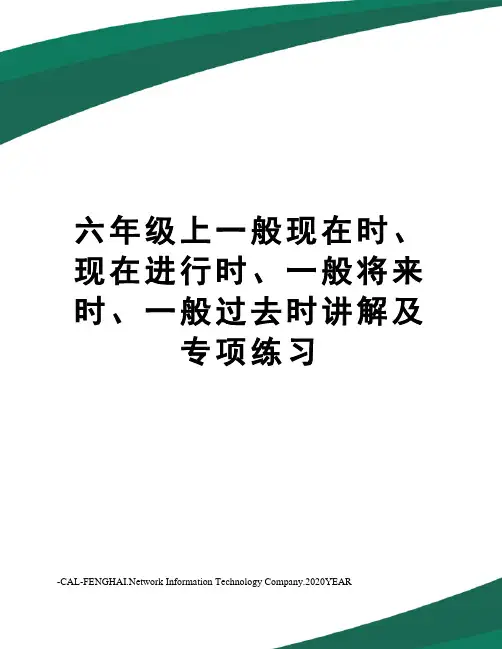
六年级上一般现在时、现在进行时、一般将来时、一般过去时讲解及专项练习work Information Technology Company.2020YEAR六年级上一般现在时、现在进行时、一般将来时、专项练习Class:_________ Name:_________ No:_________小学英语3种时态复习一、用动词的正确形式填空1. I ________________ (do) my homework every evening.2. We _________________ (fly) kites in the park next Sundays.3. Tom ___________(play) the piano every Saturday. Now he________ (play).4. She _______(like) swimming. She ___________ (swim) this weekend.5. Usually my mother _______ (wash) the dishes after lunch. But my grandma____________ (wash) now.6. Look at the man! He ___________ (read) a magazine.7. Look! The plane ______________ (fly) over the building.8. Listen! My aunt ____________ (sing) in the room.She is a singer. She _____ (like) singing. She _______(have) a music show. She is excited.9. Tom and Mike always ______ (swim) in the river. They _____ (swim) in the swimming pool this Sunday. Look! They ______ (swim).10. What ______ you usually ______ (do) in the evening?I _______ (play) computer games.11. What _______ you _______ (do) now?I _______ (make) a paper plane.12. What _______ he _______ (do) nowHe ______ (dance).13. ______ your mother ______ (read) newspaper in the morning?Yes, She ________ .16. _______ you _______ (like) fishing?No, I ______ . I like ______ (swim),but my brother ______ (like).17. How ______ your father _______ (go) to work every day?He ______ (go) by bike. But it’s cold today. He ______ (take) the No.21 bus,18. _______ the monkey _______ (like) climbing trees Yes, it _______ .19. What _______ your father ______ (do) after lunch He _______ (read) acomic book.20. ________ you ______ (collect) stamps Yes. I _______ .________ your brother ______ (collect), too No, he ________ .二、选择题1. _____ he _____ to the park at 6:30 in the morning No,he _____ .A. Does; goes; doesB. Does; go; doesn’tC. Does; go; does2. Tim always _____ a picture at home. He _____ a car now.A. draws; is drawingB. draw; drawC. draws; draw3. She usually _____ her friends. They often _____ tea.A. see; drinkB. sees; drinksC. sees; drink4. He usually _____ the dishes at night, but tonight he _____ clothes.A. wash; washB. washes; is going to washC. is washing; washes5. Mr. Green usually _____ his newspaper in the evening, but he and his wife _____ television this evening.A. reads; watchesB. reads; are going to watchC. reads; watch6.Where are the man and the womanThey _____ near the tree.A. sitB. sitsC. are sitting7. _____ your father _____ divingNo, he _____ .He ______ writing stories.A.Does; like; doesn’t; likesB.Does; likes; doesn’t; likeC.Do; like; don’t; likes8. Mr. Green often _____ his newspapers at night. But he _____ an interestingbook tonight.A. reads; readsB. reads; readC. reads; is going to read9. The old man _____ playing sports in the park. He _____ morning exercise now.A. likes; is doingB. likes; doesC. like; doing10. Where ______ the boy _____He _____ across the river now.A. does; swim; swimsB. is; swimming; is swimmingC. is, swim, is swimming11. _____ you _____ to music nowYes, we _____ .A. Do; listen; doB. Did; listen; didC. Are; listening; are12. Look! Two cats ______ across the wall.A. runB. runsC. are running13. She _____ tea, but he _____ .A. likes; doesn’t B; like; don’t C. like; doesn’t一般过去时一般过去时的构成:一般过去时是用动词的过去式来表示。

人教版六年级英语时态转换练习题30题【含答案解析】1. I often go to school by bike. But yesterday I _____ to school on foot.A.goB.wentC.goes答案解析:B。
一般现在时中,“I often go to school by bike”表示经常发生的动作,用动词原形go。
一般过去时中,yesterday 是过去的时间标志,动词要用过去式went。
goes 是第三人称单数形式,不符合此语境。
2. She usually has breakfast at 7:00. But this morning she _____ breakfast at 7:30.A.haveB.hadC.has答案解析:B。
usually 表明一般现在时,has 是have 的第三人称单数形式。
this morning 是过去的时间标志,要用一般过去时,have 的过去式是had。
3. We _____ football every Sunday. But last Sunday we _____ basketball.A.play;playedB.played;playC.play;play答案解析:A。
every Sunday 是一般现在时的标志,we 是第一人称复数,用动词原形play。
last Sunday 是过去的时间标志,用过去式played。
4. My father often _____ newspapers in the evening. But yesterday evening he _____ a book.A.reads;readB.read;readsC.reads;reads答案解析:A。
often 表明一般现在时,father 是第三人称单数,read 的第三人称单数形式是reads。
yesterday evening 是过去的时间标志,read 的过去式还是read。
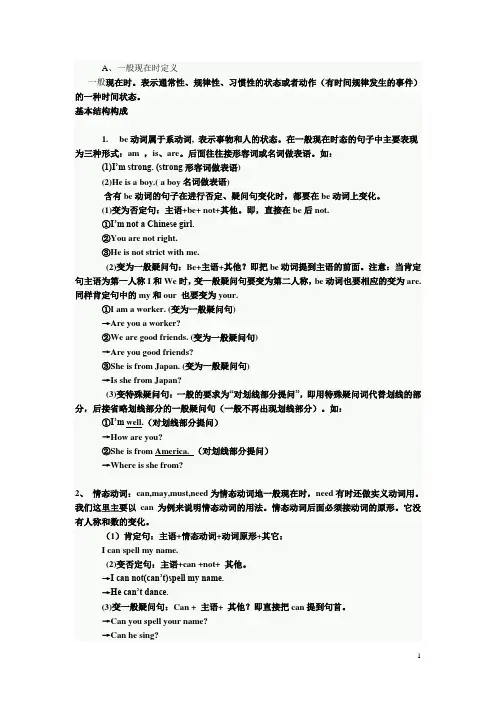
A、一般现在时定义一般现在时。
表示通常性、规律性、习惯性的状态或者动作(有时间规律发生的事件)的一种时间状态。
基本结构构成1. be动词属于系动词, 表示事物和人的状态。
在一般现在时态的句子中主要表现为三种形式:am ,is、are。
后面往往接形容词或名词做表语。
如:(1)I’m strong. (strong形容词做表语)(2)He is a boy.( a boy名词做表语)含有be动词的句子在进行否定、疑问句变化时,都要在be动词上变化。
(1)变为否定句:主语+be+ not+其他。
即,直接在be后not.①I’m not a Chinese girl.②You are not right.③He is not strict with me.(2)变为一般疑问句:Be+主语+其他?即把be动词提到主语的前面。
注意:当肯定句主语为第一人称I和We时,变一般疑问句要变为第二人称,be动词也要相应的变为are.同样肯定句中的my和our 也要变为your.①I am a worker. (变为一般疑问句)→Are you a worker?②We are good friends. (变为一般疑问句)→Are you good friends?③She is from Japan. (变为一般疑问句)→Is she from Japan?(3)变特殊疑问句:一般的要求为“对划线部分提问”,即用特殊疑问词代替划线的部分,后接省略划线部分的一般疑问句(一般不再出现划线部分)。
如:①I’m well.(对划线部分提问)→How are you?②She is from America. (对划线部分提问)→Where is she from?2、情态动词:can,may,must,need为情态动词地一般现在时,need有时还做实义动词用。
我们这里主要以can为例来说明情态动词的用法。
情态动词后面必须接动词的原形。