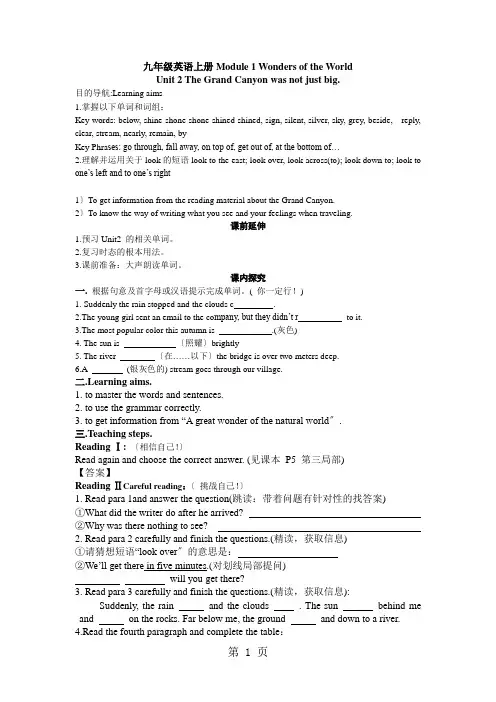
外研版九年级英语上册Module 1 Unit 2 The Grand Canyon was not
- 格式:doc
- 大小:33.50 KB
- 文档页数:4
第 1 页 九年级英语上册Module 1 Wonders of the World
Unit 2 The Grand Canyon was not just big.
目的导航:Learning aims
1.掌握以下单词和词组:
Key words: below, shine-shone-shone-shined-shined, sign, silent, silver, sky, grey, beside, reply,
clear, stream, nearly, remain, by
Key Phrases: go through, fall away, on top of, get out of, at the bottom of…
2.理解并运用关于look的短语look to the east; look over, look across(to); look down to; look to
one’s left and to one’s right
1〕To get information from the reading material about the Grand Canyon.
2〕To know the way of writing what you see and your feelings when traveling.
课前延伸
1.预习Unit2 的相关单词。
2.复习时态的根本用法。
3.课前准备:大声朗读单词。
课内探究
一. 根据句意及首字母或汉语提示完成单词。( 你一定行!)
1. Suddenly the rain stopped and the clouds c .
2.The young girl sent an email to the company, but they didn’t r to it.
3.The most popular color this autumn is .(灰色)
4. The sun is 〔照耀〕brightly
5. The river 〔在……以下〕the bridge is over two meters deep.
6.A (银灰色的) stream goes through our village.
二.Learning aims.
1. to master the words and sentences.
2. to use the grammar correctly.
3. to get information from “A great wonder of the natural world〞.
三.Teaching steps.
Reading Ⅰ: 〔相信自己!〕
Read again and choose the correct answer. (见课本 P5 第三局部)
【答案】
Reading ⅡCareful reading:〔 挑战自己!〕
1. Read para 1and answer the question(跳读:带着问题有针对性的找答案)
①What did the writer do after he arrived?
②Why was there nothing to see?
2. Read para 2 carefully and finish the questions.(精读,获取信息)
①请猜想短语“look over〞的意思是:
②We’ll get there in five minutes.(对划线局部提问)
will you get there?
3. Read para 3 carefully and finish the questions.(精读,获取信息):
Suddenly, the rain and the clouds . The sun behind me
and on the rocks. Far below me, the ground and down to a river.
4.Read the fourth paragraph and complete the table: 第 2 页 the Grand Canyon
How deep
How wide
How long
5. Read the fifth paragraph and complete the table:
How long did the writer remain by the canyon?
Reading Ⅲ Read aloud and find out the phrases.
1.望着东方 2.从……走出来
3.穿过 4.五分钟后
5.从……的上面看过去 6.突然向下倾斜
7.眺望;向对面看 8.向下看
9.在……顶部 10.在……底部
12.在两边
三 导学探究: 边学边练,根底知识积累。 〔知识掌握在自己心里!〕
1. get out of 1) 从…内出来;逃避 2 )弃绝
I couldn't _____ _________ ________ going to that wedding. 我不能逃避出席婚礼。
He got_______ ________ the bad habit. 他改掉了这个坏习惯。
2. reply v. 答复,答复 reply to = answer
They didn’t___________ _____our new plans. 他们对我们的新建议没有作出答复。
He has not yet __________ _____ my question. 他还没有答复我的问题。
3. clear v.
①使干净;使亮堂(+of) 2)去除;拾掇(+away/off/from)
We usually ___________ the water with a filter. 我们通常用过滤器使水净化。
She ________ the leftovers from the table. 去除了剩饭
②clear adj. 清楚的;明晰的;明了的
We had a ___________ view of the mountains. 我们清楚地看到群山。
4. below prep. 1〕(指位置)在...下面;到...下面 2〕(指数量、程度等)在...以下
Her skirt came________ her knees. 她的裙长过膝。
In winter the temprature is often _____ zero。 冬天气温常在零度以下。
四 合作探究: 〔合作就是力量!〕 精讲点拨Language points
1. through 与 across的区别:
through 是“穿过〞的意思,是介词,常指“从某空间内或某物中间穿过〞,多指穿过门、窗、洞、森林、隧道等;across是指“从某个平面横过〞,多指穿过街道、马路、桥梁、河等的外表。 Eg.
walk _________ the forest , run _________ the bridge.
2. in five minutes “5分钟以后〞,“in +一段时间〞表示“在一段时间之后或之内〞,常用于一般将来时,用“how soon〞提问。
【拓展】 与how 有关的疑问词
How long “多久〞,常对for 和 since 引起的表延续的短语提问,常用于如今完成时;
How often
“多久一次〞,对频率提问,如 often ,sometimes,twice a week 等表示频率的词或短语,常用语一般如今时或一般过去时; How many 后跟复数名词,对可数名词的量来提问;How much 后可跟不可数名词,对不可数名词的量来题问,或对价格提问;
How many times 对次数提问,如twice,several times等,是“多少次〞的意思,常用于如今完成时;
How far 对间隔 提问; 第 3 页 【学后练】 用适当的疑问词完成句子:
①_______________ is it from your school to your home?
② —_______________ has he been to the USA? —Once.
③— _______________ does the boy visit his grandparents? —Twice a month.
④— _______________ will your sister come back from Shenzhen? — In a week.
⑤—_______________ are the shoes? —One hundred yuan.
五 有效训练:Consolidation .
A. 选择正确的答案:
( )1.All the students will climb the mountain if it _______ rain tommow.
A. won’t B. don’t C. didn’t D. doesn’t
( )2. — _______ will the supper be ready? I’m very hungery. — In a minute.
A. How soon B. How long C. How much D. How often