
How to Interrupt Politely
- 格式:pdf
- 大小:353.85 KB
- 文档页数:2
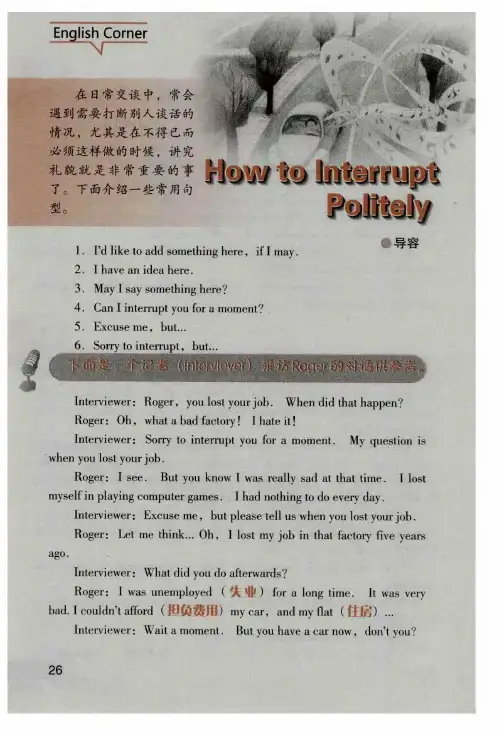


Unit 6 Period 3 Listening and speaking Learning Objectives1.Able to understand the listening material and plete related exercises.2.To learn how to interrupt others politely and know how to recycle. Learning activities目标一:Able to understand the listening material and plete related exercises.Activity 1: Listen to the lecture and choose the topics that are covered.1. What the word “smog” means.2. When the word “smog” appeared.3. What caused smog in the past.4. What causes smog now.5. The effects of smog on the environment.6. How governments try to reduce smog.7. What will happen if we don't reduce smog.Activity 2:Listen again and plete the slides.Smog in the past• Term created in: 1 ________________• Big problem in London: 2 ________________ in December 1952• Causes of the problem: burning too much coal and 3 ________________Smog in the present• Causes of the problem: 4 ________________ and factories• Measures: rules about using 5 ________________ in factories and 6 ________________ in the city centre目标二:To learn how to interrupt others politely and know how to recycle.Activity 1: Now talk about what the students say to interrupt the lecturer politely. Listen again if necessary.Lecturer: Good evening, everyone, and thank you for ing to today's talk. I'm Dr Brown and I'm going to talk about air pollution in cities what we all know as “smog”. Please feel free to stop me if you have any questions. So, first of all, a bit of history. The term “smog” was first used in the 1800s in cities that had problems with smoke and fog.Student A: Sorry for interrupting, but I believe it was in the 1900s.Lecturer : Sorry, I made a mistake. You are right. It was in the 1900s. Thank you. London was one of the cities where smog caused big problems. In December 1952, it suffered from “The Great Smog”. It was a very cold winter, so a lot of coal was burned at home and in the factories. The problem was that there was no wind, so thick smog covered the city. Nowadays...【学习目标】 【学习过程】Shanghai, Tianjin, Chongqing and all capitals of provinces and autonomous regions.•The target recycling rate in these cities has been set at 35% by 2020.Useful expressions•Sorry to interrupt, but...•Excuse me, but can I just ask...?•Could I just stop you again to check...?•Do you mind if I ask another question?•Sorry, but I was wondering whether...•Is it OK if I jump in for a second?Activity 3: Work in pairs. Talk about another environmental problem and have a similar conversation.Summary:。

Speaking - Learn Spoken English1. Agreeing/Disagreeing Expressions2. Apologizing- ways to say you are sorry3. Excuse me! Expressions used when bothering someone4. Getting to know you Expressions5. Goodbye Expressions6. Greetings Expressions7. Interrupting someone- Learn how to politely interrupt conversation8. Paraphrasing - Trying to express in your own words9. Permission - Asking for permission10. Phone expressions11. Thanks! - Expressing gratitude12. Thinking time/Fillers - Learn how to buy time to think before speaking13. Weekend - Talk about what you did over the weekend1. Agreeing/DisagreeingThere is no clearly defined difference between formal and informal ways of agreeing or disagreeing but it’s good to be careful about using expressions that sound too informal in certain situations. Simple agreement∙I agree.∙I really agree with you.∙I think you are right.∙I couldn’t agree with you more.∙You said it.∙Can’t say I don’t agree.∙I’m with you on this.∙I partly agree∙I agree on this but not that.∙It’s partly true.Accepting/Declining/Expressing acceptance∙I accept your point.∙Please accept this on our behalf.∙Sorry, I can’t accept this.∙I’m 100% with you on this!∙Great idea.∙I’ll take it.∙Sorry, I can’t take it.∙Accept my apology.Simple disagreement or refusal∙I disagree with you.∙Everyone has their own opinion, right?∙I think you’re wrong on this.∙I’m sorry but I have to refuse your request.∙You’re wrong.∙No way!∙You’ve got to be kidding!∙How can you even say that?∙Where is your logic?Strong disagreement∙I completely disagree with you.∙You are very wrong to say that.∙I totally disagree with you.∙I can’t find myself to agree with you.∙You’re dead wrong.∙You’re way wrong.2. Apologizing and Explaining OneselfThere are a few ways to apologize but a good thing to remember is that we usually add something to an apology:Part 1- Apologies∙I’m sorry…∙I’m very sorry…∙I’m terribly sorry…∙Excuse me…∙Pardon me…∙I apologize…∙I’m afraid…Part 2 - Explaining Oneself, Accepting Responsibility∙I wasn’t very well yesterday∙I didn’t see you∙It won’t happen again∙I’ll be more careful next time∙I’ll finish it before I go home∙It’s my fault∙It’s all my fault3. “Excuse me! - Bothering PeopleThis one is a general collection of expressions to use when you must bother someone for ANY particular reason.Such as…∙asking people to be quiet∙conversation openers∙permission and requests∙thanking and replying∙getting somebody’s attentionAsking people to be quietLess polite∙Shut up! [impolite]∙Quiet! / kwaöWt / Be quiet!∙Shh!More polite∙Could you be quiet, please?Conversation openers∙Excuse me, is anyone sitting here?∙Sorry, have you got the time, please?∙I think we’ve met before, haven’t we?∙It’s really hot, isn’t it?∙Are you going all the way to San Francisco?Permission and requests∙Could I use your pen?∙Do you mind if I borrow your dictionary?∙(‘Do you mind if I…?’ means ‘Is it a problem for you if I…?’)Getting somebody’s attention∙Excuse me, have you got a moment?∙Sorry to bother you, but could I just ask you something?∙Excuse me, can you spare a minute or two?∙Excuse me, are you in a hurry?∙Sure. Go ahead.∙It depends what it is.∙Sorry, I’m late already.4. Getting to know you! Polite topics when meeting for the first timeThere are certain topics that are polite to discuss when getting to know someone. Here are some of them:Talking about your background∙Originally I’m from…∙I was (born and) brought up in…∙I come from a (sporty/musical) family.∙My proudest moment was…-ing∙I’ve always dreamt of –ing / wanted to +verbDescribing your language ability∙I’m fluent in Polish.∙I speak Spanish reasonably well.∙I can get by in Portuguese.∙I speak French but it is a bit rusty.∙I know a few words of Japanese.∙I wish I could speak Italian.Like, such as, and that sort of thingo I like music such as opera, choral music, and classical music.o I really love modern music like house, rap, reggae, and hip hop.After one or two examples, we can use an expression meaning ‘et cetera’.o I’m fond of opera, and that sort of thing.o I like jazz, rock, and that sort of thing.Showing a lot of interest∙Wow!∙Really?∙(That’s) interesting!∙(That’s) fantastic∙5. Expressing Goodbyes and Farewells in EnglishThere are many ways of saying good-bye, just as there are many ways of saying hello, and it is important to use an expression of the appropriate tone and register. In the end, it’s all up to your judgment but remember that using a very formal expression with someone who is your friend, as it may sound sarcastic.Simple good-byes (Formal)∙Good-bye∙Stay in touch.∙It was nice meeting you.∙I hope to see you soon.Simple good-byes (Informal)∙Bye.∙See you.∙Talk to you later.∙Catch up with you later.∙Nice seeing you.Leaving a place (Formal)∙I have to leave here by noon.∙Is it okay if we leave your home at 9pm?∙What do you say we leave work a little earlier today?∙Would you mind if I leave the dinner before it ends?∙I need to depart for the airport in one hour.Leaving a place (Informal)∙I got to go now.∙I’ll be leaving from the office in 20 minutes.∙How about we jet off to the shops now?∙I’m afraid I have to head off now.∙Let’s get off work early.6. English Greeting ExpressionsThere are many ways of greeting people, both formal and informal. The speaker’s task is to choose the appropriate one for the situation. It is also useful to know lots of different ones so as to not repeat yourself when you meet a number of people at the same time. As with any other aspect, you need to be careful about using informal expressions with people who you do not know well or whose rank or status is higher than yours.General greetings (Formal)∙Hello!∙How are you?∙How are you doing?∙How is everything?∙How’s everything going?∙How have you been keeping?∙I trust that everything is well.General greetings (Informal)∙Hi.∙What’s up?∙Good to see you.∙How are things (with you)?∙How’s it going?∙How’s life been treating you?Greeting a person you haven’t seen for a long time (Formal)∙It has been a long time.∙It’s been too long.∙What have you been up to all these years?∙It’s always a plea sure to see you.∙How long has it been?∙I’m so happy to see you again.Greeting a person you haven’t seen for a long time (Informal)How come I never see you?It’s been such a long time.Long time no see.Where have you been hiding?It’s been ages since we last met.7. English Interrupting Expressions - How to interrupt someoneWhen you want to stop someone interrupting, don’t pause for too long, don’t lower your voice, and (if you want) you can refuse to be interrupted.You can use the following phrases to interrupt politely:How to interrupt∙Actually…∙Excuse me…∙I’m sorry, but…∙I just want to say…∙May I interrupt here?∙Do you mind if I say something?8. Paraphrasing ExpressionsParaphrasing means repeating things in a different way! You use the technique to:∙check that you have understood what someone means.∙emphasize a point, or make sure that your meaning is clear. This is useful when speaking to people whose first language is not English.Introducing paraphrasing∙So you mean…∙What you mean is…∙What you’re saying is…∙So what you mean to say is…∙Let me get this clear…∙Let me get this straight...9. Requesting Permission ExpressionsThere are many ways of requesting permission in English. However, knowing when to use the right request formula or structure is a bit tricky. This can be determined by asking yourself these questions:∙Does the other person have higher status than you? (E.g. more authority or older)?∙Is the other person a stra nger, an acquaintance, a colleague, a friend or a relative? (You don’t need polite formulas with people you know well – it sounds sarcastic.)∙Is your request going to cause the other person trouble or extra work?∙Is the other person in a good mood or a bad mood?∙Could I use your phone?∙Might I possibly use your phone?∙Sorry to trouble you, but do you mind if I use your phone?∙Would you mind if I used your phone?∙May I use your phone?∙Can I use your phone?∙I wonder if I could use your phone.10. Telephone ExpressionsThere are certain expressions that are always used while talking on the telephone. Even though it is not impossible to use more general conversation terminology, it is still preferable to stick with the accepted phone language: it will sound more professional. Here are some basics:Asking people to speak slowly/speak upSorry, could you speak slowly, please? Yes, sure.Could you speak up, please? Yes, of course.Ending a phone conversationWhen you phone for information, you can often end with phrases like this:∙OK, I think that’s everything I need.∙OK, I think I’ve got all the details∙Thanks. You’ve been very helpful.∙Thanks very much for your help.∙Bye, bye. Goodbye.11. Thanks and Expressions of GratitudeMost languages have an automatic response to thanks. The British do not automatically respond to thanks, but Americans do. A response is not necessary in British English, but is becoming more frequent. In the past, you’re welcome sounded very American. Nowadays it’s common in Britain too. Another common response in Britain is No problem (at all). Remember that p lease is not an acceptable response to thanks in either Britain or the USA.Thanking someone∙Thanks.∙Thank you.∙Thanks a lot.∙Thank you very much.∙Thank you very much indeed.∙It was very kind of you.∙I appreciate your help.∙You’ve been very helpful.Thanking someone who tries to help∙Thanks anyway.∙Thank you for (looking).∙Thanks for (trying).∙It doesn’t matter. Thanks.∙Never mind. Thanks.Responding to thanks∙You’re welcome. (US)∙Not at all. (formal, UK)∙Don’t mention it.∙(It’s) my pleasure.∙It was nothing.∙That’s alright/OK.∙No problem.∙Any time.Taking Turns in ConversationsDirecting conversationsLook at these expressions for directing conversation in a formal situation, like a business meeting. Put them into three groups:A - including quiet peopleB - stopping interruptionsC - keeping the conversation to the point∙What’s your opin ion, Sam?∙May I continue?∙Let me finish.∙Shall we continue?∙Let’s go back to the point.∙You haven’t said anything yet, Sam.∙Do you want to add anything here?∙I haven’t finished my point.∙Please allow me to finish.∙Does anyone want to say anything before we move on?Control strategiesConversation is a turn-taking process and it is more difficult when there are several people in a conversation. In different cultures there are different standards for interrupting and turn-taking; however there are also a few universal points that apply to most situations.1. The speaker can choose the next speaker. You can stop someone dominating the conversation,and you can include quieter people.2. You can stop someone interrupting by avoiding eye contact with them, and continuing eye contactwith your partner in the conversation. Don’t drop the volume of your speech (i.e. don’t begin to speak more quietly).3. If someone interrupts you, and you haven’t finished making your point, tell them clearly. You canuse phrases like:Let me finish / May I finish?Excuse me, I haven’t finished.Just a moment / Hang on a second.∙When someone won’t stop talking, and you are not interested in what they are saying, you can avoid eye contact, turn away or look at something else. Do not use conversation fillers.12. Hesitation Strategies - Conversation Time FillersOften we want to give ourselves thinking time before we answer a question, especially if we don’t13. Weekends - Asking about what people did?People often like to ask each other how they spent their holidays or weekend. There are a number of ways to both ask and answer questions about it.How was...?How was your weekend?It was lovely. How was yours? (great)It was terrible. (really bad)It was nice. (fine)A bit boring! (not very interesting)Link words: then / after that∙We had a drink. Then we went to the cinema.∙OR We had a drink, and then we went to the cinema.∙I went shopping. After that I met my sister.∙OR I went shopping, and after that, I met my sister.Anyway, so anywayIn spoken English, you use anyway or so anyway when you want to begin the next part of the story, or go back to then main story.o Janet didn’t know about it. So anyway, we got in the helicopter, and…o We drank the champagne. Anyway, we landed and…Realize, remember, find-outThe past perfect is often used after the verbs realize, remember and find out.。

BBC强烈的33个英语口语学习方法!整理许多小伙伴都想知道怎么才能轻松提高自己的英语口语,今日我就给大家共享BBC推举的33个干货,总有一个适合你!If youre reading this, I imagine you want to communicate with confidence and competence in English.假如你在看这篇文章,我能想象你是想更好、更自信地用英语沟通。
1. Record yourself speaking English.录下自己所说的英语。
2. Read aloud, especially dialogue.大声的读出来,特殊是对话。
3. Sing along to English songs while youre driving or in the shower.开车或洗澡的时候跟唱英文歌。
4. Watch short video clips and pause and repeat what you hear.看短视频,按停顿然后重复你听到的。
5. Learn vowel and consonant sounds in English.学习英语元音和辅音的发音。
6. Learn and identify schwa.学习并学会识别中性元音。
7. Learn about weak and strong forms of common words. 学会常用词的弱读形式和重读形式。
8. Learn about word stress.学会单词的重读。
9. Learn about sentence stress.学会句子的重读。
10. Identify fixed and semi-fixed phrases and practise them. 学会识别固定短语和半固定短语,并不断练习。
11. Learn about collocations.学习固定搭配词组。