
形容词讲义
- 格式:pptx
- 大小:88.42 KB
- 文档页数:10

高考英语形容词与副词一、形容词(1)作定语,常用来修饰名词或代词。
These are valuable suggestions.(这些是宝贵的建议。
)I have something important to tell you.(我有重要的事情要告诉你。
)(2)作表语,放在系动词之后说明主语的情况。
His suggestions are valuable.(他的建议很有价值。
)I felt terrible this morning.(我今天早上感到不舒服。
)(3)作宾语补足语,放在宾语之后对宾语加以修饰说明。
You must keep your eyes closed.(你必须闭上眼睛。
)I find it hard to travel around the big city.(我发现在这个大城市旅行很难。
)(4)作状语,用以说明情况。
Curious, we went into the cave.(出于好奇,我们进了洞里。
)He returned home, safe and sound.(他回到了家,安然无恙。
)形容词作定语时一般置于被修饰词前作前置定语,下列情况中形容词通常后置于被修饰词。
(1)修饰something,anybody,nobody,anything等复合不定代词时There is nothing wrong with the machine.(机器什么问题都没有。
)(2)形容词词组作定语时She bought a book suitable for children.(她买了本适合孩子们的图书。
)(3)修饰表示数量的词要后置The baby is only five months old.(这个婴儿仅有五个月大。
)(4)enough作形容词修饰名词时,一般放在名词之前,也可放在名词之后We don't bring enough money.(我们没带够钱。
)There‘ll be time enough to relax when you’ve finished your work.(你完成工作后会有足够的时间来放松。
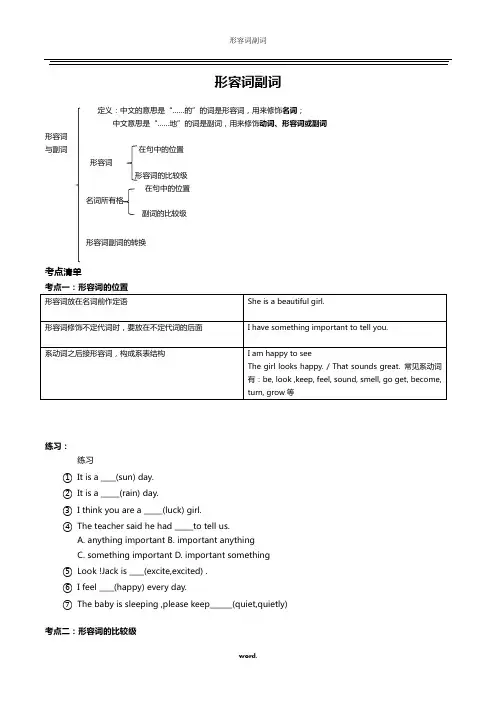
形容词副词定义:中文的意思是“……的”的词是形容词,用来修饰名词;中文意思是“……地”的词是副词,用来修饰动词、形容词或副词形容词与副词在句中的位置形容词形容词的比较级在句中的位置名词所有格副词的比较级形容词副词的转换考点清单练习:练习①It is a ____(sun) day.②It is a _____(rain) day.③I think you are a _____(luck) girl.④The teacher said he had _____to tell us.A. anything importantB. important anythingC. something importantD. important something⑤Look !Jack is ____(excite,excited) .⑥I feel ____(happy) every day.⑦The baby is sleeping ,please keep______(quiet,quietly)考点二:形容词的比较级(1)在形容词词尾加上“er”“est”构成比较级、最高级:bright(明亮的)—brighter—brightest broad(广阔的)—broader—broadest cheap(便宜的)—cheaper—cheapest clean(干净的)—cleaner—cleanest clever(聪明的)—cleverer—cleverest cold(寒冷的)—colder—coldestcool(凉的)—cooler—coolest dark(黑暗的)—darker—darkest dear(贵的)—dearer—dearest deep(深的)—deeper—deepestfast(迅速的)—faster—fastest few(少的)—fewer—fewestgreat(伟大的)—greater—greatest hard(困难的,硬的)—harder—hardest high(高的)—higher—highest kind(善良的)—kinder—kindestlight(轻的)—lighter—lightest long(长的)—longer—longestloud(响亮的)—louder—loudest low(低的)—lower—lowestnear(近的)—nearer—nearest new(新的)—newer—newestpoor(穷的)—poorer—poorest quick(快的)—quicker—quickest quiet(安静的)—quieter—quietest rich(富裕的)—richer—richestshort(短的)—shorter—shortest slow(慢的)—slower—slowestsmall(小的)—smaller—smallest smart(聪明的)—smarter—smartest soft(柔软的)—softer—softest strong(强壮的)—stronger—strongest sweet(甜的)—sweeter—sweetest tall(高的)-taller-tallestthick(厚的)—thicker—thickest warm(温暖的)—warmer—warmest weak(弱的)—weaker—weakest young(年轻的)—younger—youngest (2).双写最后一个字母,再加上“er”“est”构成比较级、最高级:big(大的)—bigger—biggest fat(胖的)—fatter—fattesthot(热的)—hotter—hottest red(红的)—redder—reddestsad(伤心的)—sadder—saddest thin(瘦的)—thinner—thinnestwet(湿的)—wetter—wettest mad(疯的)—madder—maddest(3).以不发音的字母e结尾的形容词,加上“r”“st”构成比较级、最高级:able(能干的)—abler—ablest brave(勇敢的)—braver—bravest close(接近的)—closer—closest fine(好的,完美的)—finer—finest large(巨大的)—larger—largest late(迟的)—later—latestnice(好的)—nicer—nicest ripe(成熟的)—riper—ripestrude(粗鲁的)—ruder—rudest safe(安全的)—safer—safeststrange(奇怪的)—stranger—strangest wide(宽广的)—wider—widestwise(睿智的,聪明的)—wiser—wisest white(白的)—whiter—whitest(4).以字母y结尾的形容词,把y改为i,再加上“er”“est”构成比较级、最高级:busy(忙碌的)—busier—busiest dirty(脏的)—dirtier—dirtiestdry(干燥的)—drier—driest early(早的)—earlier—earliesteasy(容易的)—easier—easiest friendly(友好的)—friendlier—friendliest funny(好玩的)—funnier—funniest happy(开心的)—happier—happiest healthy(健康的)—healthier—healthiest heavy(重的)—heavier—heaviesthungry(饿的)—hungrier—hungriest lazy(懒惰的)—lazier—laziestlucky(幸运的)—luckier—luckiest naughty(调皮的)—naughtier—naughtiest noisy(嘈杂的)—noisier—noisiest pretty(美丽的)—prettier—prettiestsilly(傻的)—sillier—silliest spicy(辣的)—spicier—spiciestthirsty(渴的)—thirstier—thirstiest ugly(丑的)—uglier—ugliest(5).双音节、多音节形容词,在单词前面加上“more”“most”构成比较级、最高级:afraid(害怕的)—more afraid—most afraidbeautiful(美丽的)—more beautiful—most beautifulcareful(仔细的)—more careful—most carefulcheerful(开心的)—more cheerful—most cheerfulcrowded(拥挤的)—more crowded—most crowdeddangerous(危险的)—more dangerous—most dangerousdelicious(美味的)—more delicious—most deliciousdifficult(困难的)—more difficult—most difficultexciting(令人兴奋的)—more exciting—most excitingexpensive(昂贵的)—more expensive—most expensivefamous(著名的)—more famous—most famousfrightened(受惊的)—more frightened—most frightenedfrightening(令人害怕的)—more frightening—most frighteninghard-working(勤奋的)—more hard-working—most hard-workinghelpful(有帮助的)—more helpful—most helpfulhonest(诚实的)—more honest—most honestimportant(重要的)—more important—most importantinteresting(有趣的)—more interesting—most interestingpolite(有礼貌的)—more polite—most politeterrible(可怕的)—more terrible—most terribletired(累的)—more tired—most tired(6).不规则变化的形容词:bad(坏的)—worse—worst far(远的)—farther—farthest (far—further—furthest) good(好的)—better—best ill(病的)—worse—worstlittle(少的)—less—least many(多的)—more—most much(多的)—more—most old(年老的)—older—oldest ( old—elder—eldest) well(好的,身体好的)—better—best练习1. Is your friend ____ (young) than you ?2. Shanghai is one of ______ (big) cities in the world.3. Do you think English is _____important than maths。

高考英语必考点学案:形容词与副词一、形容词和副词基本用法(一)形容词基本用法1.作定语,修饰名词、代词。
如:I have an interesting book.我有一本有趣的书。
2.作表语。
通常与系动词be , get , grow , bee , feel , appear, prove , seem, look, keep, smell, taste, sound , turn, remain 等连用。
如:The weather is getting cooler and cooler.天气越来越凉爽。
3.作宾补。
如:The news made every one happy.这则消息令每个人都很高兴。
The wall was painted green.墙被刷成了绿色。
4.作状语,用来说明主语的特征、状态。
表示伴随、原因、结果等。
如:Tired and hot, we had to stop to have a break.又累又热,我们不得不停下来休息。
He fell down dead.他倒下死了。
(二)副词基本用法1.作状语。
通常修饰动词、形容词、副词或整个句子。
如He runs fast.他跑得很快。
The book is very interesting.这本书很有趣。
The bus came quite early.公共汽车到得很早。
She left shortly after the meeting.会议刚结束她就走了。
(修饰介词短语)Frankly, I don’t agree with you.说实话,我不同意你的意见。
(修饰句子)2.作表语。
如:Class is over.下课了。
Time is up.时间到。
3.作定语。
如:Do you know the girl upstairs? 你认识楼上的女孩吗?Soon you will be acquainted with the people around. 不久你就会熟悉这附近的人。

形容词与副词用来描述事物大小,形状,颜色等具体特征的词叫做形容词。
1作定语修饰名词和不定代词形容词修饰名词作前置定语。
放在被修饰词之后,作后置定语。
1)形容词修饰something ,anything等复合不定代词时后置。
2,the+形容词,表示一类人注意;作主语谓语动词用复数4形容词的比较等级原级1.形容词的原级比较句型有:1) as +形容词的原级+as.其否定式为:not so (as)+形容词原级+as。
2)当我们要表示A是B的几倍或几分之几时,我们用的句型:A +几倍或几分之几as +形容词的原级+as +B。
This room is three times as big as that one.3) as many+可数名词/much+不可数名词+as.He earns as much money as his mother does.比较级和最高级大多数形容词的比较级和最高级是采用在词尾加-er和-est的形式,或在单词前加more和most构成。
3)特殊形式的比较级和最高级:英文中有些形容词的比较级和最高级的变化是不规则的。
如:原级比较级最高级good/well better bestbad/ill worse worstfar farther/further farthest/furthestold older/elder oldest/oldestlittle less leastmany/much more mostlate later/latter latest/last※对于上述形容词中有两种不同形式的特殊比较级和最高级用法做一下说明:a) farther/farthest和further/furthest的比较四个词都可以表示实际的距离。
但是further/furthest可用于指抽象意义,表示―进一步的,更深入的‖。
further study进一步研究b) older/oldest和elder/eldest的比较elder/eldest主要用来表示家庭成员之间的长幼关系my elder brother我的哥哥his eldest son他的长子在有than的比较句中一般不用elder,要用older.I am two years older than Tom.我比汤姆大两岁。