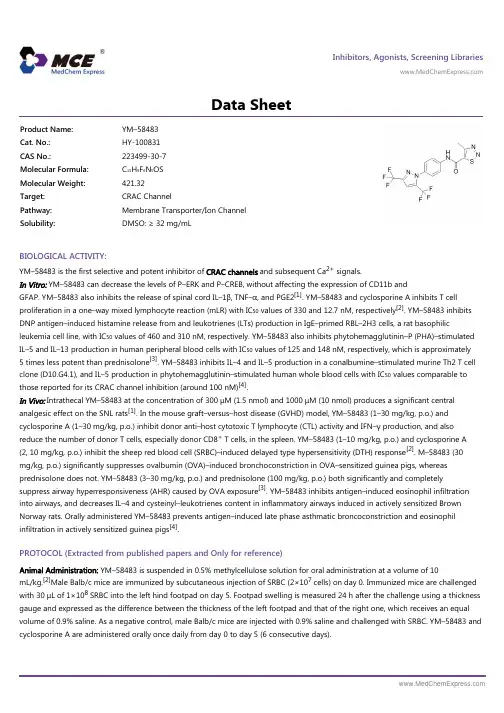
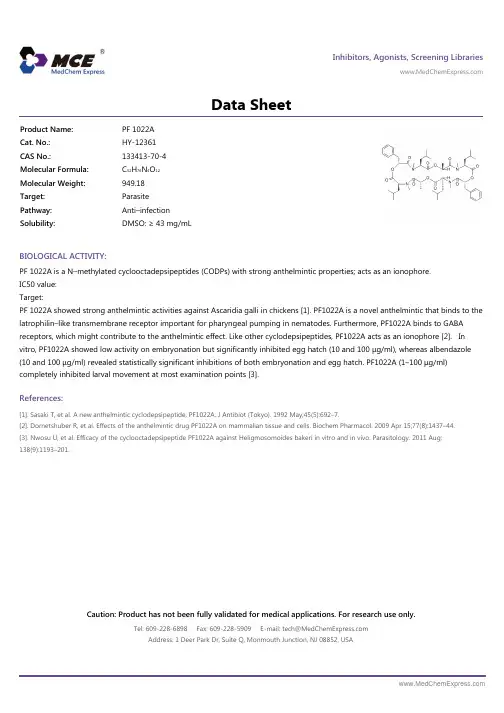
Otenabant_DataSheet_MedChemExpress
- 格式:pdf
- 大小:124.96 KB
- 文档页数:2
Inhibitors, Agonists, Screening Libraries
Data Sheet
BIOLOGICAL ACTIVITY:
Otenabant is a potent and selective cannabinoid receptor CB1 antagonist with K i of 0.7 nM, exhibits 10,000–fold greater selectivity against human CB2 receptor.
IC50 & Target: Ki: 0.7 nM (CB1)
In Vitro: Otenabant HCl has low affinity with K i of 7.6 μM for human CB2 receptors [1]. Otenabant HCl inhibits CB1 receptor with moderate unbound microsomal clearance, low hERG affinity, and adequate CNS penetration [2].
In Vivo: Otenabant acutely stimulates energy expenditure in rats and decreases the respiratory quotient indicating a metabolic switch to increased fat oxidation. Otenabant (10 mg/kg, p.o.) promotes a 9%, vehicle adjusted weight loss in a 10 day weight loss study in diet–induced obese mice [1]. Otenabant HCl reverses four cannabinoid agonistmediated behaviors (locomotor activity,hypothermia, analgesia, and catalepsy) following administration of the synthetic CB1 receptor agonist CP–55940. Otenabant HCl exhibits dose–dependent anorectic activity in a model of acute food intake in rodents and increased energy expenditure and fat oxidation [2].
PROTOCOL (Extracted from published papers and Only for reference)
Kinase Assay:[2]Membranes are prepared from CHOK1 cells stably transfected with the human CB–1 receptor cDNA. GTPγ [35S]binding assays are performed in a 96–well FlashPlate format in duplicate using 100 pM GTPγ [35S] and 10μg membrane per well in assay buffer composed of 50 mM Tris HCl, pH 7.4, 3 mM MgCl 2, pH 7.4, 10 mM MgCl 2, 20 mM EGTA, 100 mM NaCl, 30 μM GDP,0.1% bovine serum albumin, and the following protease inhibitors: 100 μg/mL bacitracin, 100 μg/mL benzamidine, 5 μg/mL aprotinin, 5 μg/mL leupeptin. The assay mix is then incubated with increasing concentrations of antagonist (10–10 M to 10–5 M)for 10 min and challenged with the cannabinoid agonist CP–55,940 (10 μM). Assays are performed at 30°C for 1 h. The FlashPlates are then centrifuged at 2000 g for 10 min. Stimulation of GTPγ [35S] binding is then quantified using a Wallac Microbeta. EC 50calculations are done using Prism by GraphPad. Inverse agonism is measured in the absence of agonist.
Animal Administration: Otenabant is suspended in 0.5% methyl cellulose.[1]Male, 14 week old C57/Bl6/6J mice which has been maintained on a high fat diet (45% kcal from fat) for 6 weeks are selected for the DIO weight loss study. The animals body weights range at least five standard deviations from age–matched chow–fed control animals mean body weight. Mice are singly housed. The mean starting weight of all animals is 38.9±0.5 g. On day 0, mice are randomLy assigned to treatment groups (n=10 per group). Mice are dosed daily with vehicle or 10 mg/kg (p.o.) CP–945,598 over 10 days, starting approximately at 30 min before the start of the 12 h dark cycle. BW and food intake are recorded daily. Analysis of variance and comparison of means are calculated for daily and cumulative FI and cumulative BW measurements. P < 0.05 is considered statistically significant.
References:
Product Name:
Otenabant Cat. No.:
HY-10871CAS No.:
686344-29-6Molecular Formula:
C 25H 25Cl 2N 7O Molecular Weight:
510.42Target:
Cannabinoid Receptor Pathway:
GPCR/G Protein Solubility:
10 mM in DMSO
[1]. John R. Hadcock, et al. In vitro and in vivo pharmacology of CP–945,598, a potent and selective cannabinoid CB1 receptor antagonist for the management of obesity. Biochemical and Biophysical Research Communications, 2010; 394;366–371.
[2]. Griffith DA, et al. Discovery of 1–[9–(4–chlorophenyl) –8–(2–chlorophenyl)– 9H–purin–6–yl] –4–ethylaminopiperidine–4–carboxylic acid amide hydrochloride (CP–945,598), a novel, potent, and selective cannabinoid type 1 receptor antagonist. JMedChem. 2009 ;5
Caution: Product has not been fully validated for medical applications. For research use only.
Tel: 609-228-6898 Fax: 609-228-5909 E-mail: tech@
Address: 1 Deer Park Dr, Suite Q, Monmouth Junction, NJ 08852, USA。