
Unit 4 Section A(Grammar Focus-3c)课件 人教版七年级英语上册
- 格式:pptx
- 大小:12.57 MB
- 文档页数:35


Unit 4 Don’t eat in class.
Section A Grammar Focus-3c Period3
Teaching and Learning Goals:
一、语言知识和语言技能:
1.能够熟练谈论校规
Don’t run in the hallways. Don’t fight.
What are the rules? We must be on time for class.
Can we eat in the classroom? No, we can’t. But we can eat in the dinning hall.
Can we wear a hat in class? Yes, we can.\ No, we can’t.
Does he have to wear a uniform at school? Yes, he does.\ No, he doesn’t.
What do you have to do? We have to be quiet in the library.
2.能够正确读出下列单词:
out; go out; practice; dish; do the dishes; before; classroom, fight, rule, outside, dining
3. 熟练掌握下列短语:
fight against; be strict with sb; too mang; too much
4.语法:
(1)熟练运用have to, can 以及他们句式的变化
(2)掌握祈使句,肯定形式与否定形式句型及其使用方法。
5. 使用所学单词及其句型进行写作。
二、学习策略:
1. 依据图片理解单词和短语。(Understand and remember the words and phrases with the
整理文本
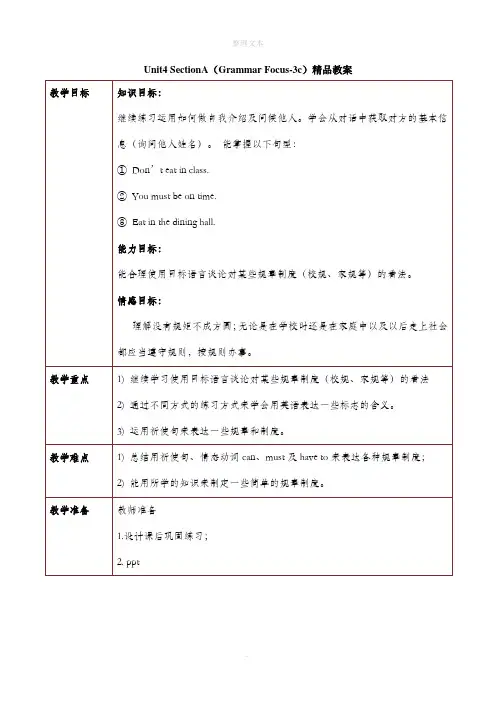
. Unit4 SectionA(Grammar Focus-3c)精品教案
教学目标 知识目标:
继续练习运用如何做自我介绍及问候他人。学会从对话中获取对方的基本信息(询问他人姓名)。 能掌握以下句型:
① Don’t eat in class.
② You must be on time.
③ Eat in the dining hall.
能力目标:
能合理使用目标语言谈论对某些规章制度(校规、家规等)的看法。
情感目标:
理解没有规矩不成方圆;无论是在学校时还是在家庭中以及以后走上社会都应当遵守规则,按规则办事。
教学重点 1) 继续学习使用目标语言谈论对某些规章制度(校规、家规等)的看法
2) 通过不同方式的练习方式来学会用英语表达一些标志的含义。
3) 运用祈使句来表达一些规章和制度。
教学难点 1) 总结用祈使句、情态动词can、must及have to来表达各种规章制度;
2) 能用所学的知识来制定一些简单的规章制度。
教学准备 教师准备
1.设计课后巩固练习;
2. ppt 整理文本
. 教学步骤
任务时间
活动形式 师生课堂活动 设计意图
Step 1
Warm-up and
revision
5分钟
1. Greet the Ss as usual.
2. Check the homework..
3. Chant:
Be polite to each other.
Wear school uniform.
Don’t be late for school.
Don’t say rude remarks in school.
Don’t eat snacks in class.
Don’t shout in class. 创设情景让学生进入学习状态。 整理文本
. Step 2
Presentation
Grammar
Focus.
Whole class 处理Grammar Focus.

人教版初中英语七年级上册第四单元Section A(Grammar Focus-3c)教案和教学反思
教学基本信息
学科 英语 学段 初中 年级 七年级
单元 Unit 4 课题 Where’s my schoolbag? 总课时数 5
课时 Section A
(Grammar Focus-3c) 课型 语法课 授课时间
教学目标及教学重点、难点
教学目标:
At the end of the class, the students will be able to:
1. learn to use prepositions: on, in, under.
2. learn to use“where”questions to ask for the location of things.
3. learn to tell others about the location of things.
教学重点:
1. Key vocabulary:
know, in your grandparents’ room, on the sofa, under the chair...
2. Key sentences:
A: Where’s the… ?
B: It’s in/ on/ under/…
A: Where are the… ?
B: They’re in/ on/ under/…
教学难点:
Learn the usage of in/ on/ under/where.
教学过程(表格描述)
教学环节 主要教学活动 设置意图 Step 1
Lead-in
(PPT 4-6) 1. Make Ss look at the pictures and describe the
position of the ball.
2. Ss work in pairs to review the language points.

Unit 4 Where’s my schoolbag? (Grammar Focus—3c)教学设计
教材分析:本部分首先通过表格的形式总结了本单元的目标语言,即:Where引导的特殊疑问句以及含有on, in, under 的答句。通过3a-3c的学习,学生在新的语境中进一步练习物品位置关系的提问和表述,进一步学习和运用介词on, in, under。3a-3c的活动安排是分层次的。3a让学生看图补全对话,主要关注语言形式(focus on form),是语言结构练习;3b让学生两人一组看图问答,是控制性的语言输出练习,要求学生输出更为完整的对话;3c是开放性的交际活动(communicative activity),且具有信息差(information gap),是比较真实的语言运用活动,因而更加关注语义(focus on meaning)。
学情分析:本单元的主要内容是谈论物品所在的位置。通过这一话题,训练学生的听、说、读、写四项基本技能。七年级学生已经有了一定的英语语言基础,所以本节课内容并不陌生,让学生通过询问物品的位置,学习一些有关家居物品和学习用品的单词,以及方位介词in, on,
under, behind 等的用法;学习并掌握Where问句的问答,一般疑问句提问并用方位介词来回答;学习名词单复数及人称代词、物主代词的用法,同时培养学生养成干净、整洁、合理摆放物品的好习惯。
教学目标:(Teaching objects)
1.Knowledge objects:Learn to talk about where thing are in English. Grasp the structures: Where
questions. and Prepositions: on, in, under.
Target language:
Where is his pencil? It is in his schoolbag.