
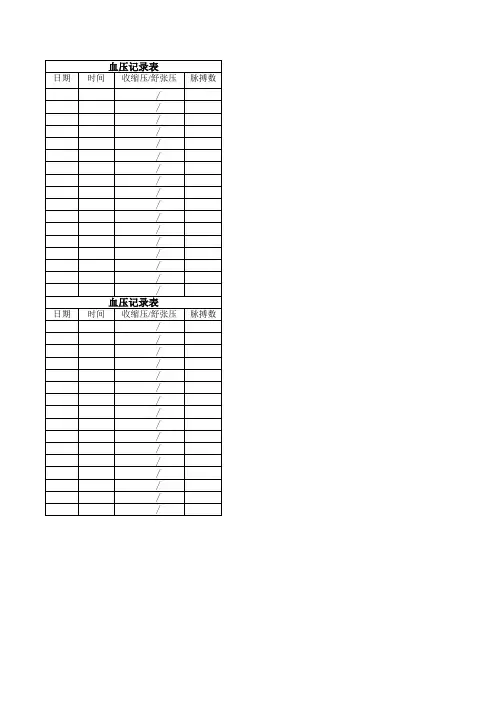
血压记录表Book1
- 格式:xls
- 大小:18.00 KB
- 文档页数:1

常规体检项目表一览全集文档(可以直接使用,可编辑实用优质文档,欢迎下载)常规体检项目有哪些,给您列个表格,让您一目了然。
北京民众体检中心根据不同人群特点针对性地推出了几款个人体检套餐,以满足受检者的不同需要。
以下就是常规体检项目的一个列表:功能意念项目表(一)社会交往(Social Communications) (1)问候(Greetings)Please say hello to your parents.Please give my love / best wishes to Lucy.(2)介绍(Introduction)This is Mr. / Mrs. / Miss / Ms Brown.(3)告别(Farewells )A.See you later / then / tomorrow / soon.I am sorry I have to go now.I am afraid I must be leaving now.(4)感谢(Thanks )A. Thank you for your help.It's very kind / nice of you.I appreciate your help.B. It's a pleasure.My pleasure.That's OK/ all right.You're welcome.Don' t mention it.(5)道歉(Apologies)A. Sorry. I'm sorry.Excuse me, please.I beg your pardon.I' m sorry for losing your book.I'm sorry to interrupt you.I'm sorry (that) I'm late.B. That's OK.Thatt's all right.Never mind.It doesn't matter.It's nothing.Forget it.(6)邀请(Invitation)A. Would you like to go for a walk?You must come to dinner with us.May I invite you to dinner?What / How about having a swim?B1. OK.Thank you.I'd like that, thanks.Yes, I'd love to.That would be very nice.B2. No, thank you.It's very nice of you, but my mother is ill.I'd love to, but I'm afraid I have no time.I'm sorry I can't. What about another time?(7)请求允许(Asking for permission )A. May I come in?Can / Could I use your telephone?Is it all right if I sit here?I wonder if I could smoke here.Would / Do you mind if I open the window?B1. Yes, please. Sure. Certainly.Please do. That's all right. Of course, you can.Go ahead, please.B2.I'm sorry, it's not allowed.I'm afraid not. You'd better not.It' s not allowed.I'm sorry, but you can smoke in the next room.(8)祝贺与祝愿(Expressing wishes and congratulations)A. Have a good day / time!Have a good journey / trip!Good luck!Enjoy yourself!Best wishes to you.Happy New Year!Merry Christmas!Happy birthday!Wish you all the success!Congratulations!Well done!B. Thank you.You, too.The same to you.(9)提供帮助(Offering help)A. Do you want me to clean the room?Can I help you?Would you like me to help you?What can I do for you?Let me take your bags.B1. Yes, please. Yes, thanks.Thank you.That would be nice / fine.Thank you for your (the) help.B2. No, thanks / thank you.Thank you all the same.That's very kind of you, but I can manage it myself.(10)约会(Making appointments )A. Will you be free tomorrow?Do you have time this afternoon?How about tomorrow morning?When / Where shall we meet?Could we meet at 4:30?Let's make it 4:30.B1. Yes, I'll be free then.All right. See you then.B2. I'm afraid I have no time then.Sorry, I won't be free then. But I'll be free tomorrow.(11) 打(Making telephone calls )A. Hello! May I speak to Tom?Hello! I'd like to speak to Mr. Green.Is that Liu Ying speaking?Can I leave a message?I'll call back later / again.I'll ring him / her up again.B. Hello! This is Mary speaking.Hello, who is this?Hold on, please.Just a moment, please.Hello, who's speaking?Sorry. He / She isn't here right now.Can I take a message?Sorry. I can't hear you.The line is bad / busy.I couldn't get through.Sorry, I'm afraid you have the wrong number.(12) 就餐(Having meals)A. Would you like something to eat / drink?What would you like (to have)?Would you like some more fish?Help yourself to some fish.Which do you prefer, rice or noodles?What would you like to drink, tea or coffee?B1.Yes, I'd like a drink.I'd like rice and chicken.Just a little, please.Can I have some more soup?It's so delicious. Thank you.I prefer noodles to rice. I like green tea.B2. No, thank you. I've had enough.I'm full, thank you.It's very delicious, but I can't eat any more.(13)就医(Seeing the doctor)A. What's the matter?What seems to be the trouble?Do you have a fever?How long have you felt like this?It's nothing serious.Take this medicine three times a day.You'll be all right / well soon.Give up smoking and keep on taking more exercises.B. I have a headache / cough / fever.I feel terrible / bad / horrible / awful.I don't feel well.I've got a pain here.It hurts here.I don't feel like eating.I can't sleep well.(14)购物(Shopping)A. Can / May I help you?What can I do for you?How many / much would you like?What colour / size / kind would you like?What about this one?Here's your change.B. I want /I'd like a pair of shoes.How much is it / are they?May I try it on?It's too big / small.Sorry, it's too expensive.Do you have any other colours / sizes / kinds?Two and a half kilos / pounds, please.That's fine. I'll take it.Just have a look.Well, I'11 think about it.(15) 问路(Asking the way)A. Excuse me. Where's the washroom?Can you tell me how to get to the post office?Excuse me. Which bus goes to World Park?Excuse me. Which is the way to the Bank of China? Excuse me. Could you tell me the way t6 the station, please? How can I get to No. 4 Middle School?B1. It's over there.It's about 400 metres from here.Go down this street until you see the tall red building.Turn right / left at the first / second crossing / comer.You can't miss it.You can take bus No. 103.You'd better take a taxi. ?B2. Sorry. I don't know. I'm a stranger here.(16)谈论天气(Talking about weather)A. What's the weather like today?How's the weather in Beijing?What a cold / hot day today!It's a nice / fine / beautiful day today.B. It's sunny / cloudy / windy / rainy / snowy / foggy.It's getting cool / cold / warm / hot.(17)语言交际困难(Language difficulties in communication) Pardon?I beg your pardon? I don't understand. Sorry, I can't follow you. Could you say that again, please?Could you repeat that, please? Can you speak more slowly, please? What do you mean by that?How do you say ... in English?I don't know how to say that in English.I don't know the word in English.How do you spell it, please?I'm sorry I only know a little English.(18)提醒注意(Reminding and warning)Don't forget your raincoat. Remember to lock the door.Make sure that all the windows are closed.Mind your head/step!No smoking!No spitting!Wet floor!Look out!Be careful!Don't touch!It's dangerous!(19)劝告(Advice)You'd better go to see the doctor.You should listen to and read English everyday.You need to buy a Chinese-English dictionary.If I were you, I'd phone him now.Don't rush / hurry/ push. Please stand in line.(20) 建议(Suggestions)Let's go and have a look.Should we go now?What / How about a picnic this Sunday?Why don't you buy a computer?Why not go to a movie?(二)态度(Attitudes)(21) 同意和不同意(Agreement and disagreement) Sure. Certainly.That's correct.Of course. All right.I agree.No problem.That's a good idea.Yes, I think so.No way.Of course not.I don't agree.I don't think so.I'm afraid not.(22)喜欢和不喜欢(Likes and dislikes)This book is very interesting.I like / love the movie (very much).I like / love to play computer games.I like taking photos.I enjoy listening to music.I'm interested in science.He is fond of music.This song is bad / awful.I don't like the movie very much / at all.I don't enjoy collecting stamps.I hate to do homework.(23)肯定和不肯定(Certainty and uncertainty)I'm sure.I'm sure of that.I'm (quite) sure (that) she'll join us.There is no doubt that it's made of silk.It's clear that it will rain soon.I'm not so sure.I'm not sure of that.I'm not sure whether / if she can come.Maybe you're right.Perhaps she is at home now.It's hard to say.(24)可能和不可能(Possibility and impossibility)A. He can / may come today.It may snow tonight. It's possible to finish the homework before 6 o'clock.B. He can't be in the office now.It's impossible to finish my homework within one hour.(25)能够和不能够(Ability and inability)He can ride a bike. He's able to pass the math exam.He is good at football.He can't swim.He's unable to walk any more.She's not good at swimming.(26)偏爱和爱好(Preference and hobbies)I prefer tea. Which do you prefer, tea or coffee?I prefer tea to coffee.I'd prefer to go by train.I like English better / the best.My favourite subject is physics.I'd rather drink coffee than tea,Where would you rather go, London or Tokyo?(27)意愿和打算(Intentions and plans)I'll go with you.I'm going to see my head teacher this afternoon.I'd like to make a phone call to her after class.I want / hope to find an English pen-friend.I plan to go to Hangzhou this summer.We are ready to move to a new house.I am thinking of driving to Beijing.I won't see the movie again.I'm not going to buy the book.I don't want to live in the big city.(28)希望和愿望(Hope and wish)I wish to see you again.I hope to become a doctor.I hope it stays fine.I wish I were younger.I hope so.I hope not.(29)表扬和鼓励(Praise and encouragement)A. Very good!Well done!Wonderful!Excellent!You speak English very well.Your dress is beautiful!Come on! Keep trying!You can do it!B. Thank you.OK. I'll try it again.(30)责备和抱怨(Blame and complaint)What do you mean by doing so?How could you cheat your teacher?Why didn't you tell me the truth?I'm sorry to have said that, but this room is too dirty, Why don't you do something about it?(31) 冷淡(Indifference)I don't care,I don't care what you do.It doesn't matter to me.I don't mind if you smoke.It's none of my business.(三)情感(Emotions)(32)高兴(Happiness)How wonderful / nice!That's lovely / great / wonderful!I'm so happy.It's well done.I'm pleased to know that.(33)惊奇(Surprise)Really?Oh dear!Is that so?What a surprise!How nice to see you!How surprising!I'm surprised.It surprises me that your English is so beautiful. Does that surprise you?Is this what you expected?(34)忧虑(Worries)What's wrong?What's the matter?Anything wrong?What should we do?Is something worrying you?Are you worried about your health?(35)安慰(Reassurance)There, there. Don't be afraid.Don't worry.It's (quite) all right.It'll be OK / all right.(36)满意(Satisfaction)Good!Well done!Perfect!That's fine.That's better.That's good enough.I'm pleased with your spoken English. (37)遗憾(Regret)I'm so sorry!It's a great pity!What a shame!That's too bad!(38)同情(Sympathy)I'm so sorry!I'm so sorry about your illness.I'm sorry to hear you are going away. (39)恐惧(Fear)Help!How terrible!I'm afraid of that dog.I'm frightened.(四)时间(Time)(41)时刻(Point of time)A. Excuse me. What's the time, please? Excuse me. What time is it?Have you got the time?When did you come to China?What time do you get up every day?B. It's half past five / twenty to nine.I came to China in 1998.I get up at 6 o'clock.(42)时段(Duration)A. How long have you been in this school? How long does it take you to get to school? When did you live in Beijing?How long have you been ill?B. I have been in this school for three years.It takes me twenty minutes by bike.I lived in Beijing from 1996 to 1999.I have been ill since last Monday night.(43) 频度(Frequency)A. How often do you go to movies?B. I go to the movie once a week.I often/never go to movies.(44) 时序(Sequence)What did you do next?Finally we found our way out.It rained even harder later on.(五)空间(Space)(45)位置(Position)A. Where is the picture?B. It's on / at / above / in / under / beside / near / behind the table. He sits at the back of the room.The lab is in the centre of the school.(46)方向(Direction)A. Which is the way to the station?Where is the train / bus going?Where are you going?B. Go down this street, and turn left / right at the first crossing. The train is going to Xi'an.The train is going to the east / west / south / north.I'm going to the railway station. I'm leaving for Shanghai.(47)距离(Distance)A. How far is your school from here?B. It's about 40 minutes by bike.It's about 6 kilometres / miles away.(六)存在(Existence)(48) 存在(Existence)A. Is there a bird in the tree?Are there any apples in the tree?What's in the tree?B. Yes, there is / are.There's a bird in the tree.There are many / a lot of birds in the tree.(49) 不存在(Non-existence)A. Is there an English book in the schoolbag?Are there any English books in the schoolbag?Isn't there any water in the bottle?B. No, there isn't / aren't (any).There isn't an English book in the schoolbag.There aren't any English books in the schoolbag.No, there's no water in the bottle.There's no more paper in the printer.(七)特征(Features)(50)形状(Shape)A. What does it look like?What's the shape of the clouds?B. It looks like a camel.It's round / long / tall / short.It's a circle / square.It's a U-shaped road.(51)颜色(Colour)A. What colour is the bag?B. It's green / red / blue / yellow / black / white / orange / purple / dark blue.I like the photo in black and white.(52)材料(Material)A. What's the table made of?What's the red wine made from?B. It's made of wood.It's made from grapes.I bought a woolen sweater yesterday.(53)价格(Price)A. How much is the dictionary?How much is it?How much are they?Is it cheap / expensive?B. The dictionary costs me 100 yuan.The dictionary is expensive / cheap.(54)规格(Size)A. What size is your sweater?What size shoes do you wear?B. The size of my sweater is XXL.It's too big / small / long / short for me.(55) 年龄(Age)A. How old are you?How old is he / she?B. I'm eighteen.He / She is six years old. Uncle Wang is an old man.(八)计量(Measurement)(56)长度(Length)A. How long is the bridge?B. It's 430 metres / feet long.(57)宽度(Width)A. How wide is the river?B. It's about 200 metres wide.(58)高度(Height)A. How tall / high is the building?B. It's 130 metres tall / high.The building has 85 floors / stories.(59) 数量(Number)A. How many students are there in your class?How much water do you drink every day?B. There are forty students in our class.I drink five glasses of water every day.(九)比较(Comparison)(60)同级比较(Equal comparison)My ruler is as long as yours.I can run as fast as you can.This book is not as interesting as that one.I can't run so fast as you can.(61)差别比较(Comparative and superlative)Lily is younger than Kate.The red skirt is more expensive than the yellow one.I run faster than Jim.Mrs. Baker walks more slowly than Mr. Baker.Jim is the tallest in his class.Tom is the best of all.(62)相似和差别(Similarity and difference)This picture is the same as that one on the wall.Lucy is like her mother.Tom looks like his father.My picture is different from yours.There are five differences between the two pictures.(十)逻辑关系(Logical relations) (63)原因和结果(Cause and effect )A. Why are you late for school?How could you miss the train / plane?B. Because I got up late this morning.As he was ill, he couldn't come to school.Since she did not feel well, she stayed at home.Because of the bad traffic, we missed the train.He ate too much, so he did not feel well.(64)目的(Purpose)A. Why are you here today?Why did you do that?B. I came here to see you off.(十一)职业(Occupation)(65)工作(Job)A.What do you do?What's your job?What are you going to be?B. I'm a teacher / doctor / worker / farmer / businessman / manager. I'm going to be a scientist / computer engineer.(66)单位(Employer)A. Where do you work?B. I'm teaching English In a high-school..企业安全生产检查项目表(全)。

智能产品英语单词编辑:理想谭一、移动设备类1. smartphone:智能手机(具有独立的操作系统,可安装各类软件实现丰富功能的移动电话。
)2. tablet:平板电脑(一种小型、方便携带的个人电脑,以触摸屏作为基本的输入设备。
)3. smartwatch:智能手表(具有信息处理能力,可连接手机等设备的手表。
)4. fitness tracker:健身追踪器(用于记录运动数据、监测健康状况的设备。
)5. smart bracelet:智能手环(可监测运动和健康数据的手环。
)二、音频设备类1. wireless headset:无线耳机(无需通过线缆连接设备的耳机。
)2. smart speaker:智能音箱(可以通过语音交互实现播放音乐、查询信息等功能的音箱。
)3. voice assistant:语音助手(通过语音交互为用户提供服务的软件。
)三、家居电器类1. smart TV:智能电视(具有全开放式平台,搭载操作系统,可实现双向人机交互功能的电视。
)2. smart thermostat:智能恒温器(可以自动调节温度的设备。
)3. smart lock:智能锁(通过密码、指纹等方式开启的锁具。
)4. smart camera:智能摄像头(可远程监控、具有智能识别等功能的摄像头。
)5. robotic vacuum cleaner:智能扫地机器人(自动清扫地面的机器人。
)6. air purifier:空气净化器(净化空气的设备。
)7. smart light bulb:智能灯泡(可通过手机等设备控制亮度、颜色等的灯泡。
)8. smart plug:智能插座(可远程控制电器开关的插座。
)9. smart refrigerator:智能冰箱(具有智能管理食物、联网等功能的冰箱。
)10. smart oven:智能烤箱(可通过手机控制、具有多种烹饪模式的烤箱。
)11. smart microwave:智能微波炉(可远程控制、具有智能菜单等功能的微波炉。

护理记录书写错误整改措施〔共6篇〕第1篇:护理记录书写总看医生写抢救记录,护理抢救记录怎么整?2023-02-18住院患者的病历中,我们可以不时看到急危重患者的抢救记录,可是,护理抢救记录在哪里?怎么写?护理到底需不需要书写抢救记录?如何书写?什么样的病人需要书写呢?忘忧草医学界护理频道护理抢救记录隐身在哪里?护理抢救记录就藏身在护理人员经常书写的危重症病人护理记录中。
为减少临床护士护理文书的书写时间,让护士有更多的时间去护理病人,如今的危重症病人护理记录都是表格式的,表格内容包括:①病人一般资料〔包括病人姓名、病案号、床号、病室。
〕②监测与病情记录〔包括生命体征、出入量、病情记录。
〕③其他:包括记录日期、时间、记录人和页码。
护理抢救记录就在病情记录里危重症病人护理记录单中,病情记录很重要:在观察和评估的根底上,将病人的主观和客观信息用语言描绘的方式记录下来,包括病人意识状态、精神状况、采取的体位、全身皮肤状况、使用的仪器设定形式及参数、静脉输液通路、鼻饲管、引流管、尿管等各种管路及引流液性质、并发症预防措施、压疮、跌倒、坠床、意外事件等平安风险、采取的护理措施及效果等,病情记录应突出专科特点。
病区记录包含有抢救记录。
病情记录详细内容包括如下:①病人主诉。
②护士观察到的病人病症、阳性体征和其他临床表现、心理及行为的改变以及重要的异常实验室检查等。
③治疗、护理措施及施行后的效果记录。
④手术记录。
⑥专科护理记录。
⑦特殊用药记录。
⑧抢救记录。
看到这里,相信护理人员应该对护理抢救记录有了粗略的理解与掌握,一般病人可以按照规定,简化护理文书书写,不再书写护理记录单,但危重症病人,尤其是ICU里入住的危重症病人,那么要认真、细致地书写护理记录,且病人病情发生突变,临床进展了抢救的,不仅医生们要写抢救记录,护士也要有相应的抢救记录。
医生书写的抢救记录有固定格式,且分大抢救与小抢救,大抢救是独立分页的,小抢救那么夹杂在病程记录中。
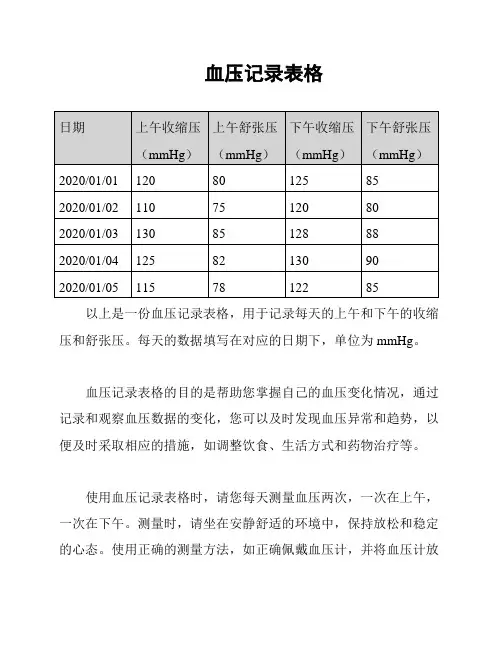
血压记录表格
以上是一份血压记录表格,用于记录每天的上午和下午的收缩压和舒张压。
每天的数据填写在对应的日期下,单位为mmHg。
血压记录表格的目的是帮助您掌握自己的血压变化情况,通过记录和观察血压数据的变化,您可以及时发现血压异常和趋势,以便及时采取相应的措施,如调整饮食、生活方式和药物治疗等。
使用血压记录表格时,请您每天测量血压两次,一次在上午,一次在下午。
测量时,请坐在安静舒适的环境中,保持放松和稳定的心态。
使用正确的测量方法,如正确佩戴血压计,并将血压计放
置在心脏水平高度。
测量完成后,请将测得的收缩压和舒张压填写
在表格的相应位置。
血压记录表格有助于您和医生共同分析和评估血压数据,以制
定更好的健康管理计划。
同时,通过长期记录和观察,您还可以了
解到某些饮食、生活惯和活动对血压的影响,从而更好地调整和管
理自己的生活方式。
请务必妥善保存和保护好您的血压记录表格,方便之后查阅和
分析。
如有需要,您也可以将表格数据与医生或其他健康专家分享,以便获得更专业的建议和指导。
祝您健康!。