河北省泊头市第一中学2019-2020学年高一上学期第二次月考英语试卷 Word版含答案
- 格式:doc
- 大小:63.00 KB
- 文档页数:11
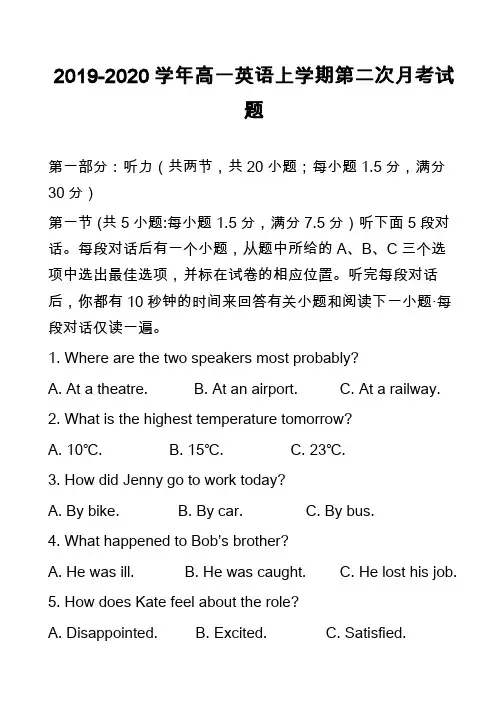
英语试题第一部分听力(共两节,满分30分)第一节(共5小题,每小题1.5分,满分7.5分)请听下面5段对话,选出最佳选项。
1.What does the man suggest the woman wear?A. A skirtB.A shirtC. Some trousers2.What are the speakers talking about?A.The man’s birthplaceB.The man’s farmhouseC.The man’s favorite mountain3.What will the man do tomorrow afternoon?A.See Simon offB.Visit the museumC.Meet the woman4.Where are the speakers probably?A.At homeB.In a cinemaC.In a restaurant5.What will the man buy?A.Some grapesB.Some bananasC.Some oranges第二节(共15小题,每小题1.5分,满分22.5分)请听下面五段对话或独白,选出最佳选项。
请听第6段材料,回答第6,7题。
6.When will the speakers go to the club?A.On November 2ndB.On November 7thC.On November 9th7.What can the speakers do at the club?A.Go sailingB.Go fishingC.Go swimming请听第7段材料,回答第8,9题。
8.What kind of music does the man dislike?A.Pop musicB.Rock musicC.Folk music9.What do the speakers decide to do first?A.Surf the InternetB.Talk to their friendsC.Buy the tickets 请听第8段材料,回答第10至12小题。
10.What is the probable relationship between the speakers?A.ClassmatesB.NeighborsC.Teacher and student11.What will Paul bring to the party?A.Some cupsB.Some platesC.Some questions12.Who will bring some food?A.BeckyB.CarolineC.Stefan请听第9段材料,回答第13至16题。
13.What color jacket does the woman want to wear?A.BlackB.BlueC.Pink14.What has the woman spent her money on recently?A.CDsB.BooksC.Clothes15.What does the man say about the woman’s job?A.It’s low-paidB.It suits herC.It wastes time16.What is the woman going to do next?A.Send emailsB.Do schoolworkC.Go shopping请听第10段材料,回答第17至20题。
17.When will the speaker leave the camp tomorrow?A.At 6:30amB.At 7:00 amC.At 7:30am18.How does the speaker feel about changing the transport?A.DisappointedB.PleasedC.Surprised19.What will the weather probably be like tomorrow?A.WindyB.RainyC.Sunny20.What will the speaker do tomorrow?A.Watch the monkeysB.Fish in the riverC.Camp around the lake第二部分阅读理解(共两节,满分40分)第一节(共15小题;每小题2分,满分30分)阅读下列短文,从每题所给的四个选项(A、B、C和D)中,选出最佳选项。
APeteAs a news reporter I have to wo rk long hours and so I get less than five hours’ sleep a night. I’m often up early in the morning searching for news, and then working late into the night. I’m an energetic person most of the time. However, I find the only way I can function (运转) properly is by taking a regular nap (小憩) during the day. I usually drop off at once. I can generally only get away with fifteen or twenty minutes at a time before the phone rings.PennyI have real problems getting to sleep at night. I do all the things you’re supp osed to do. But try as I might to get to sleep, I’ll be turning for ages, then getting up to busy myself with different things to tire myself out. And then, when I do finally drop off, I tend to wake up at the slightest (最轻微的) sound and lie awake for hours worrying. I’ve tried all kinds of treatment, but none worked. I just can’t remember when I last got a good night’s sleep.AmyI’m normally so tired by the end of the day that I never have any problems dropping off. I’ll sleep anywhere — in a hotel, on a plane, I can even sleep through a noisy party in the house next door, anything. All the same, I need a good eight hours’ sleep to make me feel refreshed (精神焕发的) otherwise I tend to feel sleepy the next day.JoeI snore (打鼾) heavily. It drives my wife crazy, as she’s a light sleeper. She’ll move into another bedroom and then she’ll complain the next day that she didn’t get a good sleep. I’ve tried sleeping on my side but in spite of my efforts, none of it has done any good. My wife has asked me to lose weight —I don’t believe it will make any difference, though.21. What helps Pete to work well?A. His scientific method.B. Enough sleep at night.C. His effective working hours.D. A regular short sleep during the day.22. What is wrong with Joe?A. He is in poor health.B. He always looks worried.C. He has a weight problem.D. He often fights with his wife.23. Who is a light sleeper?A. Penny.B. Pete.C. Amy.D. Joe.24. In which part of a magazine could we find this text?A. Arts.B. Jobs.C. Lifestyle.D. Education.BIf you were to travel back in time to the tenth century, you probably wouldn’t be able to understand a sentence that anyone said to you. They’d be speaking Old English. Talking to a tenth-century Englishman, you’d probably only be able to understand a few words like “a” or “the”. Only about one-sixth of today’s English words have an Old English root (词根), with the rest having foreign influences.Gradually Old English turned into the Middle English that Chaucer wrote in — but still the official language of England was French! It was only in 1362, during Chaucer’s lifetime, that English was used at the opening of Parliament (议会) for the first time. During the same year a law called the “Statute of Pleading” was passed, making English the official language in Parliament. In 1399, King Henry IV became the first king of England after the Norman Conquest whose mother tongue was English.English was still a language of low status (地位) — especially when it came to writing poetry (诗歌). During the 14th century, the Italians and French were creative. Great poets like Dante were writing in totally new ways. But English had no such great writers. This was where Chaucer made a difference. He took the language of the man in the street and turned it into many famous works, such as The Canterbury Tales. Chaucer proved poetry written in English could be every bit as good as books in French.Of course, the English language has continued to change since Chaucer’s day. For example, Shakespeare’s English is quite different from Chaucer’s. And it is still changing now. Until just a few years ago, “C U L8R” (see you later) was just a set of letters and numbers, but now most people know what it means!25. What happened during Chaucer’s lifetime?A. Old English began to turn into the Middle English.B. English’s status was greatly improved.C. English was used only in Parliament.D. English kings usually spoke English.26. Why did the author give the example of Shakespeare’s English?A. To explain English is always changing.B. To explain how the Middle English changed.C. To show Shakespeare’s English is unusual.D. To show how people respond to new words.27. How is the text developed?A. By space.B. By comparison.C. By importance.D. By time.CMatthew Shifrin got his first Lego blocks when he was 5. “I’ve been in love with Legos ever since,” he says. Shifrin is blind. Now 18, he has spent years trying to make Legos easier for blind kids to enjoy.The blocks themselves are not difficult for blind people to put together. But Lego’s large sets— including bridges, starships, historic scenes, and famous buildings — are a different story. They have hundreds or even thousands of pieces and complex (复杂的) written instructions. These make it very hard for blind people to build a set without a lot of help from a person who can see. “I was always just drooling (痴迷于) over the sets because they sounded so amazing,” Shifrin says. “But I knew that I would never have access to (可以使用) them.”That changed on S hifrin’s 13th birthday. Lilya Finkel, a family friend, gave him the Lego set Battle of Alamut, a castle with 821 pieces. She had translated the instructions into Braille (盲文). She had also made other changes, like dividing the pieces into plastic bags based on which step they were to be used in. Shifrin could build the set without his parents’ help. “This was a rare case in which the impossible was made possible and the playing field was leveled,” he says.Now Shifrin hopes to share accessible Lego instructions with other blind kids. He and Finkel have translated more than 20 Lego instructions for the blind. Shifrin has also set up a website, Lego for the Blind, where people can download instructions and volunteer to help translate instructions into Braille. “I hope that the next generation of blind children will benefit and will feel the level playing field that I felt when I built that first set,” he says.28. What does Paragraph 2 mainly talk about?A. Some kinds of Lego sets.B. How to build a Lego house.C. People’s different opinions on Lego.D. Why Lego’s large sets are difficult for the blind.29. What was special about Shifrin’s birthday gift from Finkel?A. It was a castle.B. It was blind-friendly.C. It was bagged well.D. It was hard to put together.30. Which of the following words can best describe Shifrin?A. Childish.B. Helpful.C. Brave.D. Proud.31. What is the best title for the text?A. Amazing successB. Games for childrenC. For the love of LegoD. The way to build with LegosDI did some research and examined how British English and American English changed between the 1930s and the 2000s. Take spelling, for example — towards the 1960s it looked like the UK was going in the direction of not using the “u” in “colour” and writing “centre” as “center”. But since then, the British have become more confident (自信的) in some of their own spellings. In the 2000s, the UK used an American spelling choice about 11% of the time while Americans use a British one about 10% of the time. There is also no need to worry too much about American words, such as “vacation”, “liquor” and “lawmaker” entering British English. There are a few examples of this kind of vocabulary change but they are mostly uncommon words and are not likely to change British English too much. The British are still using “mum” rather than “mom” and “petrol” rather than “gas”.But when we start thinking of language more in terms of style than vocabulary or spelling, a different picture appears. Some of the bigger trends (趋势) in American English are moving towards a freer use of language. American sentences are on average (平均) one word shorter in 2006 than they were in 1931.Americans also use a lot more apostrophes (撇号) in their writing than they used to, which has the effect of turning the two words “do not” into thesingle “don’t”.“The hand of the king” becomes the shorter “The king’s hand”.However, in all these ways Brits are changing too — and in the same way as Americans. They’re just about 30 years behind the trend that Americans seem to be leading.So this raises a question, is British English actively following American English or is this something that is simply a natural trend in language use? Perhaps the British would have gone in that direction even if America had never been discovered? I’d liketo agree with the second idea but because of the fact that British people learn plenty of American language through different ways, I think the first is more correct.32. What did the British do in the 1960s?A. They used some American spellings.B. They built up confidence in their language.C. They did research on language differences.D. They went in the direction of harder spellings.33. What does the author try to show by using examples like “petrol”?A. British English has changed a lot.B. Some uncommon words are used less often.C. American words are entering British English.D. American spelling won’t change Br itish English too much.34. Which of the following is a trend of American English?A. It is using shorter words.B. It is turning to proper grammar.C. It is avoiding using apostrophes.D. It is trying to make sentences simpler.35. Which of the following is the author’s opinion about the languages?A. American English is going the wrong way.B. British English is following American English’s example.C. American English is borrowing a lot from British English.D. Languages wouldn’t change much if America was not discovered.第二节(共5小题;每小题2分,满分10分)根据短文内容,从短文后的选项中选出能填入空白处的最佳选项。