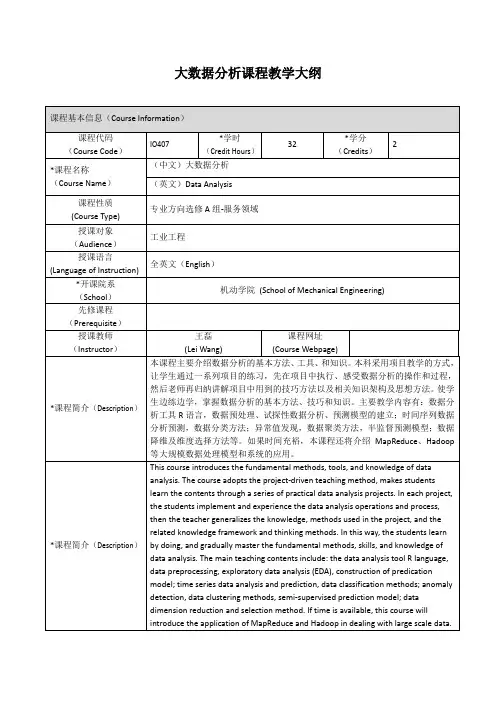
大数据分析课程教学大纲
- 格式:pdf
- 大小:278.39 KB
- 文档页数:3
大数据分析课程教学大纲
课程基本信息(Course Information)
课程代码
(Course Code) IO407 *学时
(Credit Hours) 32 *学分
(Credits) 2
*课程名称
(Course Name) (中文)大数据分析
(英文)Data Analysis
课程性质
(Course Type) 专业方向选修A组-服务领域
授课对象
(Audience) 工业工程
授课语言
(Language of Instruction) 全英文(English)
*开课院系
(School) 机动学院 (School of Mechanical Engineering)
先修课程
(Prerequisite)
授课教师
(Instructor) 王磊
(Lei Wang) 课程网址
(Course Webpage)
*课程简介(Description) 本课程主要介绍数据分析的基本方法、工具、和知识。本科采用项目教学的方式,
让学生通过一系列项目的练习,先在项目中执行、感受数据分析的操作和过程,
然后老师再归纳讲解项目中用到的技巧方法以及相关知识架构及思想方法。使学
生边练边学,掌握数据分析的基本方法、技巧和知识。主要教学内容有:数据分
析工具R语言,数据预处理、试探性数据分析、预测模型的建立;时间序列数据
分析预测,数据分类方法;异常值发现,数据聚类方法,半监督预测模型;数据
降维及维度选择方法等。如果时间充裕,本课程还将介绍MapReduce、Hadoop
等大规模数据处理模型和系统的应用。
*课程简介(Description) This course introduces the fundamental methods, tools, and knowledge of data
analysis. The course adopts the project-driven teaching method, makes students
learn the contents through a series of practical data analysis projects. In each project,
the students implement and experience the data analysis operations and process,
then the teacher generalizes the knowledge, methods used in the project, and the
related knowledge framework and thinking methods. In this way, the students learn
by doing, and gradually master the fundamental methods, skills, and knowledge of
data analysis. The main teaching contents include: the data analysis tool R language,
data preprocessing, exploratory data analysis (EDA), construction of predication
model; time series data analysis and prediction, data classification methods; anomaly
detection, data clustering methods, semi-supervised prediction model; data
dimension reduction and selection method. If time is available, this course will
introduce the application of MapReduce and Hadoop in dealing with large scale data. 课程教学大纲(course syllabus)
*学习目标(Learning
Outcomes) 1.Master the thinking methods and knowledge framework of data analysis
2.Master the fundamental data analysis methods such as data preprocessing and
visualization, classification, clustering, etc.
3.Master a data analysis tool: R language
4.Learn to implement data analysis methods in solving practical problems
1.掌握大数据分析的思维方法和知识框架
2.掌握基本的数据分析方法,如:数据预处理及可视化,分类,聚类等
3.掌握一种数据分析的工具:R语言
4.学会用数据分析的方法解决一些实际问题
*教学内容、进度安排及
要求
(Class Schedule
& Requirements) 教学内容 学时 教学方式 作业及要
求 基本要
求 考查方式
数据分析概念介绍
Introduction to data
analysis 1
R语言学习
Learning R 3
预测水藻爆发项目
Project: Predicting
Algae Blooms 5
数据预处理及试探
性分析
Data preprocessing
and exploratory
analysis 1
预测股市收益项目
Project: Predicting
Stock Market
Returns 5
数据分类方法
Data classification 1
诈骗交易发现项目
Project: Detecting
Fraudulent
Transactions 5
数据聚类方法
Data clustering 1
基因芯片样本分类
项目
Classifying
Microarray Samples 5 数据降维方法
Data dimension
reduction 1
大数据分析及商务
智能技术介绍/学
生项目报告
Big data analysis
and Business
intelligence/Student
project
presentation 4
*考核方式
(Grading) 成绩由2部分组成:(1)小组作业(包括平时小做作业、文献阅读报告、项目演
示等)50%,(2)个人项目(每位学生自已寻找感兴趣的题目,提交项目报告,
项目演示文档,数据,程序等)50%。
The grades includes two parts: (1) Group assignment (including homework, paper
reading report, and project presentation) 50%; (2) Individual project (Self-select a
topic by each student, submit project report, project presentation slides, data, coeds)
50%
*教材或参考资料
(Textbooks & Other
Materials) (Data Mining with R: Learning with Case Studies,Luis Torgo,Chapman & Hall/CRC,
2011, ISBN978-1-4398-1018-7)
其它
(More)
备注
(Notes)
备注说明:
1.带*内容为必填项。
2.课程简介字数为300-500字;课程大纲以表述清楚教学安排为宜,字数不限。