
Unit 1 Extra Study
- 格式:ppt
- 大小:346.50 KB
- 文档页数:71

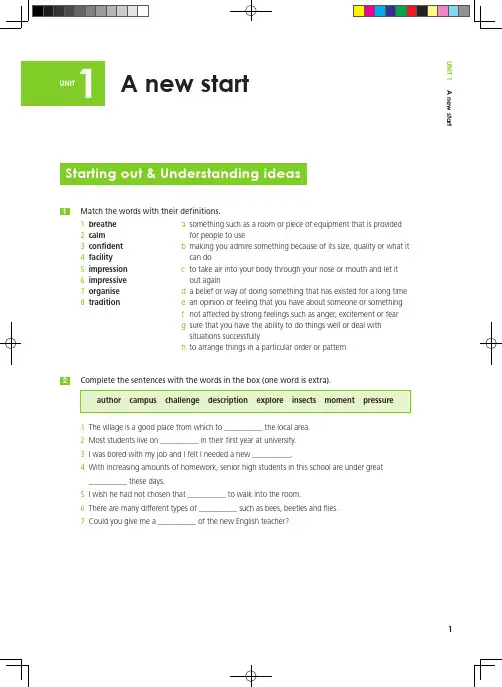
This is a true story about something that happened to me last summer. I was on holiday with my family at a beach in the south of England. I was very interested to 1e__________ the local area, so one morning I woke up early and set off along the quiet road. In my2e__________ to discover the local area, I forgot to tell my parents where I was going.It was a hot, sunny morning and I soon felt thirsty, but I was determined to 3c__________ myself by walking to the highest point. I’m a good walker and so I pushed my way up the hill, although it was quite hard work. At the top, I saw many birds flying around their nests. Feel curious, I left the road and moved towards the nests. Aha, there were some baby birds in the nest. “If I take a picture of the baby birds, will I be attached?” With4b__________ in my stomach, I held my camera up and pointed it at the birds.Just then, one of the birds made a loud noise. I was so surprised that I dropped my camera! I didn’t have time to worry about it, though. To protect their nests, the birds started to fly at me to make me go away. They flew at me one by one. I 5r__________ back down the hill. Near the bottom of the hill, I heard a car 6e__________. It was my mum’s car! I jumped in and shut the door, looking at her in 7p__________.“Go! Go! Go!” I shouted.I spent the rest of the summer saving up for a new camera.•First, visitors can listen to a presentation by 1__________________ in the school hall.•Then, they can see the impressive facilities and 2__________________ in the gym.•After that, visitors go to our 3__________________ and see how students study science.•Before lunch: free time to explore the campus.•Lunch from 12:30 pm to 1:30 pm.•After lunch, visitors can experience different 4__________________.•Before the day ends, visitors and students can 5__________________ in the school hall.•Finally, students can 6__________________.Work in pairs. Take it in turns to plan an open day schedule for your school. Use some of the ideas from Activity 7a as well as your own ideas.☐1S ummerhill School in England is a very special kind of school. It was founded in 1921 by A.S. Neill with the belief that the school should be made to fit the child, notthe child fit the school. The school is run with the idea that teachers and students areequal. Students are free to choose which lessons to go to, if any, and create their owncourse of study.☐2A s a boarding school, most of students at Summerhill stay in school during the term time. Children have power to control access to their own rooms. Every pupil hastheir own bedroom space. The bed areas are personalised by the children, expressingtheir character. Summerhill’s ideas about teaching challenged the traditional modelof how schools were run, and they shocked many people.☐3B ut Summerhill’s approach to giving children freedom to select what to do at school also gained many followers, especially in the United States. Many schools opened inthe US following Neill’s idea that children learn best when they are free from beingforced to learn.☐4T he school is run by a committee of teachers and students who together decide rules such as appropriate bedtimes. Attending classes is voluntary, but most students chooseto go to the classes that interest them. The structure of the school may be unusual, butteachers work in standard classrooms and teach in the same way as usual schools.☐5S ummerhill has been in existence for about one hundred years and is still going strong. It appears that many parents and children still value what Neill thought wasmost important – allowing children to grow up happily and be encouraged to livetheir own lives.a An unusual school with usual classroom teaching methods.b Some schools in the United States follow Summerhill’s example.c The school should suit the child, not the other way round.d Summerhill is a continuing success as a different kind of school.e Summerhill challenged traditional views of what a school should be.Read the passage and answer the questions.1When was Summerhill founded?_____________________________________________________________________________2Where do students express their character?_____________________________________________________________________________3In which country did Neill’s ideas gain popularity?_____________________________________________________________________________4Who runs the school?_____________________________________________________________________________5What do parents and children value about Summerhill?_____________________________________________________________________________Thursday 8 OctoberI have just come back from a great school trip. Some of the activities were challenging, butI really enjoyed it!We went by bus to a sports camp out of town. As we drove, I viewed the impressivecountryside through the window. My first sight on arriving at the camp was seeing a big group of students barn dancing. “That looks complicated, but fun!” I thought.After we changed out of our school uniforms into sports clothes, we were taken to the gym. Here, a teacher taught us how to do various difficult exercises. I struggled to dosome of them, but my friend Cara showed me how to do them. I still could not do them well, but with Cara’s help, I did not stop trying.After lunch, we could select a new sport or activity to learn. Cara chose to learn how to skateboard. I thought it looked frightening, but she was really excited about it. I chose to learn how to barn dance. At first, I could not figure out how the dancers remembered all the moves, and I felt disappointed. Then I realised that a person at the front was calling out each move. Everyone was dancing in pairs, and helping their partners to remember what to do and where to go. I had a go, and I soon memorised them. I felt much happier!By the end of the day, I was able to dance every dance! As the saying goes, “Practice makes perfect!”When the sports camp day finished, our teacher asked us to rate the experience. I gave it10 out of 10!1Where did the student go on the school trip?_____________________________________________________________________________2What activity did the author try first?_____________________________________________________________________________3What activity did Cara try after lunch?_____________________________________________________________________________4How successful was the author at doing these activities?_____________________________________________________________________________5What did the author think about the sports camp?_____________________________________________________________________________Write a journal entry about a school trip experience you have had.。

八年级下册unit1-10词组英汉互译Unit 11.在人们家中in people’s home2.在家通过电脑学习study at home on computers3.将来in the future4.免费的be free5.活到200 岁live to be 200 years old6.一百年之后in 100 years7.一张纸a piece of paper8.更多/更少的树more/few trees9.更多/更少的污染more/less pollution10.更少使用地铁use the subway11.更多使用…use sth a lot12.同意某人的意见agree with sb13.与…谈话talk to/with sb14.使用某物做某事use sth to do15.在上小学be in elementary school16.住在一间公寓live in an apartment17.乘坐火箭到月球fly rockets to the moon18.爱上…fall in love with…19.独自居住live alone20.能够做某事be able to do sth21.去香港度假go to Hong Kong on vacation22.世界杯the World Cup23.飞到月球度假fly to the moon for vacation24.有朝一日one day25.为某人工作work for sb26.看起来精神look smart27.实现come true28.预言未来predict the future29.看见某人做某事see sb do/doing30.数以百计的hundreds of31.在太空in space32.拥有某人自己的机器人have one’s own robot33.科幻小说science fiction movies34.帮助某人做家务help with the housework35.与…做同样的事do the same things as sb 36.叫醒某人wake up37.与…交朋友make friends with sb38.某地有某人在做某事there be sb/sth doing sth39.看起来更像look more like40.一遍又一遍地over and over again41.有更少的工作去做have less work to do42.做某事有趣be fun to do43.在25年到50年之后in 25 to 50 yearsUnit 21.挡住;阻止…进入keep out2.与…某人就某事争吵argue with sb about sth3.与…争吵have an argument with sb=argue with sb4.告诉某人(不要)做某事tell sb (not ) to do sth5.得到一份兼职的工作get a part-time job6.打开turn on7.把…声音放得太大play…too loud8.给…写信write sb a letter9.给…打电话call sb up10.一场球赛的票a ticket to a ball game11.使…惊讶surprise sb12.支付…pay for13.从…借…borrow sth from sb14.为某人买某物buy sb sth15.不知道have no idea16.有同样的发型have the same haircut17.查明find out18.请家教get a tutor19.需要去做need to do20.邀请某人去做某事invite sb to do sth21.把某物落在家里leave sth at home22.做某事失败fail (in) sth23.与…相处融洽get on well with sb24.与…相同的be the same as25.归还某物return sth26.在字典中查找…look up…in a dictionary27.与…打架have a fight with sb28.与…比较compare with29.向…抱怨某事complain to sb about sth30.感觉处于(太多的)压力之下be/feel under (too much) pressure31.买不同的衣服get different clothes32.把…从一个地方带到另一个地方take sb from 名词 to 名词33.直到…才…not…until34.尽可能多地充实到孩子们的生活中来fit as much as possible into their kids lives35.屡见不鲜nothing new36.厉害地强迫某人push sb hard37.总是在做某事be always doing38.计划做某事plan to do39.一方面on the one hand40.另一方面on the other hand41.从很小的年龄开始start from a very young ageUnit 31.到达arrive at/get to/reach2.在…前面in front of3.在…的前部in the front of4.在理发师的椅子上 in/on the barber’s chair5.睡懒觉sleep late6.在电话中交谈talk on the phone7.航天博物馆the Museum of Flight8.降落在中央大街上land on Center Street9.报警call the police10.沿着街道走walk down/along the street11.起飞/脱下take off12.有一次不寻常的经历have an unusual experience 13.大约在10点钟at around ten o’clock14.跟着某人做某事/去某地follow sb to do/地点15.对…感到惊讶be surprised/amazed at16.在树上in the tree/on the tree17.朝…喊叫shout to sb/shout at sb18.在火车站at the train station19.逃跑run away20.沿着…走walk around21.纽约市New York City/the city of the New York22.对…说say to sb23.飞往纽约的航班the flight to New York24.在医生的诊所at the doctor’s25.看望住院的姨妈visit aunt in hospital26.2008年奥运会the 2008 Olympics27.记得做过某事remember doing sth记得去做某事remember to do sth28.在历史上in history29.在现代美国历史上in modern American history30.最重要的事件之一one of the most important events31.听说hear about/of32.多于;超过more than33.玩得高兴have fun/have a good time/enjoy oneself34.沉默地做某事do sth in silence35.在当今时代in recent times36.被…毁坏be destroyed by37.对…有意义have meaning to38.在太空in space39.与(不与)…一样…as…as/not as/so…as40.环绕地球around the world41.一个民族英雄a national hero42.全世界all over the world/around the world43.因/作为…而著名be famous for/as44.第一次做某事do sth for the first time45.日常活动everyday activitiesUnit 41.看肥皂剧watch soap operas2.举行一次惊喜晚会have a surprise party3.在周五晚上on Friday night4.生某人的气be mad at sb5.首先first of all6.做课外家庭作业do a homework project7.递给某人某物pass sb sth=pass sth to sb=pass on sth to sb=pass sth on to sb8.在公共汽车站at the bus stop9.理应做某事be supposed to do10.擅长be good at=do well in11.很抱歉做某事be sorry to do sth12.感冒have/catch a cold13.身体健康be in good health14.一次期末考试an end-of-year exam15.在某事方面感到费劲have a hard time with16.做某事很吃惊be surprised to do17.捎去某人的问候send one’s love18.到现在为止for now19.抄袭别人的家庭作业copy others’ homework20.传些口信pass on some messages21.大打一架have a big fight22.忘记去做某事forget to do23.养成一个坏习惯start a bad habit24.克服get over25.改变某人的生活change one’s life=change the life of sb26.在一个贫困的山村in a poor mountain village27.听起来像sound like28.一个北京大学的毕业生a Peking University graduate29.一个为期一年的计划a one-year program 30.由…发起be started by31.教育部the Ministry of Education32.派人去做某事send sb to do33.对某人来说是一个新的经历be a new experience for sb34.海拔2000米2000 meters above sea level35.使某人觉得恶心make sb feel sick36.经历不同的事experience different things37.打开某人对外面世界的视野open up one’s eyes to the outside world 38.给某人生活一个好的开始give sb a good start in life39.在某人的生活中有一个好的影响be a good influence in one’s life40.关爱地球母亲care for “Mother Earth”41.无国界医生Doctors Without Borders42.濒危野生动物wild animals in danger43.处于危险之中be in danger44.脱离危险be out of dangerUnit 51.去参加晚会go to the party2.玩得高兴have a great time3.让某人进let in4.备考study for one’s test5.一半的同学half the class6.岁末晚会end of year party7.穿牛仔裤wear jeans8.把…拿走take away9.在晚会期间during the party10.校大扫除school clean-up11.儿童医院探视Children’s Hospital visit12.环球旅行travel around the world13.获得教育get an education14.足球代理人soccer agent15.谋生make a living16.似乎seem like sth/doing sth17.梦想的职业dream job18.捐给慈善机构give…to charity19.一直all the time20.受伤get injured21.很难做某事have a difficult/hard time22.实际上in fact23.能够be able to/can24.手机mobile phone25.与某人度过时光spend time with sbUnit 61.收集贝壳collect shells2.滑冰马拉松skating marathon3.你第一双滑冰鞋your first pair of skates4.募捐raise money5.整整五小时the whole five hours6.三年半three and a half years7.填充动物玩具stuffed animals8.妖怪雪球snow glob of the monster9.用光run out of10.在我十七岁生日时on my seventeenth birthday11.顺便说一下by the way12.最常见的the most common13.送某人某物send sb sth14.才艺表演a talent show15.额外的英语课extra Englsih class16.古币old coins17.自由话题free topic18.想起think of19.著名人物famous characters20.黑龙江省会the capital of Heilongjiang Province21.具有丰富多彩的历史with a colorful history22.欧洲的影响European influence 23.苏联风格in Russian style24.家史family history25.惊奇be surprised26.受到…的欢迎be welcomed by27.宋朝皇帝the Song Emperor28.西方历史western history29.越…越the+比较级…the +比较30.确信be certain that/to doUnit 71.介意做某事mind doing sth2.调小/大turn down/up3.洗餐具do the dishes4.从…里出来get out of5.立即right away/at once6.一会儿in a minute7.在开会be at the meeting8.完成这些工作finish these tasks9.在厨房里in the kitchen10.帮某人做某事help sb do/with sth11.抱怨complain about sth12.商店职员store clerk13.给你拿错了食品bring you the wrong food14.不好使don’t work15.恼怒get annoyed16.排队等候wait in line17.长时间的电话聊天have a long telephone conversation18.到处跟着我follow me around19.回到…go back to20.一直all the time21.碰巧发生在某人身上happen to sb22.试着不做某事try not to do sth23.加号cut in line24.有点晚a bit late25.定购食物order food26.压低你的声音keep your voice down27.讲英语的国家English-speaking country28.社会行为social behavior29.与某人站的近stand close to sb30.亚洲国家Asian country31.在各种条件下in all situations32.即使even if33.当众in public34.小心take care to do sth35.熄灭香烟put out the cigarette36.被批评be criticized37.扔垃圾drop litter38.捡起pick up39.表现礼貌behave politely40.依靠depend on41.地方报纸local newspaperUnit 81.幸运儿lucky guy2.做一顿特别的饭make a special meal3.你自己的选择your own choices4.大腹便便的猪a pot-bellied pig5.好伙伴good company6.带某人出去take sb out to do7.睡着fall asleep8.半途中half way9.树上的一片叶子a leaf from a tree10.赠送give away11.公园长椅park bench12.试着做某事try to do sth13.通过不同的方式in different ways14.来自于中国各地from across China15.在舞台上on stage16.各种年龄层all age groups17.鼓励某人做某事encourage sb to do sth18.取得进步make progress 19.奥委会the Olympic Committee20.从…中得到乐趣have fun with sth21.讲本族语的人native speakers22.使某要对某事感兴趣make sb interested inUnit 91.太空博物院 space museum2.游乐场 amusement park3.水上乐园 water park4.曾经到过某个地方 have been to5.到某个地方去了 have gone to6.呆在某个地方 have been in7.既不也不;两者都不 neither nor8.听说 hear of9.迪斯尼人物 Disney character10.主题公园 a theme park11.当然 of course12.过山车 a roller coaster13.以┉为主题 be themed by14.四处走动 walk around15.总是一直 all the time16. 迪斯尼巡游 Disney Cruise17.兜风 take a ride18.在船上 on board19.走不同的路线 take different routes20.结束 end up21.空中乘务员 a flight attendant22.导游 a tour guide23.象…这样的 such as24.考虑 think about25.胜于,而不是 rather than26.在东南亚 in Southeast Asia27.度假 take a holiday28.在一方面 on the one hand29.在另一方面 on the other hand30.超过多余 more than31.四分之三 three quarters32.三分之一 one third33.做某事有困难 have some problem doing34.不管还是;whether or35.夜狩 night safari36.在白天 during the daytime37.在更自然的环境里 in a more natural environment38.全年 all year round39.靠近 be close toUnit 101.闲聊 small talk2.祝一天愉快 have a good day3.浏览;粗略看一遍 look through4.排队等候 wait in line5.穿过一条繁忙的街道 cross a busy street6.开场白 open questions7.感谢函 Thank-you note8.想要 feel like9.出现;陪伴 come along10.融洽相处get along11.想起 think of12.有一个家宴 have a family dinner13.交通拥挤 heavy traffic14.至少 at least。

Unit 1 The mass mediaExtended readingAdvertising: the power of persuasion◆内容分析:【What】本板块的语篇话题是一篇杂志文章,作者从多个角度阐释了广告的影响力,即说服受众购买某个产品或某种服务的力量。
文章从广告的定义、历史、作用、形式、未来发展趋势等方面进行介绍,清晰地说明了广告与大众传媒、商业活动、科技进步以及日常生活的紧密联系,揭示了广告文化的意义和特色。
【Why】本板块的语篇旨在通过介绍广告如何说服受众,引导学生正确认识广告的内涵,理解广告的作用,感受无处不在且丰富多样的广告文化对人们产生的影响,并启发学生思考广告的发展给社会生活带来的种种变化。
【How】本板块的语篇是杂志说明文,主旨明确,结构清晰。
语篇紧扣标题中的关键词persuasion,说明了广告最核心的目的。
文章首先通过广告与大众传媒的紧密关系,说明了广告如何通过大众传媒发挥影响力;其次介绍了广告设计依据顾客购买欲心理所采用的几种技巧;最后展望广告未来的发展方向。
在写作手法上,作者利用举例、对比和向读者提问等方式引导读者练习现实生活,使得说明更加通俗易懂。
◆教学目标:By the end of this section, students will be able to:1. understand why and how advertising persuades people into purchasing a product or service;2. analyse the writing techniques of the article;3. find out the techniques used in their favourite advertisements;4. explain their attitudes towards advertising tailored to individual customers’ needs.◆教学重难点:Students will figure out a little bit hard for them to:1. analyse the techniques of the advertisements;2. express their own attitudes towards advertising.◆教学过程:Step 1 Lead-inEnjoy a video, introducing a funny advertisement.After watching the video, students get to talk about advertising methods.Step 2 DiscussionAsk the students to discussion the questions:Have you ever purchased a product or service after seeing the advertisement promoting it? Why or why not?Step 3 Main ideas of paragraphsListen and then tell the main ideas of each paragraph.1. Definition2. Relationship3. Functions4. The technique of creating a slogan5. The technique of relating a “brand ambassador”6. Product placement7. The future of advertisingStep 4 AnalysisHave students read the article and fill in the following chart.Step 5 Careful readingHave students read each paragraph and answer the questions:Para. 1:Q: What is advertising?A: It refers to the activity of promoting a product or service. In other words, it refers to persuade people to buy a product or service.Para. 2:Q: What is the relationship between advertising and the mass media?A: The history of advertising has always been closely linked with that of the mass media. From the ancient simple advertisements painted on outdoor signs to the colorful, interactive ones in smartphone apps, advertising and the mass media have developed in hand.Para. 3:Q: Why does a company launch a mass media advertising campaign when it wants to promote a product or service?A: Because the mass media reaches so many people, it is a perfect vehicle for advertisers. In addition to making people aware of a product or service, a successful advertisement will also create a desire to buy, thus boosting business.Para. 4-Para. 6:Q: What ways the advertisers have developed to persuade people into purchasing their products or services?A: Slogans, brand ambassadors and product placement.Q: What ways are slogan used to make us remember the product or service?A: Slogans use simple but impressive language.Q: Who can be a “brand ambassador”? Why they employ the brand ambassa dor to promote their product or service?A: A famous actor, a sports star, or even a fictional character. Because the more we like the brand ambassador, the more we will be attracted to buy the product.Q: Why did the author say some advertisements are not so obvious? What mass media use product placement?A: Product placement is typically used in films with huge box-office success and TV shows with high ratings. Besides the films and TV shows, other types of mass media use product placement too, including video games.Para. 7:Q: What are the past, present and future of advertising?A: In the past, advertising was all about reaching as many people as possible with the same message,Now, advertising is becoming more digital and more personalized. In the future, advertising will be even more about understanding individual customers and sending them advertisements that are tailored to special needs.Step 6 Further thinkingWhat is your favourite advertisement?What techniques does it use to promote the product or service?Step 7 Critical thinkingWhat advantages and disadvantages the advertising brings to us?What is your own attitude towards it?Step 8 RetellingHelp students retell the article.Step 9 Language points1.Word study: advertise /ˈædvətaɪz/ v.It pays to advertise. 做广告是值得的。