
2020年4月17日浙江省学考选考高2020届高2017级高三温州二模英语试题及参考答案
- 格式:pdf
- 大小:8.95 MB
- 文档页数:12

2020年温州市第七中学高三英语二模试题及答案第一部分阅读(共两节,满分40分)第一节(共15小题;每小题2分,满分30分)阅读下列短文,从每题所给的A、B、C、D四个选项中选出最佳选项AYou have to praise the smoothness(顺畅)of ants on the move. No matter how many of them are going toward a place, there's never a hold-up. A new research paper shows how ants keep traffic flowing by changing their behavior to meet changing conditions.For their experiments, researchers from the University of Toulouse focused on Argentine ants, animals that often move from colony(群落)to colony depending on where the food is. Making use of Argentine ants' talent for fast travel, the researchers built bridges connecting their colonies. The bridges were different in width from a fifth to three-quarters of an inch. The colonies, too, were of different sizes, ranging from 400 to more than 25,000 ants.Then the researchers sat back andmonitoredthe traffic. To their surprise, even when those narrower bridges were full of ants, there were no "traffic accidents". "When the number of ants on the bridge increased, ants seemed to be able to understand the situation and adjusted(调整)their speed accordingly to avoid making the traffic flow stop. "the authors note. "Moreover, ants avoided entering a busy road and made sure that the bridge was never too packed to cross.”The lesson for humans? The traffic problem may lie in our inability to adjust our driving habits for the good of the whole. Driving is fun when there are few cars on the road. Then the traffic moves very slowly. And yet, some impatient driver still acts like he's alone on the road.The research suggests that projects, like the ever-widening of highways, may never free us from traffic jams. As long as we drive along with our own habits, no matter how many other people are on the road, we'll always end up in a traffic jam. Indeed, less space may actually be a good thing. It leaves less room for individual choice and forces us to take a page from the driving book of ants.1. What is Paragraph 2 mainly about?A. The results of the experiments.B. The purpose of the experimentsC. The preparation of the experiments.D. The requirements of the experiments2. What does the underlined word "monitor" in paragraph 3 probably mean?A. watch and check.B. seek and improveC. design and planD. discuss and practise3. What is the best title for the text?A. Is widening highways a solution?B. Why don't ants need traffic lights?C. Can we learn safe driving from ants?D. What can ants teach us about traffic jams?B"Long time no see." is a very interesting sentence. When I first read this sentence from an American friend's e-mail, I laughed. I thought it was a perfect example of Chinglish.Obviously, it is a word-by-word literal translation of the Chinese greeting with wrong English grammar and structure! Later on, my friend told me that it is a standard American greeting. I was too surprised to believe her. Her words were unbelievable at all. So I did research onGoogle. com. To my surprise, there are over 60 thousand web pages containing "Long time no see." Though it is sort of informal, it is part of the language that Americans use daily. Interestingly, if you type this phrase in Microsoft Word, the software will tell you that the grammar needs to be corrected.Nobody knows the origin of this Chinglish sentence. Some people believe that it came from Charlie Chan's movies. In the 1930s, Hollywood moviemakers successfully created a worldwide famous Chinese detective named "Charlie Chan" on wide screens. Detective Chan liked to teach Americans some Chinese wisdom by quoting Confucius. "Long time no see." was his symbol. Soon after Charlie Chan, "Long time no see." became a popular expression in America thanks to the popularity of these movies.Some scholars compare America to a hugemelting pot. All kinds of cultures are mixed in the pot together, and they change the colour and taste of each other. Language is usually the first thing to be influenced in the mixed pot.You can have some examples from other countries such as pizza from Italian, sushi from Japanese, and déjà vu from French etc. There is a long list! Since Americans admire Chinese culture more and more nowadays, I believe more Chinese words will become American English in the future. In this way, the American's melting pot keeps adding richness and flavour.4. What did the writer himself feel surprised at?A. The Chinglish expression "Long time no see."B. So many literal translations of the expressions used in America.C. "Long time no see." is used as a standard American English greeting.D. Finding out Americans use the expression every day.5. What do the underlined words "melting pot" in Paragraph 4 probably mean?A. Confucius's words.B. Culture mixture.C. A kind of cooked dish.D. American changing cultures.6. According to the passage, what can be inferred?A. Detectives translated the phrase "Long time no see."B. Cultures cannot be changed in the huge melting pot.C. The huge melting pot greatly affects all kinds of languages.D. Hollywood made "Long time no see." popular.7. What is the main idea of the passage?A. Some Chinese expressions are introduced into English.B. You'll not be surprised at a tofu and peanut butter hamburger in a restaurant in America.C. Some American expressions can be used in China.D. American English keeps being enriched by different cultures.CIf you have ever tried to catch a resting butterfly, you know it is surprisingly difficult. A new study helps explain why.Previous research had suggested that a butterfly's overhead wing clap forces the insect forward. Researchers thought the wing clap likely formed a pocket of air that shoots out like a jet, but no one had tested that until now.To understand their flight, they placed six butterflies one at a time inside a wind tunnel which was filled with smoke and then used a laser to light up the smoke just behind the butterfly. Four high-speed cameras were placed in the tunnel to take photos of the movement of the butterfly and the-smoke as the butterfly was taking off. This let the researchers create a 3D picture of that air movement as the insect flapped its wings.They observed a total of 25 takeoffs by six butterflies. Each included up to three wing beats after takeoff.The butterflies proved more likely to clap their wings together during the first few wing beats than later in flight.The photos show that forces created by the wings give rise to a flight path. The butterflies rise as their wings move down and shoot forward as their wings move up. A wing clap on takeoff, paired with a quick tum, allowed the butterflies to fly away quickly. They also noticed the wings formed an air pocket just before clapping and that the wings' flexibility and this pocket improved the jet force created by the clap.“The study is exciting,” says Ayodeji Bode-Oke, a mechanical engineer in Charlottesville. That means “we havesolved the longtime puzzle about how butterflies fly, and it proves nothing is impossible on the road of scientific research. I can't wait to learn about how the study might inform designs for small aerial vehicles.”8. Why was laser used in the experiment?A. To frighten the butterflies into lying.B. To help researchers observe the butterflies.C. To help take clear photos of air movement.D. To guide the butterflies through the smoke.9. What is the finding of the research-according to paragraph 5?A. Butterflies fly forward as wings move down.B. An air pocket forms after butterflies clap wings.C. Butterflies beat wings three times before taking off.D. Upward wing movements help butterflies fly forward.10. According to the writer, the finding of the research can be used for .A. helping catch a resting butterfly more easilyB. helping do research on other butterfly-like insectsC. helping provide inspiration for making small flying vehiclesD. helping widen the applications of small flying vehicle11. What can be the best title for the text?A. Why Can Butterflies Fly Like a Jet?B. How Can Butterflies Make Wing Claps?C. How Can Butterflies Make Quick Tums?D. Why Can Butterflies Run Away Quickly?DWhat will future schools look like in 100 years? Imagine future schools in which students are totally engaged in a class. They are concentrating on working together to solve real-world problems. They are self-driven and are coming up withamazing ideas on the spot. They are concerned with each other’s well-being as part of a team. Their concerns reach far beyond the classroom to others all over the globe.The school of the future will be an amazing melting pot of different peoples coming together to solve real-world problems.Will they even be called “schools” in the future?The teacher-student relationship is changing. Teachers are acting more as helpers rather than keepers of all knowledge. Students are driving their own education to the path that they feel best fits them. In the future, employers may not be as concerned with a diploma. They’ll look more at cases and examples of how students contribute to solving real-world problems. They’ll want to know how well they work in a team.What will problem-solving look like in the future?Information from the Internet is accessible everywhere and at unimaginable speeds. Kids are connected to news around the world in real time. Imagine someone could put out a request to the global community to help solve an issue in their own community! Classes can adopt an issue and work with other classes around the world in real time to create solutions.What will information look like in the future?It’s already everywhere. Users can get flooded by the constant flow of information. The need to understand what is true and what is not is important. The flipped classroom (翻转课堂) has already completely changed lecture-based lessons. It presents interesting content to students before they even come to class. They can access the Internet as many times as they want to review the lessons.12. What is the key message of the first paragraph?A. The things students will do in the future school.B. The situation where students will be in the future.C. The attention students will pay to in the classroom.D. The methods students will use to study in the classroom.13. What will be thought highly of when students solve real-world problems?A. Respect.B. Patience.C. Teamwork.D. Concern.14. What can we infer from the fourth paragraph?A. Teachers encourage students to develop leadership.B Students are really relaxed with their heavy study.C. The employers value students’ diplomas most.D. Students have the right to choose the most suitable lessons.15. What’s the purpose of the flipped classroom?A. To help students to improve the problem-solving ability.B. To provide the lessons for students to study before or after class.C. To help students to keep in contact with the outside world.D. To help students to understand the most difficult content.第二节(共5小题;每小题2分,满分10分)阅读下面短文,从短文后的选项中选出可以填入空白处的最佳选项。

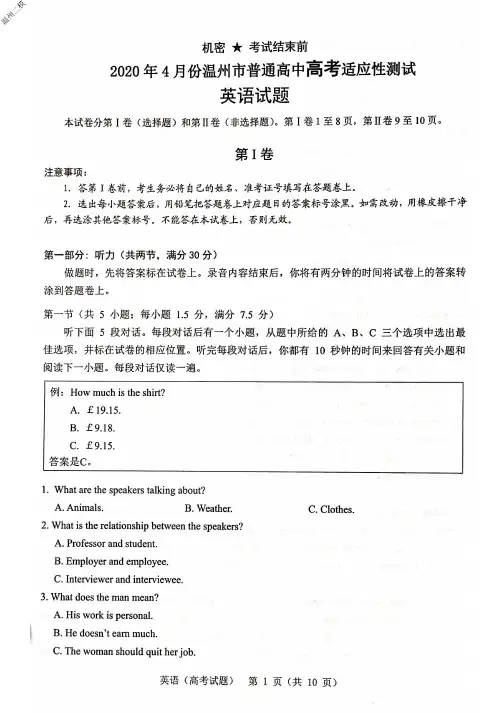
第I卷第一部分:听力(共两节,满分30分)第一节(共5小题;每小题1。
5分,满分7。
5分)听下面5段对话。
每段对话后有一个小题,从题中所给的A、B、C三个选项中选出最佳选项,并标在试卷的相应位置.听完每段对话后,你都有10秒钟的时间来回答有关小题和阅读下一小题。
每段对话仅读一遍。
例:How much is the shirt?A。
£ 19.15。
B. £ 9.15.C. £ 9.18.答案是B。
1。
Where did the woman probably leave her hat?A. In a restaurant。
B。
In a car。
C. In a shop.2。
What is the time right now?A。
7:15. B. 9:15. C. 11:15.3. What are the speakers discussing?A。
Whether to go to France。
B. What to do in France。
C. How to go to France.4。
Why is the girl upset?A。
Her family is about to move. B. Her mother is out of work.C. She has no friends now.5. What was the weather like in the Lake District on their holiday?A. Snowy.B. Sunny.C. Rainy。
第二节(共15小题;每小题1。
5分,满分22。
5分)听下面5段对活或独白.每段对话或独白后有几个小题,从题中所给的A、B、C三个选项中选出最佳选项,并标在试卷的相应位置。
听每段对话或独白前,你将有时间阅读各个小题,每小题5秒钟;听完后,各小题将给出5秒钟的作答时间。
每段对话或独白读两遍。
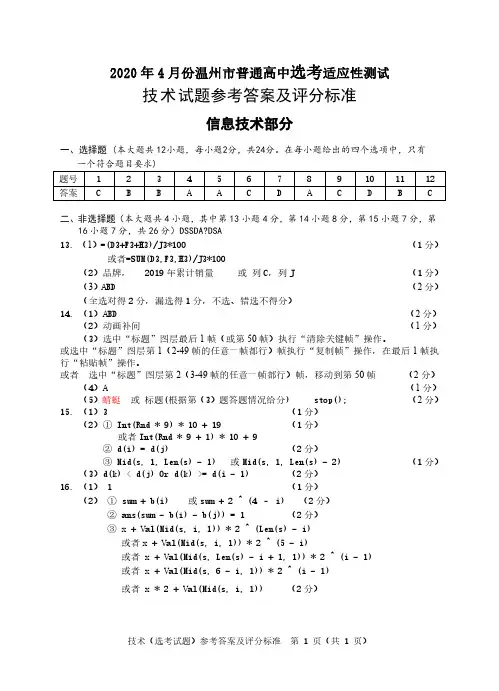
2020年4月份温州市普通高中选考适应性测试技术试题参考答案及评分标准信息技术部分一、选择题(本大题共12小题,每小题2分,共24分。
在每小题给出的四个选项中,只有一个符合题目要求)题号123456789101112答案C B B A A C D A C D B C二、非选择题(本大题共4小题,其中第13小题4分,第14小题8分,第15小题7分,第16小题7分,共26分)DSSDA?DSA13.(1)=(D3+F3+H3)/J3*100(1分)或者=SUM(D3,F3,H3)/J3*100(2)品牌,2019年累计销量或列C,列J(1分)(3)ABD(2分)(全选对得2分,漏选得1分,不选、错选不得分)14.(1)ABD(2分)(2)动画补间(1分)(3)选中“标题”图层最后1帧(或第50帧)执行“清除关键帧”操作。
或选中“标题”图层第1(2-49帧的任意一帧都行)帧执行“复制帧”操作,在最后1帧执行“粘贴帧”操作。
或者选中“标题”图层第2(3-49帧的任意一帧都行)帧,移动到第50帧(2分)(4)A(1分)(5)蜻蜓或标题(根据第(3)题答题情况给分)stop();(2分)15.(1)3(1分)(2)①Int(Rnd*9)*10+19(1分)或者Int(Rnd*9+1)*10+9②d(i)=d(j)(2分)③Mid(s,1,Len(s)-1)或Mid(s,1,Len(s)-2)(1分)(3)d(k)<d(j)Or d(k)>=d(i-1)(2分)16.(1)1(1分)(2)①sum+b(i)或sum+2^(4–i)(2分)②ans(sum-b(i)-b(j))=1(2分)③x+Val(Mid(s,i,1))*2^(Len(s)-i)或者x+Val(Mid(s,i,1))*2^(5-i)或者x+Val(Mid(s,Len(s)-i+1,1))*2^(i-1)或者x+Val(Mid(s,6-i,1))*2^(i-1)或者x*2+Val(Mid(s,i,1))(2分)2020年4月份温州市普通高中选考模拟考试技术(测试卷)参考答案第二部分通用技术(共50分)一、选择题(本大题共13小题,每小题2分,共26分。