
Chap07微观经济学原理
- 格式:ppt
- 大小:338.50 KB
- 文档页数:46
CHAPTER OVERVIEWAND TEACHING TIPSIn Chapter 3 you explained the laws of supply and demand, and you familiarized students with the effects of changes insupply and demand. This leads naturally to the related question, “By how much?” How large are the responses tochanges in the market, and on what does this responsiveness depend? This chapter introduces students to the concept ofelasticity and exposes them to two types of elasticities: price elasticity of demand and price elasticity of supply. Theseconcepts are difficult for students, particularly for those who have math anxiety. Emphasize the importance of percent-age changes in the numerator and denominator of the elasticity equations, and distinguish between price elasticity ofdemand and the slope of the demand curve. Do not hesitate to spend class time working through examples that illustratethe relationships between the price elasticity of demand and supply, and the demand and supply curves.The final section of the chapter provides students with the opportunity to apply market analysis and elasticityconcepts in the arena of public policy-making. Distinguish carefully between the party who writes the check to the gov-ernment for a tax and the party who bears the economic burden of taxation. Just because taxes are often “paid” to thegovernment by sellers does not mean that the sellers actually experience reduced incomes when new taxes are imposed.Price ceilings and price floors describe another type of government intervention into the operation of markets.LEARNING OBJECTIVES1.Define the term price elasticity of demand.2.Discuss the factors that determine whether price elasticity of demand is elastic, unitary-elastic, or inelastic, andcompare consumer behavior in the short run and the long run. Describe elastic and inelastic regions that exist alongany demand curve.3.Calculate price elasticity of demand using a method of averages, ant interpret your result.4.Explain, using diagrams, the relationship between total revenue and price elasticity of demand.5.Define the term price elasticity of supply.6.Discuss the factors that determine whether price elasticity of supply is elastic, unitary-elastic, or inelastic, andcompare consumer behavior in the short run and the long run.7.Calculate price elasticity of supply using a method of averages, and interpret your result.8.Apply supply, demand, and elasticity concepts to the following situations and markets: (a) agriculture markets, (b)gasoline taxes, (c) minimum wages, and (d) energy price controls.SUGGESTED ANSWERS TO QUESTIONS IN THE TEXT1.Agood harvest shifts a fairly inelastic supply curve to the right. Equilibrium moves down along a relativelyinelastic demand curve to support a (much) lower price, and hence lower farm revenues.2.More price elastic: perfume and ice cream because they are closer to luxuries than necessities; chocolate ice creamand automobiles because there are more substitutes for these goods than there are for ice cream and automobiletires, respectively.3.Demand would be inelastic, with ED= .5.4.Assume that demand and supply both show some price elasticity.a.Output and price up along supply curve (demand-curve shift), assuming apartments are normal goods.b.Output down and price (paid by renters) up along demand curve (supplyshift).c.If this price is below equilibrium (which makes sense if the policy is to have an impact), this is a price ceiling,established to protect buyers. Ashortage of apartments will result, with quantity demanded greater than quantity supplied.15CHAPTER 4
CHAPTER OVERVIEWAND TEACHING TIPSAt this point, students should have a clear picture of the mechanics of the competitive model. As you begin this chapteron monopoly power, remind students that the competitive model was thoroughly explored in order to provide a bench-mark for further analysis. Emphasize the efficiency properties of competitive equilibrium and the role that this industri-al structure plays as the benchmark against which to measure the inefficiencies of other types of market structure.Emphasize, too, the ease with which competitive equilibria can be computed and the consequent ease with which com-parative statics can be conducted. These computations are used not necessarily to gain absolute insight into the effectsof, say, a tax change, but to gain some insight into how to analyze a tax change correctly and what to expect. When theresult under imperfect competition matches the competitive result, some comfort can be taken in the coincidence; whenthe result differs from the competitive result, some effort to explain this difference produces greater understanding of theconcepts involved.Chapter 9 presents the standard marginal revenue-marginal cost analysis of a profit-maximizing monopolist andconcentrates on the costs associated with the single-seller exploitation of market power. Here, too, we have a bench-mark rather than a realistic model of firms that we see operating in the marketplace in the United States, where monopo-lization is illegal. (When we do see firms operating with monopoly status, there exists heavy government regulation thatimpacts the firms’decisions.) Once this chapter is completed, students will have two benchmarks to use, one describingthe most competitive of all market structures and one describing the least competitive of all market structures. Theyshould then be armed with the tools they need to understand more practical models of industrial structure.LEARNING OBJECTIVES1.Define and describe the patterns of imperfect pare the three varieties of imperfect competitors: monopoly, oligopoly, and monopolistic competition.3.Discuss the sources of imperfect competition, namely, cost conditions and barriers to entry.4.Explain the concept of marginal revenue as it applies to the monopolist. Calculate marginal revenue given data onmarket demand.5.Define and illustrate the process of determining the profit-maximizing level of output for the monopolist.6.Contrast the profit-maximizing rule for a perfect competitor with the profit-maximizing rule for a monopolist, andshow that perfect competition can be described as a special case of the general MC = MR rule.7.Recognize the importance of the marginal principle, and apply it to the decision-making process.SUGGESTED ANSWERS TO QUESTIONS IN THE TEXT1.Consult the definitions. General Motors:oligopoly in the United States, monopolistic competition worldwide (?) Local pizza restaurant: monopolistic competitor Microsoft: monopolistic in some product marketsYour college: (?)2.a.Amonopolist maximizes profits when MC = MR. For the monopolist, P>MR.b.Monopolists who face more inelastic demand curves have a greater degree of control over price and are able tocharge higher prices.39CHAPTER 9Imperfect Competition and ItsPolarCase of Monopolyc.Monopolists do not ignore the marginal principle. They “let bygones be bygones” just as perfect competitorsdo.d.Monopolists who maximize sales will produce where MC>MR, which will not be a profit maximizing solution.Monopolists underproduce and overprice relative to the competitive ideal.3.Constant TR means MR equals 0.4.Monopoly tends to be characterized by a single seller of a unique product in a market with significant barriers toentry. Judge Jackson’s comments describe such a market. For these PC operating systems, network externalitiesare quite significant so that for many buyers there are no close substitutes. This serves as a significant barrier to theentry of rivals.5.The slopes of TCand TR are equal at q = 4; i.e., MR = MC.6.Consult Figure 9-1. Ahorizontal demand curve means that price is fixed at, say, P. Total revenue is the TR(q) = Pqand MR = P. Profits are maximized where MR = MC, but MR = Pmeans that MC = Paswell (to be a long-termequilibrium, P= min(AC), too). Panel (a) of Figure 9-1 shows this. Panel (b) shows TR(q) linear with slope PandTC(q)parallel (and tangent, so profits are zero) at the same output q*.Note that MC stops declining at q1ql.

- 1 - 微观经济学(第七章) 课程讲稿
第七章 生产要素价格与收入分配理论
第二节 不同要素价格的决定
教学要求:
掌握劳动供给曲线、土地的供给曲线、超额利润的来源;
熟悉地租、租金、准租金与经济租金;
了解工资、利息与利率、正常利润等。
教学重点、难点及关键知识点:
重点是不同要素的供给和需求及其特征;
难点是准租金与经济租金。
方法及手段:
课堂理论讲授、板书、多媒体辅助教学
教学基本内容(教学过程)
一、工资的决定
(一)工资及其种类
1.工资
——使用劳动要素所支付的报酬,即劳动地收入。
2.种类
(1)计时工资和计件工资
(2)货币工资与实物工资
(3)名义工资与实际工资
(二)完全竞争市场上工资与就业量的决定
——这里所说的完全竞争指在劳动市场上的完全竞争状况,无论是劳动力的买方或卖方都不存在对劳动的垄断。在这种情况下,工资完全是由劳动的供求关系决定的。
1.劳动的需求
——从劳动的需求方面说,劳动的价格取决于劳动这一要素的边际收益产量,也就是取决于劳动的边际生产力。随着劳动这一要素的雇用量的增加,劳动的边际收益产量递减,所以劳动需求曲线从左上方向右下方倾斜。
——在完全竞争下,一种要素的收益产品曲线MRP与其边际产品价值曲线VMP重合。
- 2 - 微观经济学(第七章) 课程讲稿
2.劳动的供给
——从供给方面说,劳动的供给曲线是一条后弯曲线:最初从左下方向右上方倾斜,在达到一定点以后,便开始转向左上方弯曲。即劳动供给量开始时随工资的提高而增加,后来则随工资的提高而降低。
——因为,工资收入增加固然可以为劳动者增加效用,但也由此牺牲了闲暇时间,这又是一种负效用,当收入达到一定程度后,由工资收入给劳动者增加的正效用不足以抵消劳动的负效用时,人们就宁愿少工作而增加闲暇时间,不愿为多一点工资而多工作牺牲闲暇。
——在完全竞争下,一种要素的供给曲线S也就是使用这种要素的边际成本曲线MFC。
经济学原理 微观经济学
第一章 经济学十大原理
人们如何做出决策:1.人们面临权衡取舍
2. 某种东西的(机会)成本是为了得到它所放弃的东西
3. 理性人考虑边际量
4. 人们会对激励做出反应
人们如何相互交易:5.贸易可以使每个人的状况变得更好
6.市场通常是组织经济活动的一种好方法
7.政府有时可以改善市场结果
整体经济如何运行:8.一国的生活水平取决于它生产物品和劳务的能力
9. 当政府发行了过多货币时,物价上升
10. 社会面临通货膨胀与失业之间的短期权衡取舍
稀缺性:社会资源的有限性
经济学:研究社会如何管理自己的稀缺资源
效率:社会能从其稀缺资源中得到最大利益的特性
平等:经济成果在社会成员中平均分配的特性
机会成本:为了得到某种东西所必须放弃的东西
理性人:系统而有目的地尽最大努力实现自己目标的人
边际成本:对行动计划的微小增量调整
激励:引起一个人做出某种行为的某种东西
市场经济:当许多企业和家庭在物品和劳务市场上相互交易时,通过他们的分散决策配置资源的经济
产权:个人拥有并控制稀缺资源的能力
市场失灵:市场本身不能有效配置资源的情况
外部性:一个人的行为对旁观者福利的影响
市场势力:单个经济活动者(或一小群经济活动者)对市场价格有显著影响的能力
生产率:每一单位劳动投入所生产的物品与劳务数量
通货膨胀:经济中物价总水平的上升
经济周期:就业和生活等经济活动的波动
第二章 像经济学家一样思考
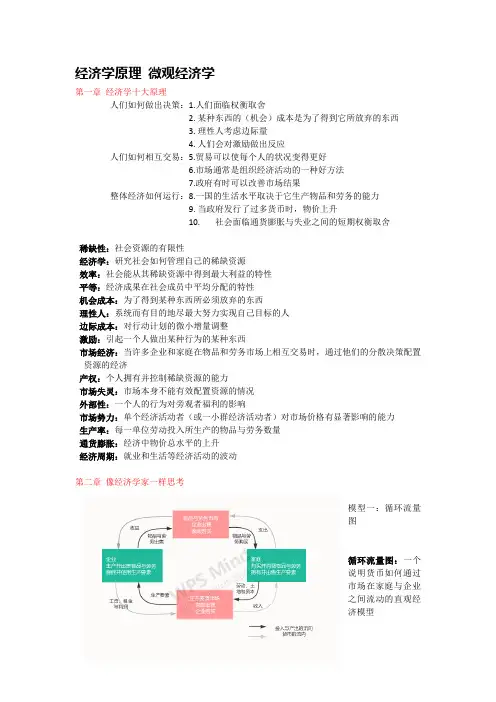
模型一:循环流量图
循环流量图:一个说明货币如何通过市场在家庭与企业之间流动的直观经济模型
模型二
生产可能性边界:表示在可得到的生产要素与生产技术既定时,一个经济所能生产的产品数量的各种组合的图形
图中是假设只生产电脑和汽车两种商品
生产可能性边界的移动
图中是生产电脑的效率提高
电脑行业的技术进步使经济在生产中任何一个汽车及定量的同时,都可以生产出比以前更多的电脑。结果,生产可能性边界向外移动。如果该经济点从A点移动到G点,那么,汽车和电脑的产量都增加了。