一般现在时态,现在进行时态,一般过去时态,一般将来时态讲解及专项练习
- 格式:docx
- 大小:34.54 KB
- 文档页数:27
一般现在时态,现在进行时态,一般过去时态,一般将来时态讲解及专项练习
一般现在时态,现在进行时态,一般过去时态,一般将来时态讲解及专项练习
一、一般现在时
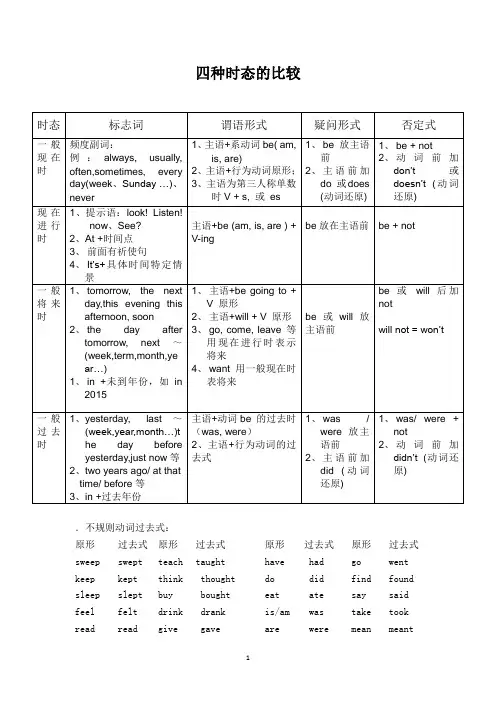
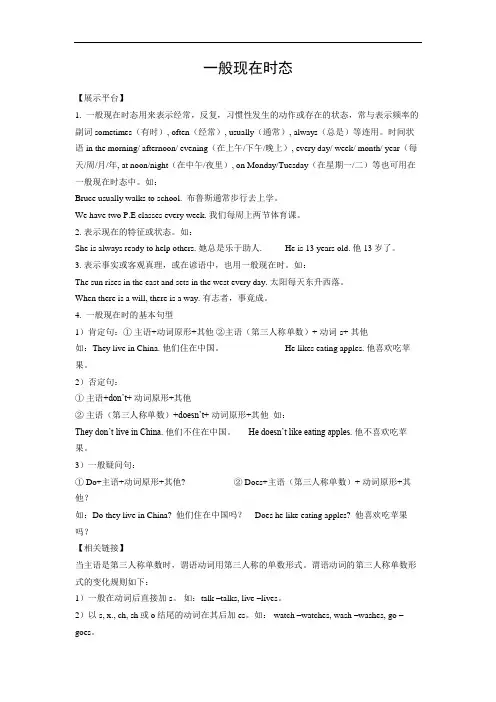
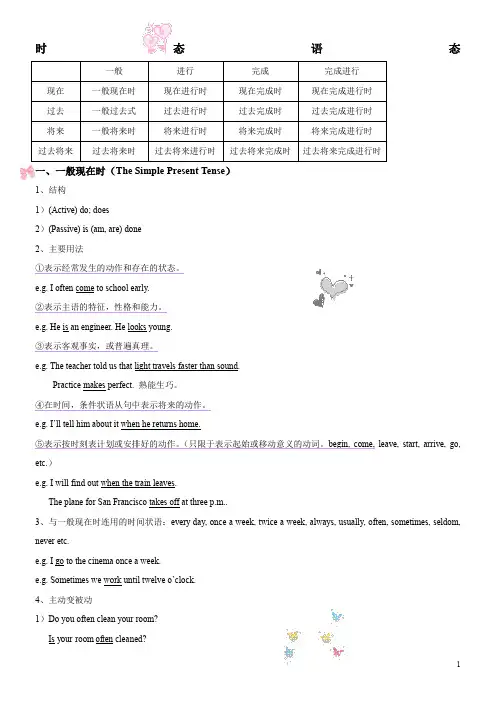
一般现在时表示经常、反复发生的动作或存在的状态.
一、表示一般现在时的时间状语
一般现在时常和always, often, usually, every day, sometimes等表示时间的状语连用.
二、行为动词在一般现在时中的用法:一般人称的谓语动词用原形.,但单数第三人称做主语时谓语动词词尾发生变化:即.动词词尾加-s;或.-es,
三、动词遇到单数第三人称时的表示方法
在一般现在时中, 当主语是单数第三人称时, 行为动词的形式是在词尾加-s 或–es 具体方法如下:
1.一般情况下,直接加-s
Eg:works,plays, rains, sees
2.以sh, ch, s, x 或o 结尾的词后加–es
Eg:washes, teaches, fixes, does, goes
3.以辅音字母加-y 结尾的,先把‘y’改成‘i’, 再加-es
Eg:studies, flies, carries
四、一般现在时的用法:
1、表示经常、反复发生的动作,现存的习惯或状态。常与often,
always, usually, every day, sometimes, never, once a day, seldom等时间状语连用。例如:
I am a teacher.
We are Chinese.
She goes to work every day.
He always helps others. 2、表示客观事实或普遍真理。例如:
There are seven days in a week.
The earth goes round the sun.
The sun rises in the east and sets in the west.
The water boils at 100℃.
Actions speaks louder than words. 行动胜于言辞。(谚语)
3、在连词when, before, if, as soon as, until 等引导的表示将来的行为的状语从句中,常用一般现在时表示将来的动作。例如;
If it is fine tomorrow, we’ll have a football match.
I’ll ring you up before I leave the office.
When I finish my homework, I’ll tell you a story.
4、表示安排或计划好的未来的动作,只限于go, come, leave,
start, stay, return, arrive, begin, be 等动词。例如:
My train leaves at 6:30 this morning.-
How long do you stay here?
We start at 8 tomorrow morning for Beijing.
5、表示主语的特征、性格、能力等。
Tom studies very hard.
She is always ready to help others.
I major in English.
6、一般现在时还可用在戏剧,电影的剧本解说,体育比赛的解说以及图片的说明等场合。
Tom carries the ball to the left. 汤姆把球带到左方。
The picture shows us how they built the motorway last year.
这张照片给我们展示了他们去年如何建设高速公路。
课堂练习:
1. 写出下列动词第三人称单数的变化形式;
be have come go stay teach write take study watch fly play
I.用所给动词的适当形式填空。
1. We often___________(play) in the playground. 2. He _________(get) up at six o’clock.
3. __________you _________(brush) your teeth every morning.
4. What (do) he usually (do) after school?
5. Danny __________ (study) English, Chinese, Math, Science
and Art an school.
6. Mike sometimes __________(go) to the park with his sister.
7. At eight at night, she __________(watch) TV with his parents.
8. ________ Mike________(read) English every day?
9. How many lessons _________your classmate________(have)
on Monday?
10. What time _________his mother_________(do) the
housework?
11. Mike __________(like) cooking.
12. They ______(have) the same hobby.
13. My aunt _______(look) after her baby carefully.
14. You always__________ (do) your homework well.
15. I __________(be) ill. I’m staying in bed.
16. She __________ (go) to school from Monday to Friday.
17. Liu Tao __________ (do) not like PE.
18. The child often __________ (watch) TV in the evening.
19. Su hai and Su Yang __________ (have) eight lessons this
term.
20. -What day __________ (be) it today? -It’s Saturday.
21. He often _______(have) dinner at home.
22. Daniel and Tommy _______(be) in Class One.
23. We _________(not watch) TV on Monday.
24. Nick _________(not go) to the zoo on Sunday.
25. They _____(like) the World Cup?
26. What they often ____(do) on Saturdays?
27. Your parents _____(read) newspapers every day? 28. The girl ____(teach) us English on Sundays.
29. She and I _____(take) a walk together every evening.
30. There ____(be) some water in the bottle.
31.What time_________ his father_________(do) the work?
32.He _________(get) up at five o’clock.
33.__________ you _________(brush) your teeth every morning.
34.What ________ ( do ) he usually ________( do ) after school?
35.Tom ________ ( study ) English, Chinese, Maths, Science and
Art at school.
36. Kitty sometimes __________(go) to the park with his sister.
37.At eight at night, she __________( watch ) TV with her
parents.
38. ________ Mike________( read ) English every day?
39.How many lessons________ your classmates______( have )
on Monday?
40.We often___________ ( play ) football in the playground.
课后习题
II.选择
( ) 1. _____ you have a book?
A. Do
B. Are
C. Is
D. Have
( )2. They _________ on a farm.
A. working
B. is work
C. work
D. is worked
( ) 3. Does Peter like to watch TV? __________.
A. Yes, he like B. No, he doesn’t
C. Yes, he’d like
D. No, he likes
( )4. She doesn’t __________ her homework in the afternoon.
A. doing
B. to do
C. does
D. do
( )5. How ____________ Mr. Brown ___________ to America?
A. do,go
B. is,go
C. does,go
D. does,goes
( )6. Where’s my camera? I____________ it.
A. am not finding
B. am not seeing
C. can’t find
D. can’t look at
( )7. How ___________ he go to work? He ___________ to work by
bike.
A. does ;go
B. do;goes
C. do ;go
D. does;goes
( )8. ______ you usually late for school?
No, _____________.
A. Do ; I am
B. Does ;not
C. Are ; I’m not