
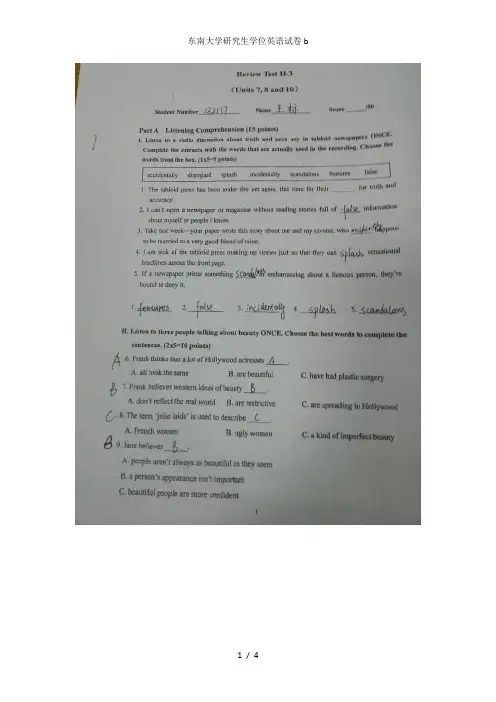
东南大学研究生学位英语试卷b
- 格式:docx
- 大小:304.79 KB
- 文档页数:4

2022研究生学位英语考试真题及答案全文共10篇示例,供读者参考篇1Hey guys, have you ever wondered what kind of questions are on the 2022 postgraduate English exam? Today, I'm going to share the questions and answers with you!Question 1:Fill in the blank with the correct word:She likes to play piano _____ her brother likes to play guitar.Answer:whileQuestion 2:Choose the correct option:I _____ to the supermarket yesterday.a) gob) goesc) wentAnswer:c) wentQuestion 3:Make a sentence using the words provided:Dog - park - happyAnswer:The dog is happy playing in the park.Question 4:Write a short paragraph about your favorite animal.Answer:My favorite animal is a panda. Pandas are so cute and fluffy. They love to eat bamboo and play in the trees. I wish I could hug a panda one day!Question 5:Translate the following sentence into English:。
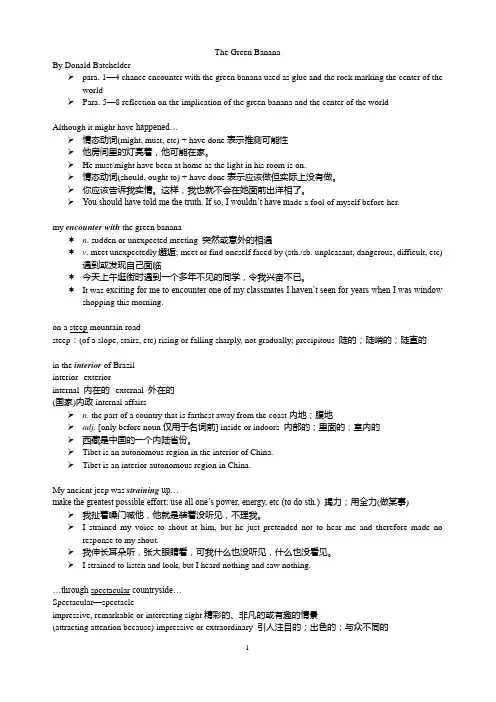
The Green BananaBy Donald Batchelder➢para. 1—4 chance encounter with the green banana used as glue and the rock marking the center of the world➢Para. 5—8 reflection on the implication of the green banana and the center of the worldAlthough it might have happened…➢情态动词(might, must, etc) + have done表示推测可能性➢他房间里的灯亮着,他可能在家。
➢He must/might have been at home as the light in his room is on.➢情态动词(should, ought to) + have done表示应该做但实际上没有做。
➢你应该告诉我实情。
这样,我也就不会在她面前出洋相了。
➢You should have told me the truth. If so, I wouldn’t have m ade a fool of myself before her.my encounter with the green banana✶n. sudden or unexpected meeting 突然或意外的相遇✶v. meet unexpectedly邂逅; meet or find oneself faced by (sth./sb. unpleasant, dangerous, difficult, etc)遇到或发现自己面临✶今天上午逛街时遇到一个多年不见的同学,令我兴奋不已。
✶It was exciting for me to encounter one of my classmates I haven’t seen for years when I was window shopping this morning.on a steep mountain roadsteep:(of a slope, stairs, etc) rising or falling sharply, not gradually; precipitous 陡的;陡峭的;陡直的in the interior of Brazilinterior--exteriorinternal 内在的--external 外在的(国家)内政internal affairs➢n. the part of a country that is farthest away from the coast内地;腹地➢adj. [only before noun仅用于名词前] inside or indoors 内部的;里面的;室内的➢西藏是中国的一个内陆省份。

2007年硕士研究生专业英语考试卷Part 1 Translation (60 minutes) (60%)Section A: Translate the following paragraphs into Chinese (30 minutes) (30%)Managers advancing into the fog of the future tend to either cling to the fiction of prediction despite limited visibility or veer to the other extreme, relying on good luck and hustle and hoping for the best. Neither extreme is effective or necessary. Indeed, a careful examination of volatile markets over time reveals recurrent patterns. Understanding these patterns can help executives navigate a foggy future.It was only when the company began to look at customer information in a more holistic fashion - gathering, consolidating, and analyzing all of its customer interaction information in a single pool - that it was able to correct such inefficiencies. Now everyone who is delayed for, say, nine hours gets the same compensation, and when a gate agent hands a passenger a flight voucher, that transaction is reflected immediately in the customer information database. The passenger will be denied a second voucher even if he gets to a phone within a few seconds.An even bigger problem is getting past correlations in the data to be able to argue causality. If a researcher finds that highly successful companies tend to have formal knowledge management initiatives, for example, does that mean that explicit management of knowledge is a key to success? Or does it mean that knowledge management is the kind of organizational boondoggle that only a company flush with cash indulges in? Making the argument for causality in one direction or the other requires not only a sufficient data set but also a rational model for how the observed phenomena relate to known outcomes.Section B: Translate the following paragraphs into English (30 minutes) (30%)任何决策都无法回避风险。

研究生学位英语复习EST1Part I Listening ComprehensionSection 1, Conversation (10 minutes, 10 points)Section 2, Passages (10 minutes, 10 points)Part II: Cloze Test (10 minutes, 15 points)Scientists who study the Earth's climate are convinced that volcano eruptions have a significant effect on general weather patterns. In fact, one of the many (36) which attempt to explain how an icc age begins holds that the (37) is a dramatic increase in volcanic eruptions. The volcanic explosions, besides causing local thunderstorms and lightning, inject great amounts of gas and (38)_into the stratosphere (同温层).At this (39), the volcanic material spreads all the way around the Earth・ This volcanic material (40) a certain amount of sunlight and (41) some back into space・ The net result is to (42) the planets surface・ For instance, 43 was perhaps the largest eruption occuned in 1883 when the Indonesia volcano Krakatoa exploded. The following year was (44) in Europe as the H year without summer0 because the (45) was so cool and rainy.While there is (46) scientific agreement that volcanic eruption can lead to cooling, (47) of how this happens are not clear. As a result, scientists cannot (48) whether the volcanic activity which (49) past icc ages would result (50) sufficient cooling to cause a glacial period・ Similarly, it is not possible for scientists to predict the climate effect of a future volcanic eruption with any confidence・36. A. theories B・ inventions C. judgments D. discoveries37.A. cause B. course C・means D. case38. A. petroleum B. ash C. flame D. garbage39. A. relation B. instance C・ moment D. altitude40. A. scatters B・ releases C. constitutes D・ absorbs41. A. carnes B. converts C. reflects D. gathers42. A. cool B. warm C. freeze D. heat43. A. such B. what C. there D. that44. A. known B. reported C. marked D. testified45. A. air B. temperature C. sky D. weather46. A. committed B. optimistic C・general D. absolute47. A・ indexes B・ predictions C・ details D. decisions48. A. analyze B. determine C. assure D・ assume49. A. confronted B. promoted C・ proceed D. preceded50. A. in B. from C. to D. with Part I ReadingPassage OneWe use emotive language to express our own attitudes and feelings・ We also direct emotive language at other people to persuade them to believe as we do or to do as we want them to do; and, of course, other people direct emotive language at us to get us to believe or to do what they want.We are subjected to a constant stream of persuasion day in, day out, at home and in school, on the radio and on television. It comes from parents and teachers, from preachers and politicians, from editors and commentators, but, most of all, of course, from advertisers. Most of this persuasion is expressed in emotive language and is intended to appeal to our feelings rather than to be weighed up by our powers of reasoning・Wc should look at the motives behind all this persuasion. Why do they want to persuade us? What do they want us to do? We are not thinking very clearly unless we try to see through the veil of words and realize something of the speaker's purpose.An appeal to emotion is in itself neither good or bad. Our emotions exist and they are part of our personality. On some occasions people appeal to our emotions on the highest levels and from the best of motives. A case in point is ChurchilVs wartime speeches: whatever people thought of Churchill as a politician, they were united behind him when he spoke as national leader in those dark days ― their feelings responded to his call for resolution and unity.It is a characteristic of social groups that the members have a feeling of personal attachment to the group ■一to the family in earliest childhood and extending later to the school, the team, the church, the nation, in patterns that vary from time to time. Hence a speaker from our group will find in us feelings to which he can readily and genuinely appeal, whether our reaction is favorable or not. We are at least open to the appeal and we appreciate the context in which it is made・1.The major functions of emotive language discussed in the passage are Io ・・A.extend our powers of reasoning and carry out a purposeB.advertise and produce the wanted social effectsC・ show one's feelings and appeal to those of othersD. make others believe in us and respond to our feelings2.It is suggested in the third paragraph of this passage that wcA should keep a cool head when subjected to persuasion of various kindsB need to judge whether a persuasion is made for good or badC・ have to carefully use our emotive languageD・ should avoid being easily seen through by an appeal from others3.The source from which emotive language flows upon us in its greatest amount is ・・A.the mass mediaB. the educational institutionsC.the religious circles D・ the advertising business4.Churchill is mentioned in the passage as」A.an example of how people weighed up persuasion with reasoningB・ a national leader who brought out people's best feelingsC・ a positive example of appealing to people's motionD.a politician who has been known as a good speaker5.What is NOT mentioned as relevant to our emotions in this passage?A.Social contextB. Personal experienceC. The personality of national leadersD. Religious belief6.It can be inferred from the passage that a persuasive speaker must ・A.find out what group his audience is attached toB.vary his speech patterns from time to timeC.know how to adapt his way of speaking to the needs of the audienceD.be aware whether the listeners are favorable to his opinion or notPassage TwoAs goods and services improved, people were persuaded to spend their money on changing from old to new, and found the change worth the expenses. When an airline equipped itself with jets, for example, its costs ( and therefore air fare) would go up, but the new planes meant such an improvement that the higher cost was justified. A new car ( or wireless, washing machine, electric kettle) made life so much more comfortable than the old one that the high cost of replacement was fully repaid. Manufacturers still cry their wares as persuasively as ever, but are the improvements really worth paying for? In many fields things have now reached such a high standard of performance that further progress is very limited and very expensive. Airlines, for example, go to enormous expense in buying the latest prestige jets, in which vast research costs have been spent on relatively small improvements. If we scrap these vast costs we might lose the chance of cutting minutes away from flying times, but wouldn't it be better to see air fares drop dramatically, as capital costs become relatively insignificant? Again, in the context of a 70mph limit, with platoons of cars traveling so densely as to control each other's speeds, improvements in performance are virtually iiTelevanl; improvements in handling are unnecessary, as most production cars grip the road perfectly; and comfort has now reached a very high level indeed・ Small improvements here are unlikely to be worth the thousands that anybody replacing an ordinary family car every two years may ultimately have spent on them. Let us instead have cars ■一or wireless, electric kettles, washing machines, television sets ■一which are made to last, and not to be replaced・Significant progress is obviously a good thing; but the insignificant progression from model-change to modcl-changc is not.7.The author obviously is challenging the social norm that ・•A.it is. important to improve goods and servicesB・ development of technology makes our life more comfortableC.it is reasonable that prices are going up all the timeD.slightly modified new products are worth buying8.According to this passage, air fares may rise because -rA people tend to travel by new airplanesB.the airplane has been improvedC.the change is found to be reasonableD.the service on the airplane is better than before9.According to the author, passengers would be happier if theyA.could fly in the latest model of reputable planesB・ could get tickets at much lower pricesC・ see the airlines make vital changes in their servicesD. could spend less time flying in the air10.When manufacturers have improved the performance of their products to a certain level, thenit would be_. .A.justified for them to cut the priceB.unnecessary for them to make any new changesC.difficult and costly to further better themD.insignificant for them to cut down the research costs11.In the case of cars, the author urges that we -・A.can cel the speed limitB. further improve the performanceC・ improve the durability D・ change models every two years12.The author's criticism is probably based on the fact that ・・A.we have been persuaded to live an extravagant life today B・ many products we buy turn out to be substandard or inferiorC.inflation is becoming a big problem in the world todayD.people arc wasting their money on trivial technological progressPassage ThreeRecent studies on the male-female wage gap predict that even though entry salaries for males and females in the same occupation are nearly equal because women's market skills have improved vastly, the chances of the overall gap closing in the foreseeable future are minimal. This is due to several factors that are likely to change very slowly, if at all. An important reason is that women are concentrated in occupations — service and clerical — that pay less than traditional male jobs. It is possible that more women than men in their twenties are hesitant to commit themselves to a year-round, lifetime career or job for many reasons There is lingering attitude on both the part of women and their employers that women are not cut out for certain jobs・ Not only does this attitude channel women into lower-paying work, but it also serves to keep them from top management positions・Another significant factor in the widening wage gap between men and women entering the work force, even in comparable jobs, is that women often drop out at critical points in their careers to have a family. Women still have the primary responsibility for child-bearing; even if they continue to work, they often forgo overtime and promotions that would conflict with home responsibilities・ The ages of25 to 35 have been shown repeatedly to be the period when working consistently and hard is vital to advancement and job security・ These are precisely the years when women are likely to have children and begin to slide away from men in earning power. Consequently, a woman's income is more likely to be seen as secondary to her husband's・13.According to recent studies on the male-female wage gap,」A.there is much hope of narrowing the male-female wage gap in the near futureB.working women will have many opportunities to hold high-paying jobs in the near futureC・ women's pay will still stay al a level below that of men in the near futureD. salaries for males and females in the same occupation will be equal in the near future14.Women arc kept from top management positions partly because they - •A.decide to devote themselves to certain lifetime jobs in their twentiesB.are inclined to rank family second to workC.tend to have more quaiTels with their employersD・ still take an inconect attitude towards themselves15.Which of the following is implied in the passage as a partial reason for women's concentration in certain occupations?A.Social division of labor.B. Social prejudice against themC・ Employment laws. D. Physiological weakness・16.The worcT 伽go" in Paragraph 2 could be best replaced by - •A.give upB. drop outC.throwawayD. cut out17.It can be inferred from the second paragraph that -・A.merfs jobs are subject to changeB.women tend to be employed off and on at the same jobC.men' chances of promotion are minimalD.women used to be employed all the year round18.Which of the following statements is NOT true?A.Women's market skills have improved greatly・B.Child care is still chiefly women's workC・ Women are typically employed in clerical and service jobs・D.Domestic duties no longer conflict with women's jobs.Passage FourIt seems that the life of a television reporter is fantastically admired by many people. But this is only one side of the coin. First, he never goes deeply into anyone subject ― he may be expert at mastering a brief in a short time and M gctting up H a subject, but a week later he is on to the next subject, and a week later still he is on to the subject after that. He seldom grasps with a full-scale investigation anyone thing. He has to be able to forget what he was working on a few weeks before, otherwise his mind would become messed up.Second, a reporter does not have anything lasting to show for what he does — there is no shelf of books, no studio full of paintings・ He pours his life into something which flickers in shadows across a screen and is gone forever・ I have seen people in many television jobs turn at the end of watching one of their own programs and say something like: H Well, that's all those days/weeks/months of work. Travel and worry sunk without trace." As a way of life it conics to seem like blowing bubbles ■一entertaining to do, and the bubbles numerous and pretty to look at, and all different, but all disappearing into thin air.Third, the pace of life is too fast. Not only is it destructive of one's private life, one does not even have time to give proper consideration to the things one is professionally concerned with -not enough time to think, not enough time to read, not enough lime to write one's commentary, prepare one's interviews and so on. When one disengages from it and allows one's perceptions, thinking, reading and the rest to proceed at their natural pace one gets analtogether unfamiliar sense of solidarity and well-being・Fourth, the reporter is at the mercy of events. A revolution breaks out in Cuba so he is off there on the next plane ・ Somebody shoots President Reagan so he drops everything he is doing and flies to Washington. He is like a puppet pulled by strings ™ the strings of the world's affairs. He is not motivated from within. He does not dec ide for himself what he would like to do, where he would like to go, what he would like to work on. He is activated from without, and his whole life becomes a kind of reflex action, a series of high-pressure responses to external stimuli. He has ceased to exist as an independent personality.19. A TV reporter never makes an in-depth study of a subject becauseA.he usually gets one side of the pictureB.the subjects that he has to attend to often switch from one to anotherC.he does not know how to develop it to its full scaleD.that is the life that suits him20.A. it is implied but not stated that many people ・・A.know nothing about the work of a TV repor 1 erB.think the life of a TV reporter dull and boringC・ have a biased opinion against the job of a TV reporterD.tend to underestimate the hard part of being a TV reporter21 TV reporting, according to this passage, is something _______ ・A.profitable for a person to take upB.interesting to do but quick to fade outC・ causing a person to forget his previous workD・ producing a lasting effect22.A TV reporter is in most need of - •A. being a master of his timeB・ proper consideration of his professionC.a comfortable life of his ownD.disengaging himself from work23.The activities of a TV reporter are largely geared to ・・A. his motivationB. his working styleC.current affairsD. reflex to pressures24.The title of this passage would best be given as ・・A.What a TV Reporter Can and Cannot AccomplishB.The S OITOWS of TV ProfessionalsC.The Confession of a TV ReporterD.The Drawbacks in the Life of a TV ReporterPaper TwoPail IV Reading and Answering Questions (25 minutes, 10 points)The conflict between what in its present mood the public expects science to achieve in satisfaction of popularhopes and what is really in its power is a serious matter because・ even if the true scientists should all recognize the limitations of what they can do in the field of human affairs, so long as the public expects more there will always be some who will pretend, and perhaps honestly believe, that they can do more to meet popular demands than is really in their power. It is often difficult enough for the expert, and cel lainly in many instances impossible for the layman, to distinguish between legitimate and illegitimate claims advanced in the name of science. The enormous publicity recently given by the media to a report pronouncing in the name of science of The Limits to Growth, and the silence of the same media about the devastating criticism this report has received from the competent experts, must make one feel somewhat apprehensive about the use to which the prestige of science can be put. But it is by no means only in the field of economics that far-reaching claims arc made on behalf of a more scientific direction of all human activities and the desirability of replacing spontaneous processes by H conscious human control".If I am not mistaken, psychology, psychiatry and some branches of sociology, not to speak about the so-called philosophy of history, are even more affected by what I have called the scientistic prejudice, and by specious claims of what science can achieve・Questions :What is the main thought of the passage? What should be our correct attitude towards science?回答该项问题一般要注意,第一问主要是结合文章回答问题,可以或多或少的引用文中内容回答,第二问主要是考察我们研究生对某个现象的认识。