2011-2012学年第一学期期中考试试题-八年级英语
- 格式:doc
- 大小:2.08 MB
- 文档页数:14
2011-2012学年第一学期期中考试试题-八年级英语
D
2
3
4
( )4. How did Peter get to school
yesterday?
( )5. What will Linda have to do this
evening?
II.听对话(本大题有5小题,每小题1分,共5分,录音听两遍)
根据对话内容回答问题,选出最佳答案。
听第一段对话,回答第6小题。
( )6. How often does John eat junk
food?
A. Often. B. Once a month.
C. Once a week.
5 听第二段对话,回答第7小题。
( )7. )What should Robert’s
grandfather eat?
A. Tofu. B. Beef. C.
Dangshen.
听第三段对话,回答第8小题。
( )8. How long is Sally staying in New
York?
A. Two weeks. B. Two days
C. A week.
听第四段对话,回答第9-10小题。
( )9. What does Ben look like?‘
A. He has short hair. B. He’s
of medium height. C. He has long
hair.
( )10: What does Ben do?
A. A music teacher. B. A
singer. C. A movie star.
6 III.听短文(本大题有5小题,每小题1分.共5分,录音听两遍)
请你根据所听内容选出最佳答案。
( )11. Ted’s birthday is _______.
A. July 10 th B. July 11th C.
July 9 th
( )12. The weather was _______on
Ted’s birthday.
A. sunny B. cool C.
cloudy
( )13. Green Park is _______.
A. in front of Ted’s house
B. far from Ted's house
C. behind Ted’s house
( )14. _______friends came to Ted's
party.
A. Three B. Four C. Five
( )15. Alan went to visit _______.
A. the Great Wall B. the
7 Summer Palace C. the Palace Museum
IV.听填信息(本大题有5小题.每小题1分,共5分,录音听两遍)
听对话,完成信息采集表。
二、基础与阅读部分
V.单项选择(15分)
( )21. Do you know his parents? Yes, they __ English
teachers in our school.
A. are all B. all are C. are both D. both is
( )22. The book is___. Most of the teachers are___in it.
A. interesting, interested B. interesting,
interesting
C. interested, interesting D. interested,
interested
( )23.___do you play tennis? I play three times a week.
A. What B. How C. How often D. What’s
( )24. What’s ___ with you?
A. matter B. the wrong C. wrong D. up
( )25. You shouldn’t ___ anything for 24 hours.
A. eat B. ate C. eating D. to eat
( )26. There is ___ with him.
A. anything serious B. nothing serious
C. serious something D. serious anything
( )27. She always eats ___ food.
A. too many B. too much C. many too D. much
too
( )28. What’s she ___ for vacation ?
A. does B. do C. did D. doing
8 ( )29. ___ is he staying? For a week.
A. How far B. How often C. How long D. How soon
( )30. “I just finished ____ my last movie. “She says.
A. to make B. makeing C. making D.
makes
( )31. She’s leaving __ Shanghai next week.
A. to B. for C. at D. on
( )32. ___ does your friend go to school? By bike.
A. How far B. How long C. How D. What
( )33. —What are we doing next weekend?
—How about in the mountains?
A. take a walk B. going hiking
C. go for a walk D. to walk
( )34. Would you like to go with me? Yes, ___ .
A. I would B. I’d love C. I’d D. I’d love to
( )35. I’m ___ heavier than my brother.
A. a few B. few C. a little D. little
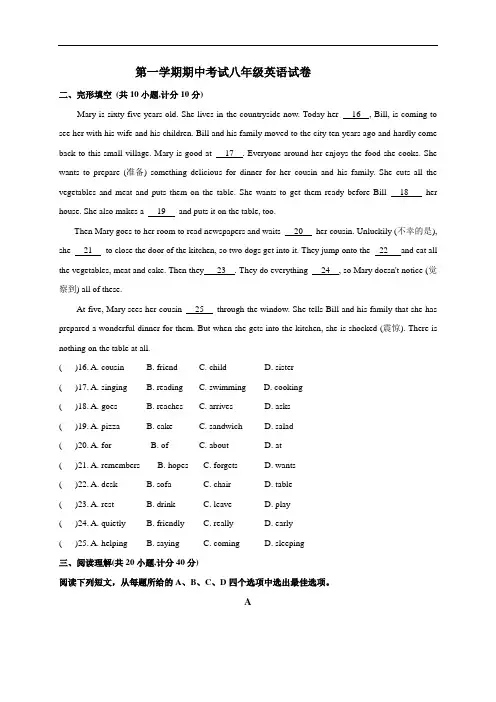
VI.完形填空(20分)
A
In North America, most students go to school 36 the school
bus. Some students also walk 37 ride bikes to school. In 38
parts of the world, things are 39 .In Japan, most students take
trains to school, although 40 also walk or ride bikes. In China,
it __41_ on where you are. In big cities, students usually ride
bikes to school or take buses. And in places 42 there are rivers
and lakes, like Hongshanhu and Kaishandao, students usually go
to school 43 boat. 44 a boat must be a lot 45 than taking
a bus.
( )36. A. take B. catch C. on D. by
( )37. A. and B. or C. but D. so
( )38. A. others B. another C. the other D. other
( )39. A. difficult B. difference C. different D. the same
( )40. A. the others B. others C. other D. another
( )41. A. depends B. because C. thinking D. out
( )42. A. who B. why C. where D. what
( )43. A. take a B. by C. on D. by a
( )44. A. That B. On C. Taking D. By
( )45. A. fun B. funnier C. more funnier D. more fun
9 B
Most children 46 TV. By watching TV they can see and
learn 47 and know many things 48 their country and the
world. They can learn better and 49 with TV than the radio(收音机). 50 ? Because they can 51 and watch 52 the same
time. Many children watch TV only on Saturday or Sunday. They
are always busy with their lessons. But 53 children watch TV
54 every night. They go to bed very late. They can’t have a good